Table of Contents
- 1What Is Capsular Contracture?
- 2What Are the Causes of Capsular Contracture?
- 3What Are the Symptoms of Capsular Contracture?
- 4What Are the Stages of Capsular Contracture?
- 5How Is Capsular Contracture Diagnosed?
- 6How Can Capsular Contracture Be Treated?
- 7How Can You Prevent Capsular Contracture After Breast Implants?
- 8What Is the Recovery Time for Capsular Contracture?
Introduction
If you have breast implants or are considering them, you may have heard about a condition called capsular contracture. When an implant is placed in the body, it is normal for scar tissue to form around it. This is your body’s natural way of healing. In most cases, this scar tissue (or capsule) stays soft and flexible. But sometimes, the scar tissue is too thick or tight, squeezing the implant. This can make the breast feel firm, look different, or even cause discomfort.
The good part is that capsular contracture is treatable, and not everyone who gets implants will experience it. Learning what it is, why it happens, and how it can be managed will help you feel more confident and prepared.
What Is Capsular Contracture?
Capsular contracture is a condition that can sometimes happen after breast implant surgery. When you get implants, your body naturally forms a soft layer of scar tissue around them, called the capsule. This is a normal part of healing. In most women, the capsule stays soft and flexible.
However, in some cases, the capsule becomes thicker and tighter than usual. This is known as contracture. When this happens, the breast may feel firmer than normal, look a little different, or in more serious cases, feel uncomfortable or even painful. Sometimes the implant may also look higher or slightly out of shape.
Mild cases do not usually cause much trouble, but more severe capsular contracture can change how the breast feels and looks. The good news is that treatments are available, and your surgeon can guide you on the best way to manage it.
What Are the Causes of Capsular Contracture?
-
Implant rupture or leakage – A damaged implant can irritate tissues and trigger contracture.
-
Genetics and immune response – Some people naturally form more scar tissue than others.
-
Implant placement – Implants above the muscle have a higher risk than those placed below the muscle.
-
Implant size – Larger implants stretch tissues more, raising the chance of hardening.
-
Surgical technique – The care with which the surgery is performed can significantly impact the outcome.
-
Bacterial contamination – Even small amounts of bacteria can cause inflammation and scarring.
-
Hematoma or seroma – Blood or fluid collecting around the implant may increase risk.
-
Textured implants – Linked to more cases of capsular contracture compared to smooth ones.
-
Post-operative care – Not following aftercare instructions or skipping check-ups can add to risk.
-
Smoking – Slows healing and increases scar tissue problems.
What Are the Symptoms of Capsular Contracture?
The following are common signs and symptoms of capsular contracture.
-
Asymmetrical breasts after an augmentation procedure.
-
The breast becomes firm and hard on palpation.
-
Displaced breast implant.
-
Pain or a tightening sensation in the breast.
-
Wrinkling of the skin near the implant.
What Are the Stages of Capsular Contracture?
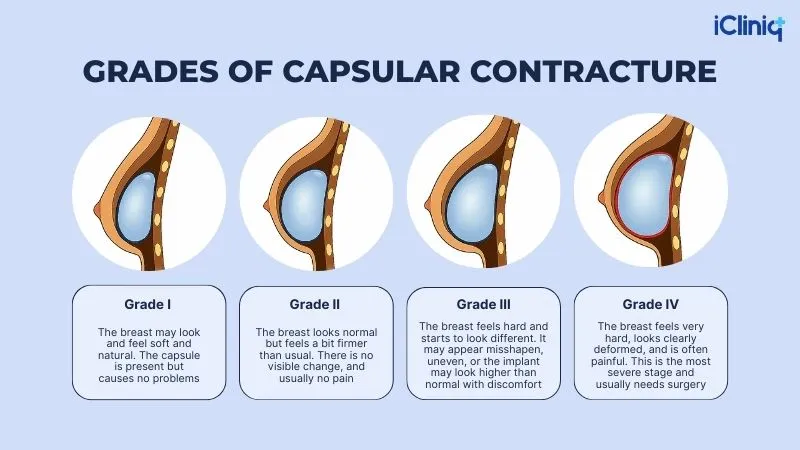
Baker Classification of Capsular Contracture (Grades I–IV)
Doctors often use the Baker scale to describe how severe capsular contracture is. It has 4 grades:
-
Grade I – The breast may look and feel soft and natural. The capsule is present but causes no problems.
-
Grade II – The breast looks normal but feels a bit firmer than usual. There is no visible change, and usually no pain.
-
Grade III – The breast feels hard and starts to look different. It may appear misshapen or uneven, or the implant may look higher than normal. Discomfort can also begin.
-
Grade IV – The breast feels very hard, looks clearly deformed, and is often painful. This is the most severe stage and usually needs surgery.
How Is Capsular Contracture Diagnosed?
Capsular contracture is usually diagnosed by a doctor during a physical examination. Imaging tests can also help. MRI (magnetic resonance imaging) is the most reliable method for confirming. In many cases, capsular contracture happens along with implant rupture. The severity of capsular contracture is commonly measured using the Baker Scale.
How Can Capsular Contracture Be Treated?
There are two ways to treat capsular contracture.
-
Surgical correction.
-
Nonsurgical treatment.
Grade I and II capsular contractures are treated non-surgically, while the surgical procedures treat Grades III and IV.
Non-surgical Treatment of Capsular Contracture:
These are non-invasive procedures that include:
-
Massage and compression: Gentle massage and pressure techniques may be recommended to soften scar tissue and improve breast flexibility.
-
Medications: Doctors may prescribe non-steroidal anti-inflammatory drugs (NSAIDs) to reduce inflammation.
-
Ultrasound therapy: Ultrasound treatments may break down scar tissue and improve the flexibility of the capsule.
-
External bracing: Special bras or bracing devices may be used to prevent the scar tissue from tightening further.
Surgical Treatment of Capsular Contracture:
These invasive treatment modalities involve the surgical removal of scar tissue. They are
-
Capsulotomy: This surgical treatment modality removes the capsule of scar tissue. In this procedure, an incision is created to facilitate the implant's movement and remove the thickened capsule.
-
Capsulectomy: Capsulectomy involves removing scar tissue and replacing existing implant material with a new one with scar tissue conductive material such as collagen (dermal matrix material), enhancing normal scar tissue formation.
-
Implant replacement: If the implant itself is causing the contracture, your surgeon may suggest replacing it with a new one. To lower the chance of it happening again, a different type of implant (such as smooth, saline, or silicone) may be chosen.
-
Implant pocket adjustment: If the position of the implant pocket is part of the problem, the surgeon may adjust its placement. For example, the implant may be moved from above the muscle to below the muscle to help reduce the risk of contracture.
How Can You Prevent Capsular Contracture After Breast Implants?
-
Careful implant placement: Placing implants under the muscle may lower the chances of developing capsular contracture.
-
Follow post-surgery care: Following your surgeon’s instructions, including recommended massage techniques, can help reduce scar tissue buildup.
-
Regular check-ups: Attending follow-up visits with your surgeon allows early detection and management of capsular contracture.
What Is the Recovery Time for Capsular Contracture?
-
Most people can return to normal daily activities in one to two weeks.
-
Strenuous exercise or heavy lifting is usually avoided for four to six weeks.
-
Many patients go back to work within one to two weeks.
-
Some pain and swelling are common at first but are usually controlled with medication and compression.
Conclusion
Capsular contracture may sound serious. But the good news is that it can be treated and managed. To manage capsular contracture, one should follow the surgeon’s advice, attend check-ups, and give the body time to heal. Recovery becomes much smoother when we trust our body. Be kind to yourself during the process, and take the healing slowly.
iCliniq Key Takeaway
-
Capsular contracture is not a serious complication.
-
However, it is always good to become familiar with the possible complications of breast augmentation procedures before planning for it.
-
If you have any doubts related to breast augmentation and its complications, consult our specialist doctor at icliniq.com.

