Table of Contents
- 1What Is Menarche?
- 2What Is the Average Age for Menarche?
- 3What Are the Facts About Puberty?
- 4What Pubertal Changes Occur In Females?
- 5When Should You Consult About Menarche With Your Child's Doctor?
- 6What Causes Delayed Menarche?
- 7What Are the Symptoms of Menarche?
- 8What Are the Facts About the Female Reproductive System?
What Is Menarche?
The meaning of the word menarche is the first menstrual cycle or first menstrual bleeding in females. It is a central event of female puberty that indicates the capability of fertility.
What Is the Average Age for Menarche?
Menarche is the onset of menstruation, and the average age for it is usually 12.8 years. Menarche will lead to puberty-induced body changes that can occur between the ages of 9 and 16 years. But this does not mean that all girls will get menarche at the same age. The first period will typically start in a female about two years after her breasts first start to develop, and pubic hair commences to grow. The age at which a girl's mother attained puberty can help predict her menarche. The genetic and environmental factors will also play a major role and can affect the age at which the menarche will occur.
Menarche can be delayed due to poor nutrition, high levels of exercise, and several medical conditions, like diabetes mellitus, ulcerative colitis, and congenital heart disease. At the same time, early menarche may occur with other conditions, like hypothyroidism, CNS (central nervous system) tumors, and head trauma. Girls usually show some increase in the height of about 2 to 3 inches after the onset of menstruation.
What Are the Facts About Puberty?
Menarche represents the physical event in a series of steps known as puberty. A growth spurt, a period of rapid physical growth, is the first physical event that is closely followed by the development of the secondary sexual characters typified by breast budding (thelarche), pubic hair growth (pubarche), and then finally by the onset of menses (menarche).
Factors that play a major role in determining the onset of puberty are:
-
Overall health.
-
Social or environmental factors.
What Pubertal Changes Occur In Females?
-
The first menstruation or menarche is the most definitive sign of puberty in females. A female's first ovulation can occur at the time of menarche. The first menstrual cycles in pubertal females are often anovulatory that are infertile.
-
Even though this is the fact in most females, there is a slight risk of getting pregnant in some who have just experienced menarche. There are also cases of females who have become pregnant before menarche. And females can also miss some periods for several months after menarche.
-
Starting earlier in puberty, ovaries and female sex accessory structures like oviducts, uterus, and vagina will grow and mature. The first external change during female puberty is usually breast tissue growth; the onset of breast growth is called thelarche or breast budding.
-
Other secondary sexual characteristics that appear in the female after puberty are growth and widening of the pelvic bone and appearance of pubic and axillary (underarm) hair.
-
Sweat and sebaceous glands in the skin will become more active and develop acne in some females due to increased activity and inflammation of the sebaceous glands.
-
The linea nigra appears as a dark band on the lower abdominal wall, especially in females with dark hair or skin.
-
A slight lowering of the voice in pubescent females but not as much as in males can happen. Metabolic rate, heart rate, and blood pressure will increase in females during puberty.
When Should You Consult About Menarche With Your Child's Doctor?
-
When your daughter starts her period before the age of 8.
-
If she has not had her first period, even at the age of 15.
-
If the girl has not had her first period even after three years of having breast growth.
What Causes Delayed Menarche?
Girls usually start their periods later than usual due to:
-
Genetic predisposition, because in some families, girls start their periods late.
-
Too much exercise.
-
Being underweight.
-
Some medications.
-
Severe long-term illness.
-
Hormonal problems.
What Are the Symptoms of Menarche?
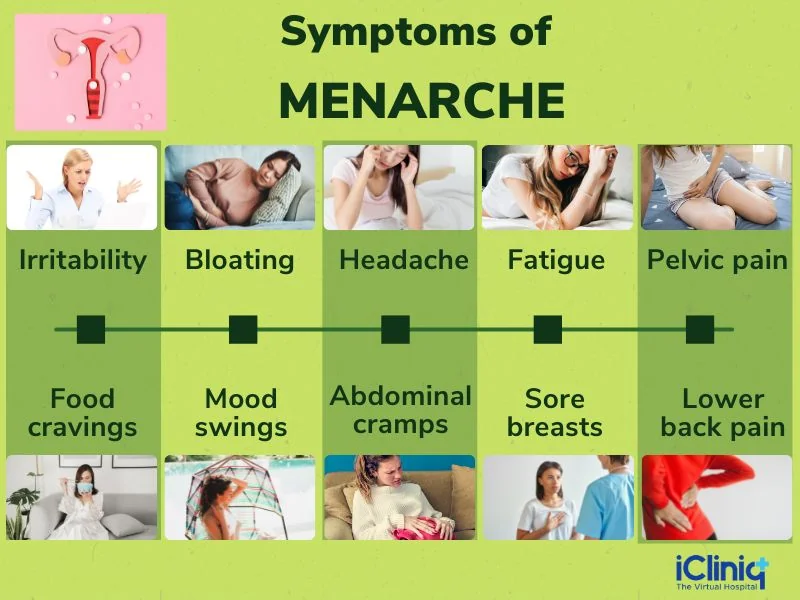
The first sign of menstruation is bleeding from the vagina. Along with the bleeding, you may also have:
-
Abdominal or pelvic cramping pain.
-
Bloating and sore breasts.
-
Fatigue.
-
Lower back pain.
-
Food cravings.
-
Mood swings and irritability.
A premenstrual syndrome is a group of symptoms that occur before the period. It includes emotional and physical symptoms. Consult with your health care provider if you have big changes in your cycle because it can be signs of other problems that should be treated.
What Are the Facts About the Female Reproductive System?
-
Girl babies are born with fallopian tubes, ovaries, and a uterus. The two ovaries are oval and will sit on either side of the uterus (womb) in the lower abdomen, called the pelvis. Each ovary will contain thousands of eggs or ova. The two fallopian tubes, which are also called uterine tubes, are long and thin. Each fallopian tube will stretch from an ovary to the uterus. The uterus is a pear-shaped organ that is located in the middle of the pelvis. The muscles in a female's uterus are so powerful that they can be expanded enough to accommodate the growing fetus inside the uterus. These muscles in the uterus are also helpful in pushing the baby out during labor.
-
When a girl attains puberty, the pituitary gland releases hormones to stimulate the ovaries to produce other hormones like estrogen and progesterone. These hormones affect a girl's body, including growth, physical maturation, and emotions.
-
Every month, a tiny egg will leave one of the ovaries. This process is called ovulation. This tiny egg will travel down to the uterus through one of the fallopian tubes. Before ovulation, the hormone estrogen will stimulate the uterus to build up its lining with extra blood and tissue. This makes the walls of the uterus thick and cushioned. The uterus is prepared in such a way for pregnancy. Therefore, if the egg is fertilized by a sperm cell, it will travel to the uterus and attach to its cushiony wall, where it slowly develops into a fetus.
-
If the egg is not fertilized, the egg will not get attached to the uterus wall. The uterus will shed the extra tissue lining, and the woman will get her monthly cycle. These blood, tissues, and unfertilized eggs will leave the uterus through the vagina outside the body. This is known as a menstrual period.
-
This menstrual period happens almost every month and for many more decades except when a woman is pregnant and enters menopause and no longer releases eggs from her ovaries.