Table of Contents
What Are Skin Rashes in Children?
Skin rashes in children are extremely common; a study of school-aged children found 90.2% had at least one skin condition. They appear as changes in skin color, texture, or surface: flat red patches, raised bumps, blisters, or scaling.
Most of them are usually harmless. Most of them start with infections, problems with a weakened skin barrier, allergies, and irritants. In many cases, these will resolve on their own without treatment or with only minimal management. Some rashes require prompt medical care, especially when fever develops or symptoms spread rapidly.
Types of Skin Rashes in Children
Infectious Rashes
-
Roseola is among the most common viral rashes in infants under 2 years old. Roseola has a typical course, characterized by a three- to five-day period of high fever followed by a pink, blotchy rash spreading from the trunk outward. The child typically feels better as the rash appears, a reassuring sign. No treatment is needed.
-
Measles (rubeola) begins with fever, cough, runny nose, and red eyes, then produces a red-brown rash that starts on the face and spreads downward. It is preventable through the MMR (measles, mumps, and rubella) vaccine. Any suspected case should be reported to a doctor promptly.
-
Fifth disease (erythema infectiosum) causes a distinctive slapped-cheek appearance, followed by bright red cheeks and a lacy rash on the limbs and trunk. Once the rash appears, the child is no longer contagious. It is mild in otherwise healthy children.
-
Impetigo is an infectious condition caused by bacteria, usually Staphylococcus aureus or Streptococcus pyogenes. It presents as honey-colored, crusted sores around the nose and mouth. It continues to impact the child's body for 48 hours post-beginning antibiotic treatment. Both topical and oral antibiotics are efficient forms of treatment.
-
A rash of a rough-textured appearance appears on the skin in conjunction with scarlet fever, which begins on the chest area and covers most of the body except the palms and soles. The symptoms of strep throat include fever and a red tongue.
-
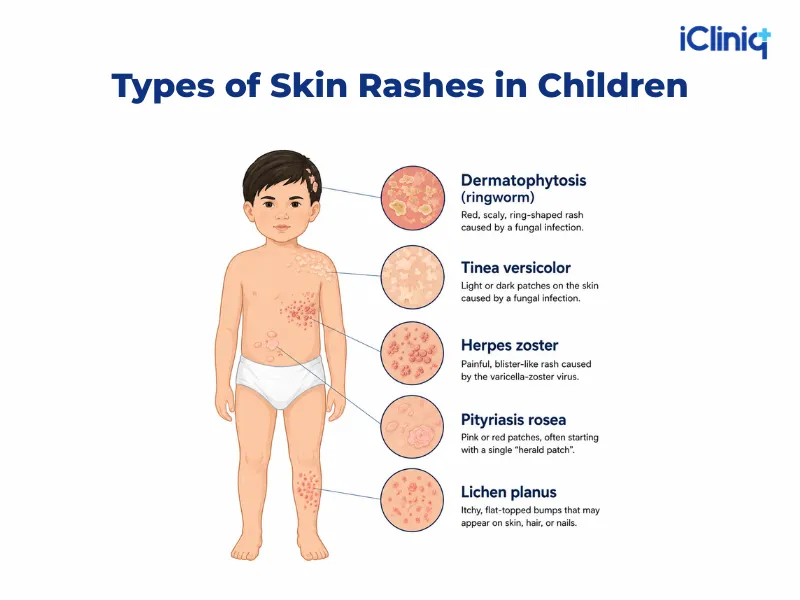
Ringworm, also known as tinea corporis, is a fungal infection that causes a circular, red spot with scaling and a central area. This disease is easily transmitted by physical contact and can be treated with antifungal creams for about two to four weeks. Scalp ringworm requires treatment with an oral antifungal agent.
-
A yeast infection occurs mainly in warm, moist areas of the skin. When this infection occurs in the diaper region, a candidal rash can appear intensely red and sharply outlined, with satellite lesions on the periphery, which sets it apart from diaper rash.
Non-Infectious Rashes
-
The most prevalent chronic skin disorder among kids is eczema or atopic dermatitis, which affects 10 to 20% of the world population. In kids, this illness produces itchy, dry rashes that appear on the skin, which are red on light skin and brown or gray on dark skin, around the cheeks and head of an infant and on the elbows and knees in older children. Eczema is characterized by itchy symptoms; without them, the disease cannot be considered.
-
Contact dermatitis is characterized by inflammation caused by direct contact with substances, including fragrant soaps, solvents, nickel products, some plants, and even wipes. Inflammation always manifests at the exact site of exposure. Avoiding the irritant and using milder corticosteroid creams will help you get rid of the problem fast.
-
Heat rash occurs when sweat glands get blocked in hot weather. You’ll notice tiny, clear, reddish, or pink bumps, often on your neck, shoulders, and skin folds. Prickly heat usually resolves on its own, and you usually do not need treatment; cooling helps the rash fade.
-
Diaper rash occurs when skin comes into contact with urine and feces. You can help by changing diapers often, gently cleaning the area, and applying zinc oxide cream to the spot. A red border with satellite spots points to a Candida infection.
Allergy and Immune-Related Rashes
Urticaria, also called hives, is a type of rash characterized by raised lesions and severe itching. The causes include allergens such as foods, insect bites, viruses, and some medications. Antihistamines are very helpful in treating the symptoms. Urticaria associated with swollen lips, throat, and breathing problems indicates anaphylaxis.
Drug reactions can cause a maculopapular rash within days of starting a new medication. More serious reactions, such as Stevens-Johnson syndrome, involve blistering and skin sloughing. Any rash that begins after a new medication should be reported to a doctor before the next dose.
Symptoms of a food allergy rash include hives or eczema. Such symptoms may develop from 2 minutes to 2 hours after ingesting the offending substance. Common sources of food allergy rashes include eggs, milk, peanuts, tree nuts, soy, and wheat.
Common Symptoms of Skin Rashes in Children
Other signs will be useful in making a differential diagnosis:
-
Itching: It is common in eczema, hives, contact dermatitis, and certain viral skin conditions.
-
Fever: It occurs in roseola, fifth disease, scarlet fever, and measles.
-
Blisters and Weeping: They occur in impetigo, chicken pox, and severe eczema.
-
Scaling and Crusting: They occur in eczema, ringworm, and bacterial infections.
-
Localizing: It occurs in contact dermatitis and diaper rash.
-
Rapid Spreading: A warning sign in infectious rashes; seek review promptly.
When Should You Worry About a Rash?
Most childhood rashes do not require emergency care. The following signs are the exceptions. Go to an emergency department immediately if the rash is:
-
Purple or dark red with spots that do not fade when pressed (non-blanching); this may indicate meningococcal disease or sepsis.
-
Accompanied by high fever, stiff neck, sensitivity to light, or confusion.
-
Spreading very rapidly, it involves blistering and skin sloughing.
-
Accompanied by throat swelling, breathing difficulty, or swallowing problems, anaphylaxis occurs.
-
Present in a child who appears very unwell, lethargic, or difficult to rouse.
See a pediatrician within 24 to 48 hours if:
-
The rash is not improving after two to three days of home care.
-
It is spreading or changing significantly.
-
Your child has an unexplained fever alongside the rash.
-
You suspect impetigo or ringworm.
-
You are unsure of the cause, and your child is uncomfortable.
-
The blanching test: Press a clear glass firmly against the rash. If the spots do not fade under pressure, seek emergency care immediately. This is the most critical check for parents to know.
Conclusion
Skin rashes in children are diverse, widespread, and treatable. Knowing the location, the presence of itching and fever, and the progression of the rash is critical for an appropriate response. An infectious rash needs proper treatment; a non-infectious rash may require adjustments to the skincare routine, while allergy-caused rashes may require antihistamines or other urgent action. If the rash is purple or does not blanch, and the child seems extremely ill, do something right away. It is treatable if you identify the signs and symptoms early. If you want more guidance, consult a skin specialist.
Key Takeaways
-
In most cases, skin rashes in childhood are benign, self-resolving, or easily treatable.
-
Skin rashes can be broadly classified into three main types: infectious, non-infectious, and allergic or immune.
-
A rash with a high fever, purple or non-blanching spots, difficulty breathing, or rapid spreading is a medical emergency.
-
Knowing the key features of each rash type helps parents respond appropriately and avoid unnecessary worry.
-
When in doubt, a pediatrician can diagnose a rash accurately - trust your instincts as a parent.

