Table of Contents
- 1What Is Psoriasis?
- 2What Does Psoriasis Look Like?
- 3What Are the Types of Psoriasis?
- 4How to Diagnose Psoriasis?
- 5What Are the Tests for Psoriasis?
- 6What Is the Management for Psoriasis?
- 7How to Control Psoriasis?
- 8How to Cure Psoriasis Permanently?
- 9How Is the Prevention of Psoriasis Possible?
- 10Key Takeaway From iCliniq
What Is Psoriasis?
Psoriasis is a chronic inflammatory skin disorder that affects various parts of the body, causing physical pain and discomfort. The typical symptoms include red, scaly areas; itching; burning; and occasionally, pain, which can disrupt everyday life, work, and social interactions.
The most difficult thing about psoriasis is that it is mostly noticeable, which results in self-awareness, social stigmatization, and a lack of confidence. Patients can be ashamed of their looks, and this can affect their mental health and their general living standards. It is also unpredictable in nature, and any stress, infections, or lifestyle triggers a flare-up, making it complex in issues related to its management.
The management of the problem must be a self-adjusted procedure that can incorporate topical interventions, phototherapy, systemic drugs, and lifestyle changes. Psychological counseling and teaching on the triggers, treatment compliance, and emotional support are vital to enhance the outcomes and decrease the flare-ups.
It is essential to diagnose early and offer specific treatment to alleviate symptoms, avoid complications, and promote physical and emotional health. With adequate care, patients can experience improved disease control, reduce its negative impact on daily life, and enhance the overall quality of life.
What Does Psoriasis Look Like?
Psoriasis often presents as red, shiny lesions in sensitive areas, making it distinct from plaques found in other parts of the body. The scales on your rash can flake off when you scratch it, exposing the weeping stage, which can cause bleeding. New bubbles can evolve into rashes or larger areas of skin damage, otherwise referred to as lesions, as the psoriasis rash continues to expand. The manifestations of psoriasis can be divided into mild and severe ones.
What Are the Types of Psoriasis?
There are several types of psoriasis, including:
-
Plaque psoriasis:
Depending on risk factors and severity, the main type of psoriasis is called plaque psoriasis. As many as 80 to 90 percent of all individuals diagnosed with psoriasis experience plaque psoriasis.
-
Inverse psoriasis:
This type typically develops in skin creases, including the genital area, often resulting in thin, plaque-like psoriasis that lacks scales.
-
Guttate psoriasis:
Guttate psoriasis may be triggered by a sore throat following a streptococcal infection. This type of psoriasis appears as small, red, teardrop-shaped, scaly patches on the skin and is common in children and young adults.
-
Pustular psoriasis:
Pustular psoriasis has very small crimson pimples surrounded by pus over plaques.
-
Erythrodermic psoriasis:
This severe condition spreads over a wider part of the skin, covering more than 90 percent of the body's surface.
-
Sebopsoriasis:
This type typically manifests on the face and scalp as small, bumpy lesions and large, round patches with a greasy, yellow scale.
-
Nail psoriasis:
Nail psoriasis leads to discoloration, small pitting, and alteration to the shape of fingernails and toenails.
-
Scalp psoriasis:
Scalp psoriasis is a chronic skin condition causing red, scaly patches on the scalp, often accompanied by itching and flaking. Types of scalp psoriasis can present as mild, fine scaling or severe, thick plaques, sometimes extending beyond the hairline.
Psoriasis Triggers to Avoid-
-
Stress.
-
Skin injuries (e.g., cuts or sunburns).
-
Infections.
-
Smoking.
-
Alcohol consumption.
-
Certain medications (e.g., beta-blockers, lithium).
-
Dry or cold weather.
-
Inflammatory foods (e.g., processed, sugary, or fatty foods).
-
Keep skin moisturized, maintain a healthy weight, and use gentle skincare products.
How to Diagnose Psoriasis?
Psoriasis diagnosis does not begin at the examination point; it starts with an interview with the dermatologist and a physical examination of the client. The doctor will ask the patient about their family history, any other health issues they may have, their lifestyle, and whether they have experienced any stressful events or infections.
During a clinical assessment, the physical examination includes examination of the skin, scalp, and nails for distribution features typical of psoriasis, which include erythematous, infiltrated, and more or less well-demarcated plaques with silvery scales, a fluffy white appearance, and pitting or telescoping of the nails or their detachment. In some cases, the presence and nature of the presentation can be ambiguous; therefore, a skin biopsy is performed to establish clear, indicative cellular and inflammatory patterns.
Differential diagnosis with conditions such as eczema, seborrheic dermatitis, or fungal infections is often necessary when certain clinical signs are present, and sometimes even a biopsy is performed. For patients complaining of weakness and joint pains, investigations that may be performed include an X-ray or MRI (magnetic resonance imaging) for confirmation of psoriatic arthritis, which is a common association. Additionally, tools are used to assess patients' conditions, such as the Psoriasis Area and Severity Index (PASI) and the Body Surface Area (BSA).
If the therapy is advanced or the tumor is invading deeper organs, additional tests may be conducted to assess the general health status, including kidney and liver function tests, as well as cholesterol and glucose levels, if systemic treatments are administered. The best approach adopted undertakes this process in various ways, helping to arrive at a correct diagnosis and the treatment to be administered.
What Are the Tests for Psoriasis?
After examining the skin and discussing your symptoms, a healthcare provider or dermatologist gives a psoriasis diagnosis. They may ask questions such as:
-
Skin disorders that run in the family, and whether you have had any tattoos in the past.
-
Your first awareness of symptoms.
-
Has it been effective in applying any remedies to the skin at home?
-
Has your skin ever had an outbreak before?
-
Which types of soap/shampoo do you employ?
If symptoms suggest psoriasis, specific attention to the affected area might be required. Laboratory tests for psoriasis are advised by the doctor. Skin plaques are a key indicator of a psoriasis diagnosis, but symptoms can mimic those of other diseases; therefore, psoriasis tests, such as a skin biopsy, may be recommended for a conclusive diagnosis. This involves taking a small piece of skin from the plaque and examining it under a microscope.
What Is the Management for Psoriasis?
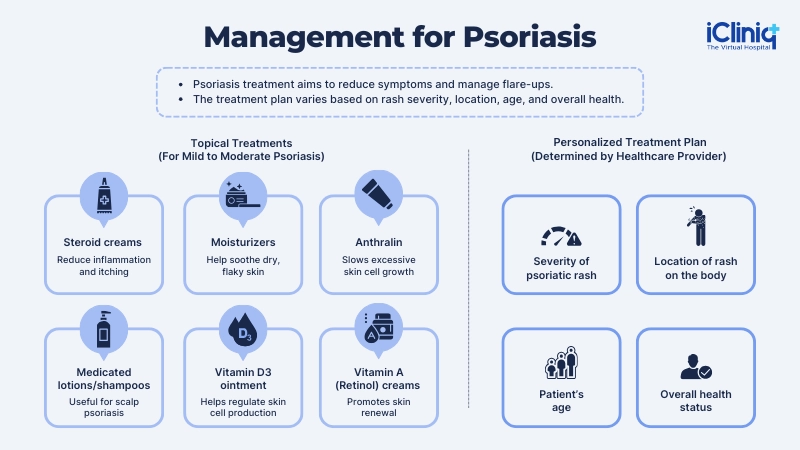
There are many ways to manage psoriasis to help reduce its symptoms. Common psoriasis management includes:
-
Steroid creams.
-
Moisturizers for dry skin.
-
A topical anti-psoriatic agent that affects cell proliferation in the skin (Anthralin).
-
Medicated lotions or shampoos.
-
Vitamin D3 ointment.
-
Vitamin A or retinol creams.
During pregnancy, treatment of psoriasis focuses on using the safest options possible, typically emollients, moisturizers, and mild topical corticosteroids, while avoiding systemic medications and certain retinoids that may pose risks to the developing fetus.
The healthcare provider will decide on a treatment plan based on:
-
The severity of the psoriatic rash.
-
Where the rash is on your body.
-
Your age.
-
Your overall health.
How to Control Psoriasis?
Medications
Various over-the-counter medicines may help reduce symptoms of psoriasis:
-
Coal tar is used for plaque psoriasis, itching, and lesions on the scalp, palm, and sole.
-
Hydrocortisone creams could minimize inflammation and ease itching.
-
Salicylic acid can help decrease inflammation and remove layers of scales from the skin, particularly in conditions such as psoriasis that affect the scalp.
-
Calamine, Hydrocortisone, camphor, or menthol-containing creams and lotions can prevent itching.
Topical therapies
Topical treatments, including corticosteroids and synthetic vitamin D, are often used for psoriasis to reduce inflammation and soothe discomfort. These aim to:
-
Reduce the rate of skin cell production.
-
Reduce inflammation.
-
Soothe itching or discomfort.
Systemic therapies
These therapies work in the body to help decrease:
-
Inflammation.
-
Disease progression.
-
Regularity of flares.
A doctor may prescribe biologics or JAK (Janus kinase) inhibitors for severe cases, including those affecting sensitive areas like psoriasis. Examples include:
-
Adalimumab.
-
Secukinumab.
-
Tofacitinib.
Phototherapy
Phototherapy involves exposing the skin to specific lights and lasers to inhibit cell growth and reduce immune responses. This can be helpful for conditions like plaque psoriasis, but care must be taken to avoid irritation or overexposure.
How to Cure Psoriasis Permanently?
So far, there is no permanent cure for psoriasis, but there are remedies aimed at preventing its effects and easing the experience for those who have it. Caring for psoriasis involves understanding the specific form of the condition a person has, the severity of their skin disease, and the patient’s overall health status. A doctor will suggest a type of treatment that best suits an individual.
How Is the Prevention of Psoriasis Possible?
Psoriasis prevention is possible in the following ways:
-
One should know how to control psoriasis, as methods may help decrease the risk of psoriasis flares, such as learning about food triggers, knowledge preservation, and recognition of basic techniques.
-
Trying to keep the right mass. It features simple and easy-to-follow instructions, such as applying lotion to the skin regularly.
-
Spending the winter time in a warm country.
-
Exercise, practice yoga, or meditation, or participate in other stress-busting activities.
People with psoriasis can benefit from eating a healthy diet involving the following:
-
Limiting alcohol intake.
-
The incorporation of meats, particularly lean sources of protein, such as chicken breast. Consuming fish that contain omega-3 fatty acids.
-
Limiting the amount of gluten consumed if the person has a gluten allergy.
-
Elimination of foods that trigger inflammation from their diet, including foods with simple carbohydrates and saturated fats.
Conclusion
Psoriasis is a chronic inflammatory skin condition that can affect any part of the body, causing redness, scaling, itching, and discomfort. Although it may affect everyday life, mental health, and self-esteem, the symptoms can be successfully treated with the help of timely diagnosis and proper treatment. Individualized therapy strategies, including topical interventions, pharmacological interventions when necessary, lifestyle modifications, and patient education, can be employed to alleviate an exacerbation, restore skin health, and enhance quality of life. Through regular attention and follow-ups, patients will be better equipped to manage their condition and lead productive and fulfilling lives.
Key Takeaway From iCliniq
-
In most cases, psoriasis is the result of the inflammation of the skin under the influence of the immune system.
-
It is usually seen on the elbows, knees, scalp, and torso, characterized by reddish, scaly spots accompanied by an itch and an uncomfortable feeling.
-
Topical treatments, emollients, lifestyle modifications, and, occasionally, medications are used in the management of symptoms to prevent exacerbations.
-
You may also visit a dermatologist in iCliniq in case of persistent skin irritation or a history of psoriasis.