Table of Contents
Introduction
Nail pitting refers to tiny inversions on the surface of affected nails or pitted depressions on the nails that are small, shallow, or deep. It may cause symptoms of psoriasis but can also result from other disease states; thus, it usually signifies a health disorder, especially psoriasis. This article will delve into the details of types of nail pitting, how to identify nail pitting, and explore the population most vulnerable to nail psoriasis. Knowledge of these aspects is important to diagnose correctly and treat patients appropriately.
What Is Nail Pitting?
How Nail Pitting Develops: Nail pitting is a condition in which the hard surface of the nail plate becomes penetrated or depressed. These pits occur due to a defect in the development of the nail matrix, the structure which is mainly involved in nail production. It can occur in the fingernails and/or toenails and can be mild to severe.
They may appear isolated or in organized groupings to give skin a rough and uneven texture. These may be installations of different colors, shapes, or sizes, uneven thickness or even roughening.
What Are the Types of Nail Pitting?
Nail pitting can be classified according to the nature of the lesion or the extent of matrix involvement. Some of the most common types of nail pitting include:
-
Shallow Pitting: This is a condition characterized by minute, slight concavities on the nail plate. Shallow pitting is typical of early nail engagement in milder cases of diseases such as psoriasis or eczema.
-
Deep Pitting: Deep pitting is different in that it results in deeper invagination that possibly changes the nail plate configuration. It is common in a typical severe psoriasis or another autoimmune illness.
-
Crater-like Pits: In the worst cases, formations appear as round and circular depressions on the nail plate and are commonly seen in moderate to severe nail psoriasis.
-
Random Pitting: Sometimes, pits are loosely distributed in the nail plate and do not follow any specificity of grouping.
-
Uniform Pitting: As with its counterpart, uniform pitting occurs when the depressions are arranged systematically, that is, in a symmetrical manner. Occasionally it is present but is most frequently noted in autoimmune diseases such as lupus or rheumatoid arthritis (chronic inflammation of joints).
The type of nail pitting that takes place is useful in making the diagnosis and in preparing for the best way that will be used to treat the disease.
How to Identify Nail Pitting?
Understanding the possibility of nail pitting is crucial to improving the diagnostic capabilities and pursuing the correct treatment. Nail pitting can often be spotted visually, but certain signs should prompt further investigation:
-
Visible Depressions: There is the development of minute depressions on the nail plate which is the most obvious symptom. These may be of a shallow or deep nature and may be of the same or differing shape and size.
-
Texture Changes: Nail pitting changes the feel and texture of the nails; the surface of the nail plate is no longer as smooth as the normal nail.
-
Nail Discoloration: At times, nail pitting is associated with yellowing, brownish, or other color changes on the nails.
-
Brittleness: Pitting may result in your nails becoming thin and weak and thus may easily break or have a tendency to crumble.
-
Associated Symptoms: Other symptoms that correlate with nail pitting include thickened nails, pitting that involves the detachment of the nails from the nail bed, or inflammation around the cuticles observed in diseases such as psoriasis.
Close monitoring is needed if nail pitting is observed accompanied by other symptoms such as joint pain, you get in psoriatic arthritis, skin changes, or skin rash. Evaluations of the condition and treatment of the nails go hand in hand with the diagnosis of the health disorder.
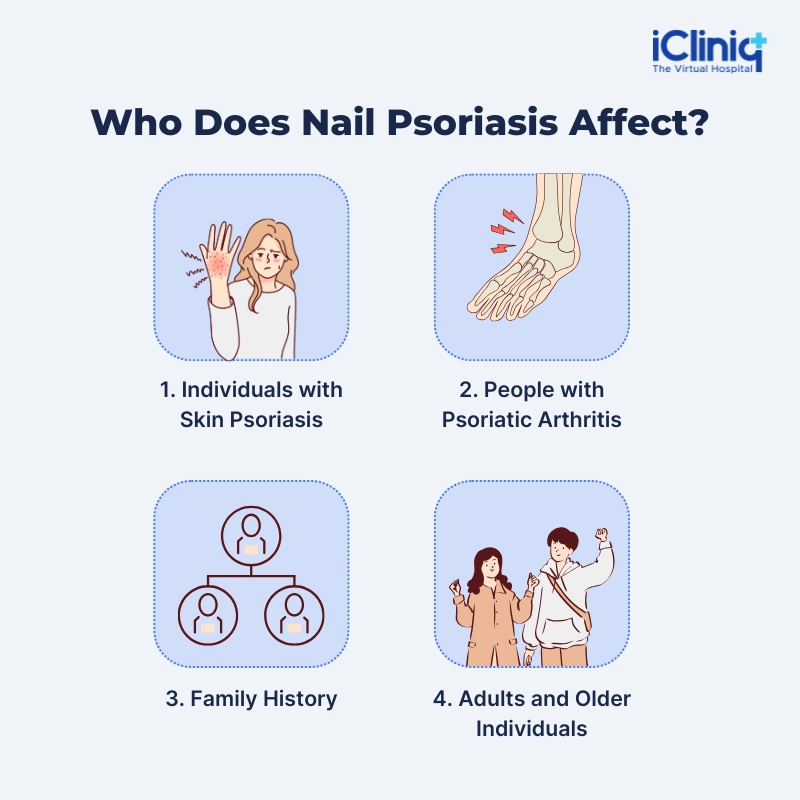
Who Does Nail Psoriasis Affect?
Nail pitting is most commonly associated with nail psoriasis affecting all nails. While it can appear in isolation, nail psoriasis is often part of a broader condition like skin psoriasis or psoriatic arthritis.
1. Individuals with Skin Psoriasis: Up to 50 percent of people with psoriasis will experience nail involvement at some point. Nail pitting is one of the hallmark signs, alongside other symptoms like thickened nails or subungual hyperkeratosis (the buildup of keratin under the nails).
2. People with Psoriatic Arthritis: In psoriatic arthritis, the immune system not only affects the joints but also impacts the nails. Around 80 percent of individuals with psoriatic arthritis report nail symptoms, including pitting.
3. Family History: A genetic predisposition to psoriasis or autoimmune disorders can increase the likelihood of developing nail psoriasis and its associated symptoms.
4. Adults and Older Individuals: While nail psoriasis can affect individuals of any age, it is more commonly seen in adults and the elderly. Although it can still happen, nail involvement is less common in children with psoriasis.
Nail Pitting Causes
The medical history of the individual determines the underlying causes of nail pitting. Among the most frequent causes are:
1. Nails Psoriasis: The most common cause of nail pitting is psoriasis, a chronic autoimmune disease. It occurs when the immune system speeds up the production of skin and nail cells, leading to irregular nail growth and the formation of pits.
2. Alopecia Areata: This autoimmune disorder primarily causes hair loss but can also lead to nail pitting. The pits are often uniform and associated with other nail changes like ridging or thinning.
3. Eczema (Dermatitis): Chronic skin inflammation from eczema can extend to the nail matrix, causing pitting and other nail abnormalities.
4. Trauma to the Nail Matrix: Physical damage to the nail matrix, whether from injury or repeated trauma, can disrupt nail growth and lead to pitting.
5. Other Medical Conditions: Rarely, nail pitting may be associated with conditions like Reiter’s syndrome (a type of arthritis), lichen planus (rash on the skin), or fungal infections.
How Does Psoriasis Affect Nails?
Nail psoriasis is therefore characterized by involvement of all the nails though the extent of involvement may vary. It can manifest initially by pitting in a single nail and will, over time, affect multiple nails. Key characteristics of psoriasis affecting nails include:
-
Diffuse Pitting: The presence of pits across most or all nails.
-
Nail Thickening: Scale buildup can cause the nails to become much thicker and rigid with so much keratin production.
-
Onycholysis: Nails may come off the nail bed and cause some level of pain.
-
Discoloration: Change in the color of nails, such as yellow-brown – this is scientifically known as an oil drop sign.
What Is the Treatment and Management of Nail Pitting?
While there is no universal cure for nail pitting, treatments aim to manage symptoms and address the underlying cause.
1. For Nail Pitting Psoriasis
-
Topical Treatments: Topical corticosteroids, vitamin D derivatives, or calcineurin inhibitors may be used in nail lacquers.
-
Systemic Therapies: For moderate to severe cases systemic medications such as Methotrexate and biologic drugs may be used.
-
Phototherapy: That is why ultraviolet light therapy is useful in improving the condition of patients with psoriasis.
2. For Other Causes
-
Alopecia Areata: The main treatment is meant to suppress antibody production through the use of corticosteroids or immunosuppressive drugs.
-
Eczema: Chronic skin inflammation, and its resulting symptoms such as pitting, can be diminished by moisturizers and anti-inflammatory treatments.
-
Trauma Prevention: Preventive measures must be taken in order not to subject the nails to further abuse.
3. General Nail Care Tips
-
Therefore preserve nails shorter to avoid getting an even worse situation.
-
Nails also need to be moisturized often to increase their flexibility.
-
Do not use ugly treatments like acrylic nails or abrasive filings on the nails.
Conclusion
Some physical symptoms associated with nail disorders include pitting which is also characteristic of nail psoriasis, alopecia areata, and eczema. Knowing the different types of nail pitting, identifying nail pitting, and identifying the persons most at risk will help in early diagnosis and treatment. As with other nails, treatment of nails with pitting can greatly enhance the quality of life and health of the toe and fingernails. If you develop nail pitting symptoms, you should seek a doctor to determine the cause of the condition and get the right treatment.

