
What Is Infant Eczema?
Infant eczema, medically known as infantile atopic dermatitis, also called baby eczema, is a chronic inflammatory skin condition that causes dry, red, intensely itchy patches on a baby's skin. It affects 10-20% of children worldwide, making it the most common skin condition in infancy.
Think of the skin like a protective wall. In babies with eczema, that wall has tiny gaps, so moisture leaks out and things like dust or soap get in. When that happens, the body overreacts, which causes the redness and itching you see. It is not a rash from an infection, and it is definitely not about hygiene. It is simply down to genetics, a sensitive immune system, and certain environmental triggers.
What Does Infant Eczema Look Like?
Appearance changes with age and varies by skin tone.
-
Under 6 Months: Eczema most commonly appears on the face in the cheeks, forehead, chin, and around the mouth. In lighter-skinned babies, affected patches appear red. In darker-skinned babies, they may look brownish or ashy. Patches are dry, rough, and scaly, sometimes with small raised bumps that weep or crust.
-
6 to 12 Months: The rash spreads to the elbows, knees, wrists, and ankles. As babies start crawling, friction brings the outer elbows and knees into the picture.
-
Toddlers (1 to 2 years): Eczema tends to concentrate in skin folds, behind the knees, inside the elbows, and around the neck and wrists.
Infant Eczema Symptoms:
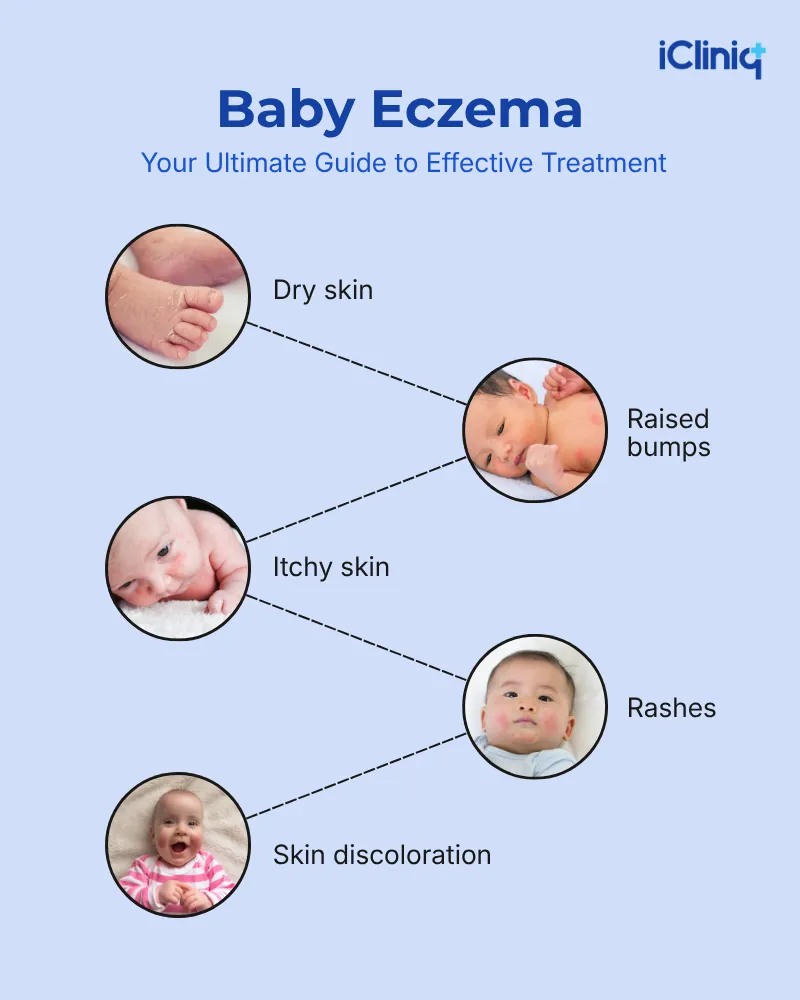
The hallmark symptom of infant eczema is intense itching, which makes it hard to control scratching and worsens the skin. Other common signs include dry, scaly patches; redness or discoloration; fluid-filled blisters that weep or crust; cracked or bleeding skin; and thickened, leathery skin in areas of repeated scratching.
Babies who can't talk or communicate that they have itching show behavioral signs like:
-
Rubbing the face against surfaces.
-
Pulling at ears.
-
They have disrupted sleep.
-
Unusual fussiness during bathing or dressing.
-
Visible scratch marks despite short nails.
Continuous itching can significantly affect the baby's sleep quality. They may wake up frequently, become irritable, or rub the affected skin against caregivers, bedding, or carpet to relieve itching. If infection develops, look for honey-colored crusting, yellow or green weeping fluid, fever, and spreading redness. This requires same-day medical attention.
Causes of Infant Eczema:
Infant eczema develops from a combination of genetic and environmental factors:
-
Skin barrier dysfunction is at the core of most cases. Filaggrin - a protein encoded by the FLG gene - builds the skin's protective outer layer. Filaggrin mutations are found in 25-50% of children with atopic dermatitis, according to the Journal of Allergy and Clinical Immunology (2024). Without adequate filaggrin, the skin loses moisture easily and allows allergens and microbes to pass through, triggering inflammation.
-
Family history is the strongest single risk factor. One affected parent raises a baby's eczema risk 2 to 3 times above that of the general population. If both parents are affected, the risk rises to 50-70%.
-
Microbiome disruption is a growing area of research. Staphylococcus aureus is present on the skin of up to 90% of children with atopic dermatitis. It disrupts the skin barrier, amplifies inflammation, and can precede the visible onset of eczema in high-risk infants.
Common Triggers That Worsen Baby Eczema
Triggers don't cause eczema; they provoke flares in babies who already have it.
|
Trigger Category |
Common Examples |
|
Skin irritants |
Fragranced soaps, bubble baths, detergents, drool |
|
Environmental allergens |
Dust mites, pet dander, mold, pollen |
|
Fabrics |
Wool, synthetics, tight clothing, rough seams |
|
Temperature & sweat |
Overheating, dry winter air, low humidity |
|
Food allergens |
Eggs, cow's milk, peanuts, soy, wheat |
|
Skin microbes |
Staphylococcus aureus colonization |
|
Teething |
Increased drool around the mouth and chin |
|
Viral illness |
Colds and infections can trigger flares |
|
Stress & overstimulation |
Disrupted sleep, new environments |
While some infants may have foods that trigger eczema symptoms, food does not usually cause eczema in children. Limiting their food without proper medical guidance may influence their growth and nutrition.
How Is Infant Eczema Diagnosed?
-
Infant eczema is diagnosed clinically, and there is no single definitive test. A pediatrician or pediatric dermatologist examines the skin, considers its appearance and distribution, and reviews family history.
-
To diagnose eczema, doctors look for a few key things. The skin is dry and itchy, or the baby is constantly scratching and rubbing it. There is usually a rash on the face or on the outer parts of the arms and legs. The child or someone in the family has a history of allergies or asthma. And the condition keeps coming back or never fully goes away.
-
Additional tests may include patch testing, specific IgE blood tests (RAST) for food or inhalant allergies, skin swabs for suspected infection, and, rarely, a skin biopsy to exclude other conditions.
-
Conditions that can look like infant eczema include seborrheic dermatitis (greasy, non-itchy scalp flaking), contact dermatitis, scabies (contagious, intensely itchy), heat rash, and psoriasis.
-
In contrast to eczema, seborrheic dermatitis (cradle cap) often results in greasy, yellow scales that cause little itching. Eczema in babies is quite itchy and can lead to dry skin.
Infant Eczema Treatment Options
-
Daily skincare is the most important part of managing eczema. The AAP recommends giving your baby a bath every day in lukewarm water for about five to ten minutes. Use a gentle cleanser with no fragrance or soap. As soon as the bath is done, within three minutes while the skin is still a little damp, slather on a thick fragrance-free moisturizer from head to toe. That moment right after the bath is when it works best. This "soak and seal" method locks in moisture when absorption is most effective. Missing this window significantly reduces the benefit.
-
Use thick creams or ointments, not thin lotions. Petroleum jelly and Aquaphor are the most effective barrier options. Thick creams like petrolatum and sorbitol dermatological ointments, triple ceramides, and hyaluronic acid lotion work well for daily use. Colloidal oatmeal creams add anti-inflammatory benefits. Apply at least twice daily, after bathing, and once more during the day.
-
Topical corticosteroids are the first-line treatment for flares. Low-potency steroids (hydrocortisone 0.5 to 1%) are used on the face and skin folds. Mild-to-moderate potency preparations are used on the body. Apply twice daily to affected areas only for the duration of the flare, typically 1 to 2 weeks, then stop. Use the Fingertip Unit (FTU) as a dosing guide: one FTU covers approximately two adult palm-sized areas.
-
Topical calcineurin inhibitors (TCIs) - Pimecrolimus for babies 3 months and older, tacrolimus 0.03% for 2 years and older, are steroid-sparing alternatives for sensitive areas or when long-term steroid use is a concern.
-
Crisaborole is a non-steroidal PDE-4 inhibitor approved for mild-to-moderate eczema in babies 3 months and older. Application-site stinging can be reduced by applying a small amount of petroleum jelly beforehand.
-
Dupilumab is the only biologic medication approved for babies as young as six months who have moderate to severe eczema. It works by blocking the signals in the body that cause the skin inflammation in the first place. According to the AAP, most children begin to see real improvement within 1 to 2 months, and it has a strong safety record.
-
For older children with severe, treatment-resistant disease, narrowband UVB phototherapy and Tapinarof cream (approved in 2024 for ages 2 and older) are additional options.
How to Prevent Infant Eczema Flare-Ups
-
Moisturize consistently. Apply thick emollient within 3 minutes of every bath, head to toe. Reapply to dry areas at least once more during the day. This is the single most impactful daily action.
-
Track and avoid triggers. Keep a flare diary for 4 to 6 weeks, and make a note of severity, the foods you are exposed to, environmental changes such as climate, and the products you use. Patterns become clear. Common culprits: fragranced products, dust mites, certain foods, fabric types, and overheating.
-
Use fragrance-free moisturizer and other products. Replace all skin products, laundry detergent, and fabric softener with fragrance-free, dye-free alternatives. Add an extra rinse cycle to remove detergent residue.
-
Choose skin-safe fabrics. Use soft cotton or bamboo fabrics for your baby. Avoid wool and synthetics. Layer clothing rather than wearing a single thick layer; overheating triggers sweating and inflammation.
-
Manage the environment around you. Use dust mite-proof covers on mattresses. Wash bedding weekly at 60°C / 140°F. Keep pets out of the baby's bedroom if pet dander is a known trigger. Use a cool-mist humidifier in winter.
-
Address the drool. Saliva irritates eczema-prone facial skin. Pat the chin and mouth dry after feeding. Apply a thin layer of petroleum jelly to the chin before feeding as a protective barrier.
-
Keep the room cool. Around 18°C / 64°F at night prevents overheating, which can provoke sweating and disturb sleep.
-
Ensure that the fingernails of your child are trimmed regularly so that the child does not damage the skin when scratching. Some people place their babies on cotton mitts while sleeping.
When to See a Doctor?
See a pediatrician promptly if the rash is itchy and recurring; is not improving after 2 to 3 days of constant moisturizing; shows signs of infection (such as honey-colored crusting, weeping fluid, or fever); disrupts sleep, or involves the area around the eyes.
Seek a referral to a pediatric dermatologist if eczema is severe or widespread, uncontrolled after 2 to 4 weeks of treatment, or recurring infections are a problem.
Seek emergency care immediately if your baby develops clusters of dark, painful blisters on the face; this may be eczema herpeticum, a medical emergency, or if a high fever accompanies rapidly spreading weeping skin.
What Complications Can Arise?
Uncontrolled infant eczema can cause additional complications besides pruritus and dry skin. Scratching can compromise the skin barrier and increase the risk of skin infections from bacteria, viruses, and fungi. Complications that may occur due to eczema include:
-
Staphylococcus aureus skin infection.
-
Disturbed sleep and increased irritability during the day.
-
Thickened skin as a result of prolonged scratching (lichenification).
-
Post-inflammatory hyperpigmentation of the skin.
-
Herpes skin infection (eczema herpeticum).
Children with eczema are more likely to experience other manifestations of atopic diseases, such as asthma, allergies, and rhinitis. This phenomenon is referred to as the "atopic march."
Conclusion
Infant eczema is common, chronic, and manageable in most cases. Moisturizing consistently every day and early flare treatment are the two pillars of disease control. Understanding your baby's specific triggers and systematically avoiding them reduces both flare frequency and severity.
Most babies improve significantly with age. According to long-term research, about 50-70% of infants show significant improvement or remission during their school years, but many continue to have sensitive skin into adolescence or even adulthood.
The condition reflects genetics and an immature immune system, not parenting quality. Getting the daily routine right makes the most meaningful difference to your baby's comfort. If you feel that your baby has similar symptoms, consult an expert right away.
Key Takeaways
-
Infant eczema affects 10 to 20% of children worldwide and typically first appears within the first 6 months of life.
-
It is caused by a combination of genetic skin barrier dysfunction (often involving the filaggrin protein) and environmental triggers, not by poor hygiene or parenting.
-
The cornerstone of treatment is consistent daily moisturization with thick, fragrance-free emollients, plus topical corticosteroids for active flares.
-
Safe home care includes lukewarm daily baths, the "soak and seal" method, fragrance-free products, and identifying personal triggers.
-
Most infants improve significantly over time, and 52-70% achieve remission by school age.
-
Infant eczema has no cure, but it is very manageable. A pediatrician or pediatric dermatologist can guide a treatment plan tailored to your baby.

