Table of Contents
- 1What Is Pustular Psoriasis?
- 2What Is Generalized Pustular Psoriasis?
- 3Who Gets Generalized Pustular Psoriasis?
- 4What Are the Risk Factors of Generalized Pustular Psoriasis?
- 5What Are the Clinical Features of Generalized Pustular Psoriasis?
- 6How to Diagnose Generalized Pustular Psoriasis?
- 7What Are the Potential Complications?
- 8How to Treat Generalized Pustular Psoriasis?
- 9What Is the Prognosis of Generalized Pustular Psoriasis?
- 10Conclusion
- 11Key Takeaways
What Is Pustular Psoriasis?
Pustular psoriasis is a variant of psoriasis characterized by pus-filled blisters on the hands and feet. These regions are painful and prone to cracking. When this condition spreads throughout the body, it can be life-threatening.
Pustular psoriasis on the face is rare. They can form on the skin, beneath a nail, or inside the mouth. Pus-filled bumps (blemishes) join together and burst open, leaving the skin raw and tender when the pus dries.
In this red area, new pustules form, which again join and burst open. Early-stage pustular psoriasis can cause mild pain or itch.
What Is Generalized Pustular Psoriasis?
According to recent research, generalized pustular psoriasis (GPP) may be considered distinct from psoriasis. It is an inflammatory skin condition with an immune activation pattern distinct from that of psoriasis, due to recessive IL36RN gene mutations that lead to errors in how the body processes certain signals.
Who Gets Generalized Pustular Psoriasis?
- Generalized pustular psoriasis can occur at any age, but it is rare in children. This is most common in people aged 40 to 50.
- This condition is present in those with a family history or prominent gene mutations who often see the signs early.
- In childhood, boys are more commonly affected, whereas in adulthood, women are more frequently diagnosed.
- Pregnant women may also suffer from GPP, which is interlinked with increased rates of maternal and fetal morbidity.
What Are the Risk Factors of Generalized Pustular Psoriasis?
About 10 percent of patients with generalized pustular psoriasis have psoriasis. Other trigger factors include:
- Drugs such as Aspirin, Lithium, iodide, Indomethacin, and some beta blockers.
- Sudden stoppage of steroids.
- Infection.
- Pregnancy.
Withdrawal of strong topical steroids and strong topical preparations such as Dithranol and coal tar can cause pustule formation. This is often associated with pre-existing psoriasis and its plaques.
What Are the Clinical Features of Generalized Pustular Psoriasis?
Generalized pustular psoriasis is an acute condition with frequent flare-ups.
- The skin first becomes dry, red, and tender.
- Pustules develop within two to three hours.
- Pustules combine after one day.
- These dry out and peel, leaving a glazed, tender, smooth surface where new pustules form.
- The scalp in pustular psoriasis has a red base, with yellow pustules.
- After this, new pustules may appear and erupt every few weeks or days.
Remission occurs after days or sometimes weeks; the skin may either revert to its previous state or develop redness. Relapses are common in generalized pustular psoriasis.
Systemic symptoms associated with generalized pustular psoriasis include:
- Fever.
- Chills.
- Headache.
- Increased or rapid pulse rate.
- Loss of appetite.
- Nausea.
- Dehydration.
- Thirst.
- Muscle weakness.
- Leg swelling.
How to Diagnose Generalized Pustular Psoriasis?
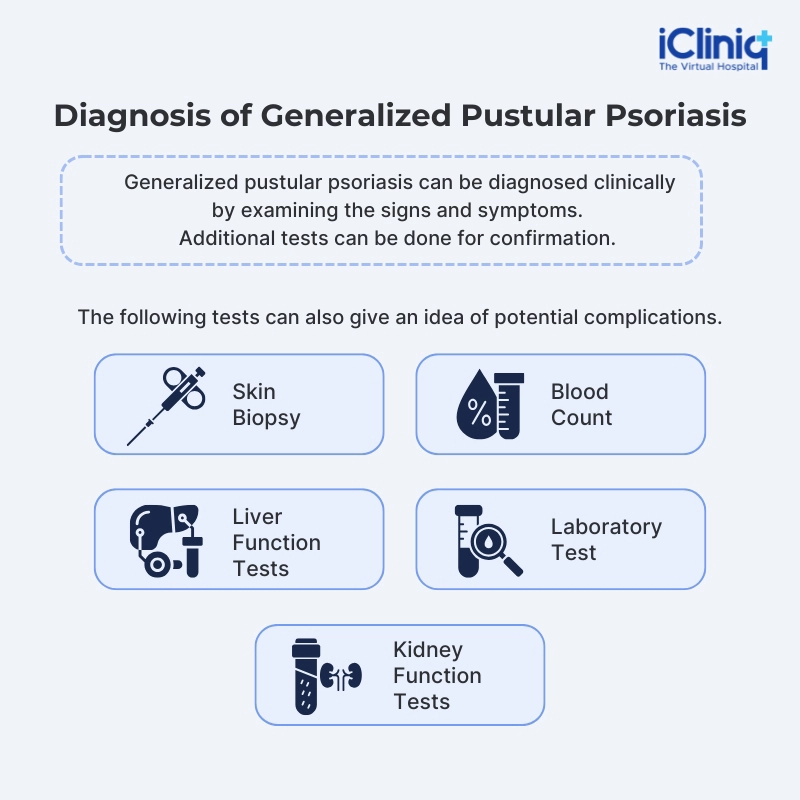
Generalized pustular psoriasis can be diagnosed clinically by examining the signs and symptoms. Additional tests can be done for confirmation. These tests can also give an idea of potential complications.
-
Skin Biopsy:
It shows pustules below the corneal layer along with neutrophils.
-
Laboratory Tests:
Tests can be performed to detect bacterial infection in cases of secondary infection.
-
Blood Count:
To check for anemia (blood loss), neutrophilia (high neutrophils), and lymphopenia (fewer white blood cells, that is, lymphocytes).
-
Liver Function Tests:
To review the functioning of the liver.
-
Kidney Function Tests:
To check if kidney function is still maintained.
-
Serum Levels:
Blood levels of calcium, phosphate, and electrolytes can also be done.
What Are the Potential Complications?
Being an acute disorder, in some cases, the disease can be fatal. Therefore, it must be given emergency medical care. The older the patients, the higher the risks. The pustules can serve as sites of secondary bacterial infection. In the initial stage, the pustules are sterile. Potential complications include:
- Renal (kidney) and liver impairment.
- Protein-losing enteropathy (it means loss of serum proteins into the intestine).
- Peripheral neuropathy (meaning damage to the nerves outside the brain and spinal cord, caused mainly due to diabetes).
- Cardiac failure (occurs when the heart muscle does not pump blood efficiently to meet the body’s needs).
- Electrolyte imbalance due to water loss.
- Disturbed protein balance, low albumin, zinc, and calcium.
The complications can lead to neutrophilia (elevated neutrophil count), anemia (blood loss), and lymphopenia (low lymphocyte count). C-reactive protein can also be seen in these patients.
How to Treat Generalized Pustular Psoriasis?
Since generalized pustular psoriasis is an emergency, immediate hospitalization is required to prevent fluid loss, restore electrolyte balance, and stabilize body temperature.
Treatment for pustular psoriasis includes:
- Topically, steroid creams and emollients can be used. Steroid creams must be low-potency.
- Systemically, Acitretin, systemic corticosteroids, Cyclosporin, Colchicine, and Methotrexate can be used cautiously and as needed.
- Antibiotics can be given if a secondary bacterial infection is suspected.
Treatment for GPP in Adults:
- Oral retinoid Infliximab can reduce inflammation and, thereby, reduce the bumps quickly. Most experts recommend this as the results are fast.
- Methotrexate, Cyclosporine, and Apremilast are other medications prescribed for patients who can not take the above medications.
Doctors may prescribe two medications as a combination treatment plan to achieve better results, such as Etanercept and Cyclosporine, Infliximab and Methotrexate, or Infliximab and Etanercept. Combination therapy requires extensive knowledge.
Treatment of GPP in Children:
If generalized pustular psoriasis has an early onset, that is, before the age of 18 years, treatment is as follows:
-
Cyclosporine:
It is the drug of choice. Improvement is seen within two to four weeks.
-
Etanercept:
It can be used to treat severe psoriasis plaques in children aged 4 to 17 years. It comes under a group of drugs called biologics. It can be administered twice weekly for 2 months until improvement is noted.
-
Methotrexate:
It can be administered in low doses to children as young as two. Improvement takes a minimum of two weeks, sometimes longer.
Other psoriasis medications, such as biologics or phototherapy, can also be used.
What Is the Prognosis of Generalized Pustular Psoriasis?
The prognosis of generalized pustular psoriasis varies. In acute cases, it can be fatal if treatment is not given.
Generally, the prognosis is better if a clear trigger can be identified. A typical example of this is generalized pustular psoriasis during pregnancy.
Conclusion
Generalized pustular psoriasis is a rare inflammatory disorder. This results in pus-filled blisters that break, leaving red, tender areas.
It is an emergency condition requiring immediate medical care. Fever, chills, and headaches may be seen along with it. It is believed to be caused by a gene mutation; however, pregnancy, the sudden withdrawal of steroids, and a previous history of psoriasis can act as triggers. Biologics and drugs help to treat this condition.
For accurate diagnosis and course of treatment, see a skin care specialist right away if you experience sudden, widespread pustules or systemic symptoms.
Key Takeaways
- Widespread pus-filled blisters and systemic symptoms, including fever and exhaustion, are the hallmarks of generalized pustular psoriasis, an uncommon and severe kind of psoriasis.
- This illness can worsen quickly and necessitate hospitalization; research indicates that early medical attention greatly minimizes complications.

