Table of Contents
Why Is the Prevention and Treatment of Eczema Needed?
Eczema, or atopic dermatitis, is a very common skin issue. The dry, red, itchy, and bumpy skin due to eczema can cause immense discomfort. As it disrupts the skin barrier, it makes your skin more sensitive and vulnerable to infection and dryness. This common skin issue is so common among children that almost 20 percent of children suffer from it. However, almost 10 percent of the adult population also suffers from it.
The exact causative factor remains unknown. Researchers point to factors such as genes, family history, environment, and allergy as possible causes. Needless to say, eczema often presents with other issues like asthma or allergy. This makes it difficult for the patient to live a normal life.
Almost 20 percent of children suffer from these skin-related issues. As it is also related to other allergic conditions, neglecting child eczema can lead to other health issues. Not only children, but almost 5 percent of the adult population is also affected by this. In adults, these skin issues can significantly affect the quality of life. That is, prevention and treatment can not only manage your eczema symptoms but also improve your overall health.
What Is the Role of Tests in Treatment and Prevention of Eczema?
Eczema can be triggered by several factors; identifying these factors is necessary. These triggering factors differ from person to person. However, if your doctor can determine the specific allergen responsible for your eczema, it will be helpful for your treatment and prevention.
These allergens can be anything. Food items such as eggs, milk, soy, tree nuts, peanuts, and seafood can trigger your eczema. Apart from these, dust and pollen can also be potential triggers. Also, cosmetic products, jewelry items, ornaments, skin care products, and detergents can trigger your eczema symptoms. Even garment products can cause eczema.
Doctors use different tests to identify these allergens:
-
Patch Test:
A patch test is a type of skin test. It is useful in contact dermatitis and can detect the causative factor within 48 hours.
-
Skin Biopsy:
This is useful for confirming the diagnosis of eczema.
-
Skin Prick Test:
This skin test can quickly detect the allergens present in the food that are causing eczema.
-
Blood Test:
The most common blood test helps detect specific immunoglobulin E (IgE) that is causing eczema. Apart from this, other tests, such as radioallergosorbent tests and immunoCAP tests, are very useful.
How Is Eczema Treated?
Your eczema treatment can be complex if the cause is something that cannot be controlled, such as genetics. That is why understanding your trigger is important and can be helpful in your treatment. Based on your symptoms and complications, doctors try to reduce your itching and discomfort and prevent additional flare-ups through treatment. The treatment follows the following protocols:
-
Use a humidifier if dry air makes your skin dry.
-
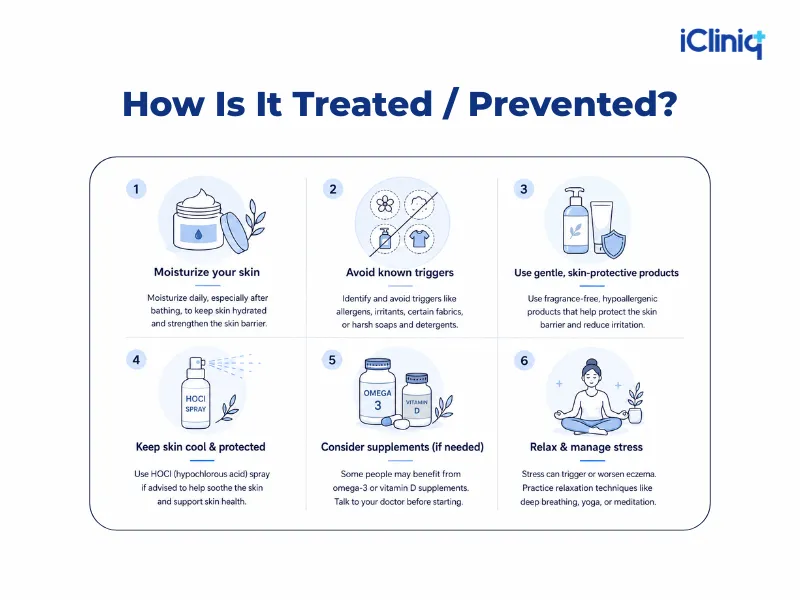
Moisturize your skin at least twice daily with suitable products, including bath oils, creams, ointments, or sprays.
-
Use lukewarm water for showers or baths instead of hot water.
-
You can use gentle soaps and other fragrance- and alcohol-free skincare products. Nonirritating, mildly acidic soaps are helpful for eczema.
Medicine:
-
Topical corticosteroids are effective in treating eczema. These steroids are available in various forms, such as gels, ointments, creams, and lotions, with the specific choice based on the patient's symptoms and severity, as determined by a dermatologist.
-
In more severe cases, dermatologists may consider topical calcineurin inhibitors. These help reduce skin inflammation through specific anti-inflammatory pathways.
-
For symptom relief, dermatologists may recommend antihistamines to address itching and burning sensations.
-
In severe or treatment-resistant cases, dermatologists may consider systemic immunomodulators or oral corticosteroids under careful medical supervision.
What Are the Modern Treatments for Eczema?
-
Phototherapy:
Ultraviolet (UV) light in sunlight has been proven to help treat certain skin conditions, including eczema. Phototherapy utilizes ultraviolet light, often ultraviolet B (UVB), from special lamps.
-
Probiotics:
Eczema is associated with poor gut and metabolic health. As a result, probiotics can improve your gut health and overall metabolism.
-
Oral Vitamin D:
Vitamin D supplements can improve your metabolism and reduce your allergic symptoms.
-
Biologics:
Biologics are newer medications that work by modulating specific parts of the immune system. They are typically considered in cases where standard treatments have not been effective and are prescribed by dermatologists based on individual patient needs.
How Can You Prevent Eczema?
Eczema can be prevented with basic skin care regimes, such as:
-
One can take a bath regularly, limiting it to not more than 10 minutes with warm, not hot water.
-
A person can use good moisturizers twice a day, such as shea butter, lotions, ointments, and creams.
-
After the bath, pat dry the skin and apply moisturizer immediately.
-
One should avoid using soap-based cleansers and use those that are free of alcohol, dyes, and fragrances.
-
Knowing your triggering factors and allergens is important. You must avoid these substances or these foods.
-
You can avoid wearing clothing or jewelry that can trigger eczema.
-
While going out, you can use an umbrella or a full-sleeved cloth to protect your skin. Because environmental factors are highly potent triggers of eczema, you should avoid dust and smoke.
-
Smoking and alcoholism can also trigger your eczema. As a result, you should avoid it.
-
Stress and anxiety are also significant triggering factors. That is why reducing your stress and anxiety can be helpful. Cognitive behavioral therapy (CBT) and meditation can reduce your stress and anxiety.
What Is the Outlook or Prognosis for People With Eczema?
Most children with eczema outgrow the condition or experience significant improvement by puberty. But unfortunately, others may continue to have some form of eczema. The condition can be well managed in adults with a good skin routine and treatment, although flare-ups can occur throughout life.
Conclusion
Eczema is a common immune skin disorder. It can be uncomfortable and affect the quality of life. However, in most cases, eczema is not a single entity and often presents with other immune conditions. As a result, proper treatment can not only manage your eczema but also improve the quality of your life. Modern medicines such as topical corticosteroids and antihistamines are very useful. Also, proper preventive measures can prevent your flare-ups. For any queries about treating eczema, you can talk to a skin care specialist for further evaluation.
Key Takeaways
-
Proper skin hydration, regular bathing, and moisturizing lotions can help with eczema.
-
Topical corticosteroids, antihistamines, and topical calcineurin inhibitors are commonly used to manage eczema symptoms under medical supervision.
-
Modern therapies, such as phototherapy or biologics, are also useful for eczema treatment.
-
Stress management, anxiety prevention, and smoking cessation can be effective in preventing eczema.

