
What Are Café Au Lait Spots?
Café au lait in French means “the light brown color of coffee with milk.” Café au lait spots, also called café au lait macules, giraffe spots, and the coast of Maine spots, are flat and hyperpigmented lesions found at birth (birthmarks). They are caused by the collection of melanocytes (pigment-producing cells) in the skin. They are usually light brown in color and can darken on sun exposure. The lesions typically have irregular borders, and the size and number can vary. They are usually the early signs of neurofibromatosis (a genetic disorder that results in benign growth in nerve tissues). Café au lait macules are very light in infants and can be challenging to diagnose. These lesions grow larger and become noticeable after two years of age.
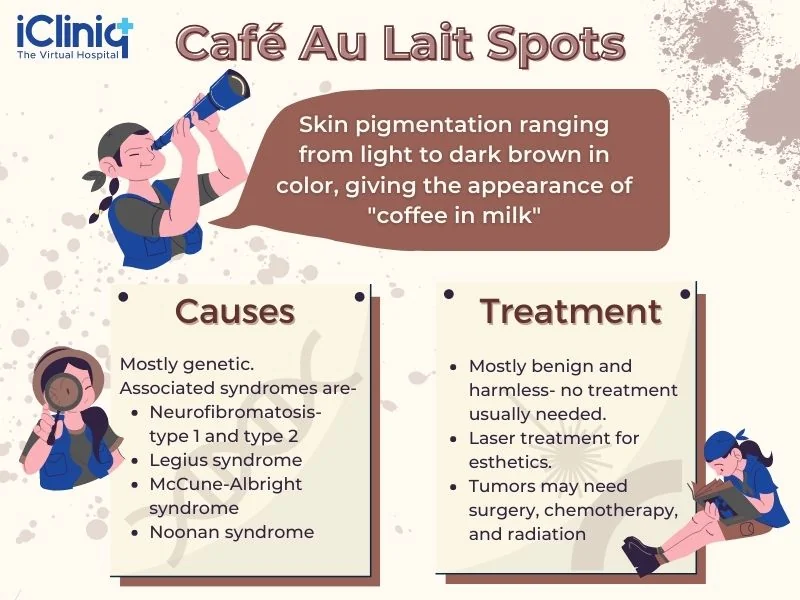
These macules are harmless in some, but in most, they indicate an underlying genetic disorder. Almost 95 % of neurofibromatosis type 1 (NF1) patients have café au lait spots, but they can also be seen in patients without NF1. Café au lait macules also occur in Coffin-Siris syndrome, McCune-Albright syndrome, Fanconi anemia, and tuberous sclerosis. These macules do not undergo malignant change. They are benign and do not cause mortality or morbidity, but the associated syndromes might cause severe complications.
.webp "Café Au Lait Spots")
What Are the Various Kinds of Café Au Lait Spots?
The shape and pattern of café au lait (CAL) spots distinguish two different categories.
-
The coast of California is the most prevalent type of CAL spot. The spot is bounded on all sides by smooth, precise lines that resemble the California shoreline in the United States. A single CAL spot or several spots with distinct edges are both possible.
-
The coast of Maine is a less popular type of CAL spot. The edges of the spots seem to be ragged and uneven, resembling the coastline of the U.S. state of Maine.
What Causes Café Au Lait Spots?
An increase in melanin production and the presence of giant melanosomes results in café au lait spots. The density of melanocytes in the café au lait spots is higher in patients with NF1 than in patients with isolated lesions without NF1. Furthermore, café au lait spots in NF1 have increased elevation in stem cell factor cytokines than café au lait spots without NF1.
These spots or macules are associated with the following genetic syndromes:
-
Neurofibromatosis Type 1 (NF1) - Almost 50 % of people with NF1 inherit a mutated gene on chromosome 17. This gene codes for neurofibromin, which suppresses tumors.
-
Neurofibromatosis Type 2 (NF2) - Similar to NF1, genetic mutations of the NF2 gene can also occur. This gene codes for Merlin protein (the function is still unknown).
-
Legius Syndrome - A syndrome caused by the mutation of the SPRED gene, which results in problems in the way cells of the body communicate.
-
McCune-Albright Syndrome - It is a syndrome caused by the mutation of the Gs protein, which affects the skin, bones, and several endocrine tissues.
-
Noonan Syndrome With Multiple Lentigines - Also known as LEOPARD syndrome, is caused by a mutation of the PTPN11 gene on chromosome 12.
The other rarer syndromes linked to café au lait spots include Watson syndrome (an uncommon genetic condition characterized by a low intelligence level, small stature, and cafe-au-lait spots), Bloom syndrome (an uncommon genetic condition that impacts immune function, growth, skin, and cancer risk), and Silver-Russell syndrome (an uncommon disorder linked to stunted growth before and after birth).
How Does a Café Au Lait Spot Look Like?
Café au lait spots are light brown in color, and the pigment is evenly distributed. These spots have well-demarcated borders, which are mostly irregular but can also be smooth. They can be oval or round.
The characteristics of café au lait spots can also help identify the underlying syndrome. For example:
-
NF1 - Six or more café au lait spots present in the trunk or extremities, the diameter of which should be greater than five millimeters (mm) in children and more than 15 mm in adults. Small café au lait spots in the axillary or inguinal regions.
-
NF2 - The main symptom includes unilateral or bilateral vestibular schwannoma. The primary skin lesion seen in NF2 is a firm subcutaneous neurilemmoma, and café au lait spots are less common.
-
Legius Syndrome - People with this syndrome have multiple café au lait spots, which measure more than five millimeters (children) and more than 15 mm (adults).
-
McCune-Albright Syndrome - Café au lait spots seen with this syndrome are less than in NF1, and the borders are more irregular. These spots are usually found in the midline of the body.
-
Noonan Syndrome With Multiple Lentigines - Multiple brown macules with well-demarcated borders measuring less than five millimeters are seen on the skin. They usually appear at birth and increase in number until puberty. These patients also develop café au lait spots.
When to Consult a Doctor for Café Au Lait Spots?
If individuals notice light brown color skin patches, make an appointment with a doctor to confirm if the spots are café au lait spots or some other pigmented lesion. A few CAL spots are normal, but more than six spots may indicate an underlying medical issue. Other signs of prevalent underlying diseases that manifest as CAL spots include:
-
Language and speech issues.
-
Tumors beneath the skin that are not malignant (neurofibromas).
-
Elevated blood pressure or hypertension.
-
ADHD (attention-deficit/hyperactivity disorder).
How Are Café Au Lait Spots Diagnosed?
There are no specific tests available to diagnose café au lait spots. The doctor can diagnose the condition based on the appearance of these patches and physical examination.
The doctor might not suggest any additional tests if they have one to three patches. But, if the spots are more than six (at least one measures 0.39 inches) and they have freckles in the groin and under the arms, the doctor might suspect neurofibromatosis or other genetic syndromes and will suggest getting genetic testing done. In case they test positive for a genetic disorder, further testing might be needed (X-ray, MRI (magnetic resonance imaging), ear examination, eye tests.) to rule out other complications of the syndrome.
What Are the Treatment Options for Café Au Lait Spots?
Treatment is usually not required for café au lait spots as they are benign and harmless. They can make these spots less noticeable by getting laser treatment using a pulsed-dye laser, Er: YAG (erbium-doped yttrium aluminum garnet laser) laser, Q-switched Nd: YAG laser (neodymium-doped yttrium aluminum garnet). But they can recur even after treatment.
If they have been diagnosed with neurofibromatosis or any other genetic syndromes, there is no cure. The doctor will suggest various treatment options based on the complications and symptoms they develop. And benign or malignant tumors due to any syndrome might need surgery, chemotherapy, and radiation.
Conclusion:
Café au lait spots are generally present at birth and permanent and can increase in number or grow in size over time. These spots are benign and do not cause any complications. But, the associated syndromes can result in severe complications, including malignant tumors. So, never ignore these spots, more importantly, if one has multiple patches on the body. They do not need treatment, but if one decides to get them removed, consult a dermatologist online now.
