- 1What Is Atopic Dermatitis?
- 2What Causes Atopic Dermatitis?
- 3What Are the Clinical Features of Atopic Dermatitis?
- 4What Increases the Risk of Developing Atopic Dermatitis?
- 5How Is Atopic Dermatitis Diagnosed?
- 6What Is the Treatment of Atopic Dermatitis?
- 7What Are the Complications of Atopic Dermatitis?
- 8How Can We Prevent Atopic Dermatitis?
- 9Conclusion
- 10Key Takeaways
What Is Atopic Dermatitis?
Atopic dermatitis (AD) is a chronic skin disorder. It is not contagious (it cannot be passed from one person to another). It involves severe itching, very dry skin, and recurring skin rashes. It is a form of eczema that occurs due to internal factors, like genes (inherited characteristics) and the body’s immune system, not because of what touched the skin.
These are usually found together in people. They can be passed down from parents, meaning they can be inherited. Atopic dermatitis typically begins in infants or toddlers. It can persist into adulthood. The areas of the body affected may vary depending on the individual’s age. Atopic dermatitis can flare up during winter, due to dust mites, pollen, stress, sweating, infections, and certain foods (in some individuals).
Atopic dermatitis is part of the “atopic triad.” This consists of:
- Eczema (skin condition with itching).
- Asthma (breathing problem).
- Allergic rhinitis (hay fever, sneezing, and a runny nose from allergies).
If the scratching continues on the itchy areas of the skin, it can weaken the skin’s protective barrier. As a result, bacteria can easily penetrate the skin and cause infections. In some children, atopic dermatitis may progress into a severe skin infection known as eczema herpeticum or Kaposi varicelliform eruption. This occurs as a result of the herpes simplex virus.
What Causes Atopic Dermatitis?
Atopic dermatitis results from a combination of genetic, immune system, and environmental factors. Recent studies have identified that mutations in a gene called filaggrin are also important. Filaggrin is a protein that helps maintain the integrity of the outer layer. It works like a shield, retaining moisture. If this protein is not functioning properly, the skin loses moisture easily, becomes dry, and allows entry of allergens (substances that cause allergies) and irritants easily.
Atopic dermatitis patients also have an overactive immune system. This means that the body overreacts to even harmless stimuli. Research has identified that certain immune system chemicals called interleukins (IL-4, IL-13, and IL-31) are involved. These chemicals cause increased itching and skin inflammation (redness and swelling). Because of this breakthrough, doctors have been able to create medicines that target these chemicals specifically.
Environmental factors also contribute to atopic dermatitis. These include pollution, climate change, urbanization, and exposure to allergens, which are thought to contribute to the rising incidence of atopic dermatitis worldwide.
What Are the Clinical Features of Atopic Dermatitis?
Symptoms of atopic dermatitis include the following:
- Itching that may be intense at night.
- Tiny, elevated bumps on the skin that crack open and release fluids upon scratching.
- Skin dryness.
- Patches range from red to brownish-gray and are commonly seen on the upper chest, ankles, feet, arms, eyelids, wrists, neck, elbows, face, and scalp.
- Scratching results in thin, raw, sensitive, and swollen skin.
- Skin becomes thick, scaly, and cracked.
Three distinct patterns of atopic dermatitis have been recognized depending on the patient's age:
-
Atopic Dermatitis in Infancy (Infantile Eczema):
Atopic dermatitis in babies begins after the age of three months. Lesions are intensely itchy papules and vesicles, which soon discharge serous fluid. Lesions begin on the face but can involve the rest of the body. But, usually, there is sparing of the diaper area, and secondary infection is common.
-
Childhood Phase:
Dry, leathery, and extremely itchy, raised areas (plaques), mainly on the elbow and knee flexors. Sometimes, a reversed (extensor) pattern may be seen.
-
Adult Phase:
Lesions are very itchy and lichenified, resembling tree bark. It involves the cubital (front of the elbow), popliteal fossa (back of the knee), and sometimes the neck. A low-grade involvement may be seen in the rest of the body. Discoid patterns (coin-shaped) of eczema may be seen.
What Increases the Risk of Developing Atopic Dermatitis?
Some people are more likely to get atopic dermatitis. You are at a higher risk if you have eczema, asthma, hay fever, or allergies, and a member of your family has eczema, asthma, hay fever, or allergies. Other risks that may be present are living in cities (urban lifestyle), exposure to pollution, and taking antibiotics in early life. These increase a person's risk of developing the condition.
How Is Atopic Dermatitis Diagnosed?
A visual examination is performed to diagnose atopic dermatitis, along with a medical history. If needed, patch skin tests can be taken to rule out other skin conditions. Also, it is essential to look for potential allergens.
What Is the Treatment of Atopic Dermatitis?
Treatment involves repairing the skin barrier, decreasing redness and swelling (inflammation), relieving itching, and preventing infection.
Conventional Treatment
The key to treatment is moisturizers. These should be used daily, even if the skin appears clear. Applying moisturizers (emollients) after bathing helps to retain moisture in the skin and prevent it from drying out.
During flare-ups (sudden worsening of symptoms), topical corticosteroids (medicated creams or ointments) are the primary treatment. They work quickly to decrease redness, swelling, and itching when used properly.
There are also non-steroid alternatives called topical calcineurin inhibitors. These are particularly helpful for sensitive areas like the face and eyelids, where potent topical steroids may not be ideal.
Advanced Treatments
For patients with moderate to severe atopic dermatitis who do not respond to conventional treatments, advanced treatments are available.
Biologic therapies are newer treatments that target specific pathways within the immune system and are increasingly used in moderate-to-severe cases that are unresponsive to standard therapies.
Oral JAK (Janus Kinase) inhibitors can quickly alleviate itching in moderate to severe cases and are now widely approved in many countries.
These novel treatments have significantly improved the quality of life for patients with severe atopic dermatitis.
Counseling and Psychotherapy
Not only can stress aggravate atopic dermatitis, but the severely affected child is also a source of stress for the whole family. Counseling is an integral part of the treatment. Counseling parents for do’s and don’ts when the patient is a child will help them lead a stress-free life. Adolescents with atopic dermatitis should be well-advised that this disease often improves or goes into remission with age. They should avoid occupations such as car mechanics, engineering, hairdressing, or nursing.
What Are the Complications of Atopic Dermatitis?
-
Asthma and Hay Fever:
Atopic dermatitis often precedes allergy and hay fever, and is seen in more than 50 percent of children over the age of 13.
-
Skin Infections:
Repetitive scratching opens the pores and creates a cracked appearance, increasing the risk of bacterial and viral infections, particularly herpes simplex.
-
Problems With Sleep:
Disturbances in the sleep pattern are seen with the presence of the itch-scratch cycle.
-
Neurodermatitis:
Itching is associated with neurodermatitis, which gradually intensifies, resulting in thick, scaly, leathery, and discolored skin.
-
Irritant Contact Dermatitis:
People exposed to soaps, irritants, and detergents, as well as those who work in damp areas, develop irritant contact dermatitis.
-
Allergic Contact Dermatitis:
Individuals with atopic dermatitis are prone to developing allergic contact dermatitis if their skin reacts to substances such as metals, perfumes, cosmetics, hair dyes, or preservatives used in skincare products.
Treatment for Complications
If the skin becomes infected, the doctor may prescribe oral antibiotics. In some severe cases, the doctor may prescribe short courses of systemic corticosteroids. However, these are not recommended for long-term use. Sedating antihistamines (anti-allergic medications that cause drowsiness) may help patients sleep better if they have severe itching at night.
How Can We Prevent Atopic Dermatitis?
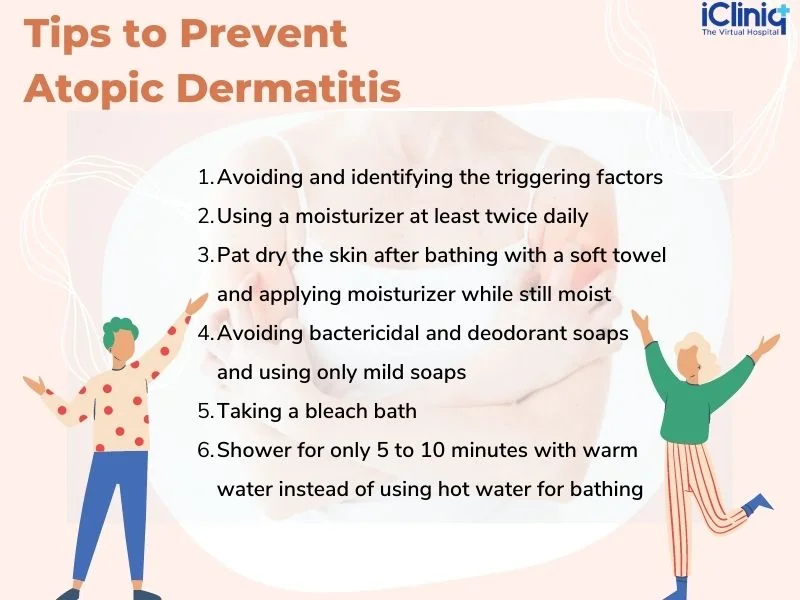
Although atopic dermatitis cannot be prevented, it can be controlled by proper care. It is very important to moisturize the skin daily to keep it healthy. It is also important to take short showers with lukewarm water rather than hot water, and to use gentle cleansers rather than soap.
After bathing, it is also important to pat the skin dry rather than rub it, and to apply moisturizer immediately to keep the skin hydrated. It is also essential to avoid environmental exposure, reduce stress, and live a healthy lifestyle.
Conclusion
Atopic dermatitis is a chronic skin condition that can be effectively controlled. It is not an infectious disease, so it is not passed from one individual to another. With proper skin care and the help of modern treatments such as biologics and JAK inhibitors, it is possible to control it effectively. Early treatment, awareness about the condition, and a regular treatment regimen are the keys to maintaining it in the long run. If the symptoms do not respond to treatment or start worsening, it is always better to consult a skin care specialist for advice.
Key Takeaways
- Atopic dermatitis is a chronic, itchy, and non-contagious skin condition.
- Associated with genetic factors and the immune system changes.
- Moisturizing and avoiding triggers can prevent flare-ups.
- Topical steroids can be used to control flare-ups.
- Biologics and JAK inhibitors can be used for severe cases.
- Early treatment and referral to a dermatologist can prevent complications.