Table of Contents
- 1What Is Alopecia Mucinosa?
- 2What Are the Causes of Alopecia Mucinosa?
- 3What Are the Clinical Manifestations of Alopecia Mucinosa?
- 4What Is the Pathophysiology of Alopecia Mucinosa?
- 5What Is the Differential Diagnosis of Alopecia Mucinosa?
- 6How Is Alopecia Mucinosa Diagnosed?
- 7How Is Alopecia Mucinosa Treated?
- 8What is the Prognosis of Alopecia Mucinosa?
What Is Alopecia Mucinosa?
Alopecia mucinosa, is also called mucinosis follicularis, follicular mucinosis, and Pinkus’ follicular mucinosis. This condition has a predilection for children and adults in the third and fourth decades of life. It is an uncommon inflammatory disorder that was described in 1957 by Pinkus. The condition can be distinguished by bald patches of skin with prominent hair follicles. The mucin formation around hair follicles could be seen under the microscope. It is unclear why dermal-type mucin is deposited selectively within an epithelial structure. However, follicular keratinocytes have been considered the source of mucin.
Mucins appear as stringy, clear, or whitish and are mainly composed of hyaluronic acid, a standard ingredient of the ground substance covering the collagen in the dermis. There are several other forms of mucinosis, and they are:
-
Pinkus type - A primary and acute disorder in children and adolescents.
-
A primary and chronic disorder occurs in people over 40 years of age.
-
Secondary disorder - It is associated with benign or malignant skin disease.
-
Urticaria-like follicular mucinosis (rare).
What Are the Causes of Alopecia Mucinosa?
The exact cause of alopecia mucinosa is not known. However, it may react with circulating immune systems and cell-mediated immunity, including a reaction to persistent antigens such as Staphylococcus aureus. In the follicle, the mucin, composed of hyaluronate and sulfated glycosaminoglycans, disrupts cellular attachments and destroys the pilosebaceous subunit. It then deposits in hair follicles and sebaceous glands to construct an inflammatory condition that later breaks down the ability of the affected hair follicles to produce hair. With this loss of the follicle, alopecia becomes evident clinically.
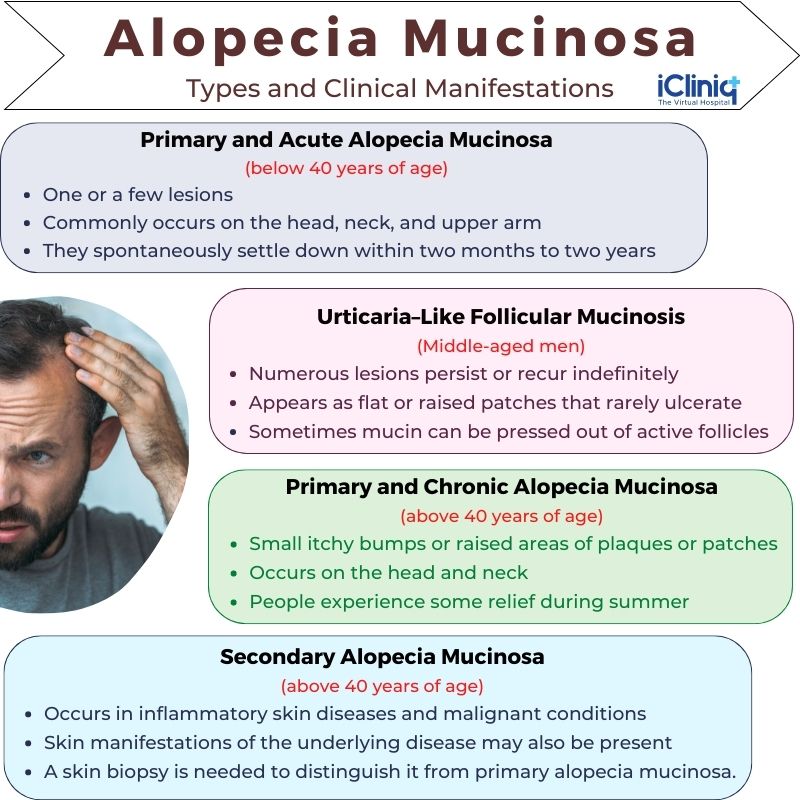
What Are the Clinical Manifestations of Alopecia Mucinosa?
Alopecia mucinosa can occur in any part of the body, but it most commonly occurs in the head and neck region.
-
It occurs as red, scaly patches.
-
Usually, patches are up to five centimeters in diameter but can also be more significant.
-
One or more lesions may be present at the onset, and over a few weeks or months, a single lesion may develop into multiple lesions.
-
During the early stages, bald patches can be reversed, and they would be non-scarring, but in more advanced cases, the hair follicles are destroyed, causing alopecia scarring.
The clinical manifestations of several other forms of mucinosis are:
What Is the Pathophysiology of Alopecia Mucinosa?
There is still a controversy on whether the disease is a reactive or neoplastic process. Some researchers suggest that alopecia mucinosa is, in fact, a form of cutaneous T-cell lymphoma with a benign or unpredictable course, while others state that it may be a cutaneous T-cell lymphoid dyscrasia. This occurs due to dysfunctional T cells producing mucin by fibroblasts surrounding follicular epithelium or excess mucin production by follicular keratinocytes. Mucin accumulates within the follicular epithelium and sebaceous glands, causing keratinocytes to disconnect. In more advanced lesions, the follicles are converted into cystic spaces containing mucin, inflammatory cells, and altered keratinocytes. A perifollicular infiltrate of lymphocytes, histiocytes, and eosinophils can be seen.
What Is the Differential Diagnosis of Alopecia Mucinosa?
The differentiation between mycosis fungoides-associated follicular mucinosis and primary follicular mucinosis is challenging, and there are no reliable criteria. Although many investigators have questioned the existence of a primary form of follicular mucinosis, features in favor of a primary form are:
-
The young age of the patient.
-
A solitary plaque or a limited number of lesions in the head and neck region.
-
The spontaneous resolution of epidermotropism and atypical lymphocytes.
Secondary causative factors of mucinosis follicularis, like granuloma fungoides, cannot be diagnosed for years, and it needs detailed follow-ups and investigations.
Some other conditions that are considered in the differential diagnosis enclose:
-
Alopecia areata causes non-scarring localized hairless plaques.
-
Psoriasis, seborrhoeic dermatitis, and tinea capitis cause dry patches and baldness.
-
Lichen planopilaris and discoid lupus erythematosus cause localized areas of scaling and scarring in alopecia.
How Is Alopecia Mucinosa Diagnosed?
With the clinical manifestations of alopecia mucinosa and supported by histopathological findings on biopsy, it could be diagnosed by:
-
Inflammation.
-
Mucin accumulation in the pilosebaceous follicle and oil gland.
-
Degeneration of follicular structures.
-
Keratinous debris inside a cystic cavity.
The microscopic findings of the underlying disease are manifested in secondary alopecia mucinosa.
How Is Alopecia Mucinosa Treated?
It is said that alopecia mucinosa has no reliable adequate treatment, and doctors find it difficult to treat this condition. Primary and acute follicular mucinosis that normally occurs in children will fix automatically on its own. As the other forms of the disease also have a small chance of spontaneous resolution, the effect of the treatment is quite difficult to interpret. The following are the treatment methods that have been tried with a limited success rate.
They are:
-
Oral antibiotics such as Minocin.
-
Topical and systemic corticosteroids.
-
Dapsone.
-
Interferons.
-
Topical and systemic photochemotherapy (PUVA).
-
UVA1 phototherapy.
-
Topical nitrogen mustard.
-
Intralesional steroids.
-
Radiation therapy.
-
Topical Bexarotene 1 percent gel.
-
Indomethacin.
In the case of secondary alopecia mucinosa, it should be treated appropriately for the underlying skin disease, especially if it is cutaneous T-cell lymphoma (CTCL).
What is the Prognosis of Alopecia Mucinosa?
The prognosis of alopecia mucinosa may depend on the type of clinical presentation. They include:
The primary acute disease generally goes away within two years. It was found that childhood alopecia mucinosa does not self-limit. This may be related to Hodgkin's disease. The primary chronic disease is generally present for many years. The extent of skin involvement may vary at any given time. Secondary alopecia mucinosa has the least favorable prognosis if linked to coexistent malignancy. If secondary alopecia is linked with the coexistence of mycosis fungoides, mortality can be expected.
It was estimated that 15-40 percent of adult individuals with alopecia mucinosa may develop lymphoma slowly if they do not have it. The malignant potential of alopecia mucinosa cannot be assessed due to its enigmatic nature and T-cell abnormalities. The morbidity of primary alopecia mucinosa is confined to cosmesis. In the case of secondary alopecia mucinosa, morbidity is linked to the associated disease process.
Reports from a single cancer center showed that individuals with alopecia mucinosa along with hematologic malignancies showed clinical differences from alopecia mucinosa with mycosis fungoides.
Conclusion:
Alopecia mucinosa is a rare disorder and may be difficult to diagnose initially. However, it is a treatable condition and can occur at a particular age, depending on the type of alopecia mucinosa. Healthcare professionals should be careful during physical examinations because of their rare incidence. In addition, people experiencing new symptoms should consider it seriously and reach a doctor early to avoid future complications.

