Table of Contents
- 1What Does Foreign Body Ingestion Mean?
- 2What Are the Commonly Ingested Foreign Bodies by Children?
- 3How Do Ingested Foreign Bodies Affect Children’s Health?
- 4What Are the Symptoms of Ingested Foreign Bodies?
- 5What Are the Common Sites of Foreign Body Impaction?
- 6How to Diagnose Ingested Foreign Bodies?
- 7How to Treat Ingested Foreign Bodies?
- 8What Are the Complications of Ingested Foreign Bodies?
Introduction
Children tend to put objects into their mouth, especially during their teething. Children between six months and three years are more likely to ingest or swallow objects from outside, such as toys, magnets, and batteries. Ingestion of foreign bodies occurs less in older children and adults.
Foreign bodies are inedible objects that are swallowed by children accidentally. However, it is also seen in adults. Coins are the most commonly ingested foreign body by children. These foreign bodies create obstructions in the food pipe or esophagus. Sometimes, these may also cause perforations in the stomach wall. If the child is asymptomatic, it may not require immediate treatment, but if symptoms are present, then a quick removal of the object is the ultimate treatment.
What Does Foreign Body Ingestion Mean?
Foreign body ingestion is the swallowing of inedible objects by children accidentally. These objects may be made of plastic, metal, or other material that may harm the body.
What Are the Commonly Ingested Foreign Bodies by Children?
The commonly ingested foreign bodies by children are:
-
Button battery.
-
Magnets.
-
Food bolus impaction.
-
Sharp or blunt objects.
-
Coins.
-
Objects made from absorbent polymers.
How Do Ingested Foreign Bodies Affect Children’s Health?
Depending on the type of object ingested, it affects the children’s health differently, as mentioned below:
-
Button Battery: These are small, coin-shaped, or disc-shaped batteries used in various electronic devices. These batteries are made of mercury and increase the levels of mercury in the body upon ingestion. It also leads to injury of the esophagus, perforation, paralysis of the vocal cord, and so on. These also contain electrical charges and, therefore, cause chemical reactions in the body.
-
Magnets: Children are more likely to ingest or swallow magnets present in toys. These cause injury to the gastrointestinal tract because of five times more attraction or magnetic forces than traditional magnets. Generally, these magnets are made of neodymium, which has great potential to injure the esophagus of children. These magnets look shiny and smaller in size and look attractive to children.
-
Sharp or Blunt Objects: Nails, pins, and toothpicks are a few commonly ingested pointy or sharp objects. These objects cause perforations on the intestines, especially in the ileum, colon, and duodenum (parts of the small and large intestines).
-
Food Bolus Impaction: Children commonly ingest big chunks of food, especially meat. These obstruct the esophagus.
-
Coins: Because coins are small, flat, and disc-shaped, they are easily swallowed and reach the stomach or intestine. Sometimes, these may get stuck in the esophagus. If a coin does not obstruct the digestive path, it easily comes out through the excretion of stool. It commonly causes zinc toxicity in the body. Coins are the most frequently ingested object by children.
-
Objects Made From Absorbent Polymers: Superabsorbent polymers are materials that absorb water more than 100 times from their surrounding environment. These are commonly used in various personal care products and agricultural products. These materials obstruct the bowel because they expand by absorbing water from the surrounding tissues upon ingestion.
What Are the Symptoms of Ingested Foreign Bodies?
The symptoms of ingested foreign bodies may vary from patient to patient. In general, the patient suffers from the following:
-
Bleeding in saliva.
-
Cough.
-
Difficulty swallowing.
-
Feeling of obstruction in the throat.
-
Pain in the chest and neck.
-
Irritation.
-
Vomiting.
-
Inflammation or infection of the appendix.
What Are the Common Sites of Foreign Body Impaction?
After swallowing a foreign body, it most commonly gets impacted in the upper part of the esophagus. Other sites are the ileum, appendix, junction of duodenum, and jejunum.
How to Diagnose Ingested Foreign Bodies?
History of Ingestion: Detailed information about ingesting the foreign body, such as the type of foreign object and timing of ingestion, must be asked carefully. The various symptoms and their onset play an essential role in planning treatment. For example, coin ingestion commonly does not create symptoms in a child and comes out of the body through excretion. This may not require an immediate treatment plan. The details of the ingestion include the following points:
-
Time of ingestion is important if the button battery or magnet is ingested.
-
The size of the object plays an important role. If the object is more than two centimeters in size, it has fewer chances of passing the stomach. If the size is more than six centimeters, it has a greater chance of getting impacted.
-
The shape of objects, such as round or sharp. The sharp object may create perforations.
-
The onset of symptoms such as vomiting within 1.5 hours of ingesting a lead object.
Physical Examination: The doctor may examine the child's stomach by applying gentle pressure. This may reveal the severity of the pain, if at all present, and tenderness. The doctor may examine the child's tonsils if an object is stuck in the tonsil region.
Imaging Tests: The commonly performed imaging tests are mentioned below:
-
X-ray: A radiograph or x-ray of the esophagus, chest, neck, and stomach helps locate the object. Most of the objects show a contrasting image in the x-ray. It also helps to identify the size, shape, and even number of objects ingested. If the foreign object is made of wood, plastic, or a thin metal sheet, it may not be seen in the x-ray and requires other imaging tests.
-
Computed Tomography Scan: It may help identify undetected objects with an x-ray. However, if the object is radiolucent (which allows the x-rays to pass through, such as soft tissues), the object will not be seen in the computed tomography scan.
-
Metal Detector: If the ingested object is metallic, rarely a metal detector is used. It is a device used to detect the presence of metal in the surrounding area.
How to Treat Ingested Foreign Bodies?
If the child does not show symptoms after ingesting a foreign body, it may not require immediate treatment or emergency surgery. However, monitoring the child’s health and the onset of symptoms must be considered. Sometimes, the ingested object comes out from the body within 4-6 days. If the child is not able to pass the object out from the body, then it requires an adequate surgical treatment as mentioned below:
Endoscopy: It is a flexible, thin tube inserted into the patient’s body to visualize the internal structures. It has a camera and a light through which the doctor visualizes the images on a screen. Endoscopy is commonly used as a diagnostic tool in various conditions but also to remove ingested objects. According to the American Society of gastrointestinal endoscopy, foreign bodies are divided into three categories to perform an endoscopic treatment:
Immediate Endoscopic Removal Is Indicated In:
-
Obstruction in the esophagus.
-
The ingested disc-shaped battery in the esophagus.
-
Sharp pointy objects in the esophagus.
Urgent Endoscopic Removal (Within 24 Hours of Ingestion) Is Indicated In:
-
Sharpless and pointless objects in the esophagus.
-
Impacted food in the esophagus.
-
Objects that are greater than six centimeters are present in the duodenum.
-
Magnets.
Non-urgent Endoscopic Removal Is Indicated In the Following:
-
Coins.
-
Objects present in the stomach that are greater than 2.5 cm.
-
Disc and cylinder-shaped battery.
Surgery: Foreign objects that are impacted or are more likely to cause complications may require surgical removal. If the child has symptoms such as vomiting, fever, or pain, then emergency surgery must be performed for immediate removal.
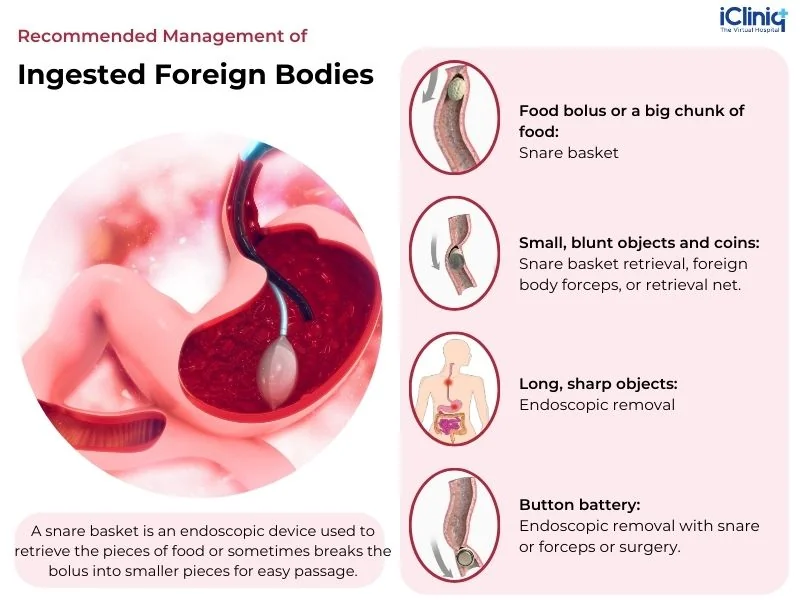
Retrieval Device: It is a medical device designed to remove a foreign object by grasping it. Standard retrieval devices include alligator forceps, snare baskets, and retrieval nets. Based on how to grasp the object, a retrieval device is selected.
Overtube: It is used to assist endoscopy. It is a semi-flexible tube that protects the esophagus from damage and perforation.
The summary of recommended management of ingested foreign bodies is given below:
What Are the Complications of Ingested Foreign Bodies?
The possible complications are:
-
Perforation of the esophagus and stomach.
-
Collapsing of lungs because of air leakage.
-
Inflammation or damage to the stomach lining.
-
Abnormal connection between the aorta and bowel (aortoenteric fistula).
Conclusion
The children commonly swallow foreign bodies such as coins, magnets, batteries, and sharp objects. Generally, coins and other blunt small objects do not show any symptoms in the patient and are easily passed out from the body with the stool. The absence of symptoms indicates less urgent or non-urgent treatment and sometimes no treatment. However, if symptoms such as vomiting, fever, difficulty swallowing, and so on are present, immediate surgical removal of the foreign body or object is required. Foreign bodies rarely cause complications, but timely treatment is essential.

