Table of Contents
- 1What Is Rheumatoid Arthritis?
- 2What Are the Types of Rheumatoid Arthritis?
- 3What Are the Symptoms of Rheumatoid Arthritis?
- 4What Causes Rheumatoid Arthritis?
- 5What Are the Risk Factors for Rheumatoid Arthritis?
- 6What Are the Stages of Rheumatoid Arthritis?
- 7What Are the Conditions Associated with RA?
- 8How Is Rheumatoid Arthritis Diagnosed?
- 9How Is Rheumatoid Arthritis Treated?
- 10What Are the Complications of Rheumatoid Arthritis?
- 11
What Is Rheumatoid Arthritis?
Rheumatoid arthritis (RA) is an autoimmune disorder that causes chronic inflammation and joint pain throughout the body. It is a long-term and disabling disease. This disease usually affects the joints of the hands and feet first, and if one side of the joint is affected, it is most likely to affect the other side too.
What Are the Types of Rheumatoid Arthritis?
The common types of RA are:
- Seropositive Rheumatoid Arthritis - 60 % to 80 % of patients test positive for antibodies called anti-cyclic citrullinated peptides (anti-CCPs) or rheumatoid factor (RF).
- Seronegative Rheumatoid Arthritis - Patients test negative for anti-CCPs and rheumatoid factors but still show symptoms of rheumatoid arthritis.
What Are the Symptoms of Rheumatoid Arthritis?
The symptoms of rheumatoid arthritis are:
- Pain, tenderness, stiffness, swelling, redness, and warmth on involved joints, usually in a symmetrical manner.
- Walking with a limp.
- Loss of joint function.
- Small joints, such as the joints in the fingers and toes, are usually affected first. In later stages, it spreads to the wrist, knee, ankle, hips, shoulders, and elbows.
- Sometimes, people with rheumatoid arthritis might notice a rheumatoid arthritis rash and other symptoms, such as joint pain and swelling. This rash usually looks red and blotchy, often on the arms or legs. It can be a sign of active inflammation in the body, though not everyone with RA experiences it. Remember that the rheumatoid arthritis rash can vary from person to person, and it might not always be a clear indication of something serious.
The symptoms of rheumatoid arthritis aggravate during periods known as flares, and they disappear during the remission period. The symptoms of rheumatoid arthritis can be mild to severe for different patients.
What Causes Rheumatoid Arthritis?
When the immune system attacks the membrane lining the joints (synovium), it leads to inflammation and thickening of the synovium. This inflammation eventually affects the cartilage and bone in the joint. The tissues holding the bones in the joint together (ligaments and tendons) stretch and weaken, making the joints lose shape and alignment.
Pathophysiology:
The three phases in which RA progresses are:
- Initiation phase.
- Amplification phase.
- Chronic inflammatory phase.
What Are the Risk Factors for Rheumatoid Arthritis?
Factors that increase the risk of an individual acquiring RA are:
- Age - Its onset is highest in older adults (60 years and above), but it can begin at any age.
- Sex - Women are two to three times more prone than men.
- Women who have never given birth.
- Children of mothers who smoked while pregnant.
- Genetics - Rheumatoid arthritis has genetic manifestations, including individuals born with the HLA (human leukocyte antigen) gene who are more susceptible. This, along with exposure to environmental factors, can increase the risk of RA.
- Smoking.
- Obesity.
What Are the Stages of Rheumatoid Arthritis?
- Stage 1 Early Stage Rheumatoid Arthritis - Joint pain, stiffness, or swelling. No damage to the bones, and only the tissue lining the joint (synovium) is inflamed.
- Stage 2 Moderate Stage Rheumatoid Arthritis - Inflammation of the synovium damages the joint cartilage, resulting in joint pain and loss of mobility.
- Stage 3 Severe Stage Rheumatoid Arthritis - In this stage, the bone also gets damaged. This results in severe pain and swelling, more loss of mobility, and bone deformity.
- Stage 4 End-stage Rheumatoid Arthritis - The joints do not work, resulting in pain, stiffness, swelling, and loss of mobility. The bones might also fuse (ankylosis).
What Are the Conditions Associated with RA?
It has been noted that people with RA commonly develop the following conditions:
-
Osteoporosis - The bone becomes porous and prone to fractures.
- Rheumatoid Nodules - Firm lumps form under the skin near the joints affected by RA.
- Sjogren’s Syndrome - An autoimmune condition where the immune system cells attack the glands that produce tears and saliva.
- Frequent infections.
- Atherosclerosis - A condition where fat or plaque builds up inside the arteries.
- Lymphoma - A type of cancer that originates in the lymphocytes.
- Carpal Tunnel Syndrome - Otherwise called median nerve compression, results in pain and numbness in the hand and arm.
- Cervical Myelopathy - It is a degenerative condition that results from compression of the spinal cord.
- Depression and anxiety.
How Is Rheumatoid Arthritis Diagnosed?
Blood tests and imaging tests detect rheumatoid arthritis. If you have symptoms of rheumatoid arthritis, consult a rheumatologist. The doctor will ask you about the symptoms you are having and will conduct a few physical examinations. The doctor will look for redness, tenderness, and warmth in the affected joint. To rule out all other causes and to check the damages done to your bones, he or she might order some blood and other tests.
You might have to get the following tests done:
- Blood Test - A blood test for rheumatoid arthritis is done to look for the presence of rheumatoid factor and anti-CCP antibodies. C-reactive protein and erythrocyte sedimentation rate (ESR) are also elevated in RA patients.
- Imaging Tests - To monitor the progression of the disease, X-rays, MRIs (magnetic resonance imaging), and ultrasounds are performed.
How Is Rheumatoid Arthritis Treated?
Start rheumatoid arthritis medications early, and keep the disease in remission period.
Rheumatoid arthritis treatment options include:
Medicines:
- Nonsteroidal Anti-inflammatory Drugs (NSAIDs) - NSAIDs like Ibuprofen and Naproxen sodium are used to reduce pain.
- Corticosteroids - Prednisone helps reduce inflammation and slows the progression of joint damage.
- Disease-Modifying Antirheumatic Drugs (DMARDs) - Methotrexate, Leflunomide, and Sulfasalazine reduce the progression of this disease.
- Biologic Response Modifiers - Abatacept, Adalimumab, Infliximab, Rituximab, Etanercept, etc.—are a new class of DMARDs.
- Occupational Therapy - An occupational therapist will teach exercises to make your joints more flexible and easier to move during day-to-day activities.
- Surgery - In case your symptoms are not getting better with rheumatoid arthritis medications and therapies, your doctor might suggest you undergo the following surgeries to repair damaged joints:
- Synovectomy - The inflamed synovium is removed.
- Tendon Repair - The inflamed and loosened or ruptured tendons are repaired.
- Joint Replacement - Damaged joints are replaced by prostheses.
- Joint Fusion - When replacement cannot be done, the joints are fused to reduce pain.
Lifestyle Changes:
- Perform regular gentle exercises like walking, swimming, water aerobics, etc.
- Apply heat and cold compressions.
- Manage stress through yoga and meditation.
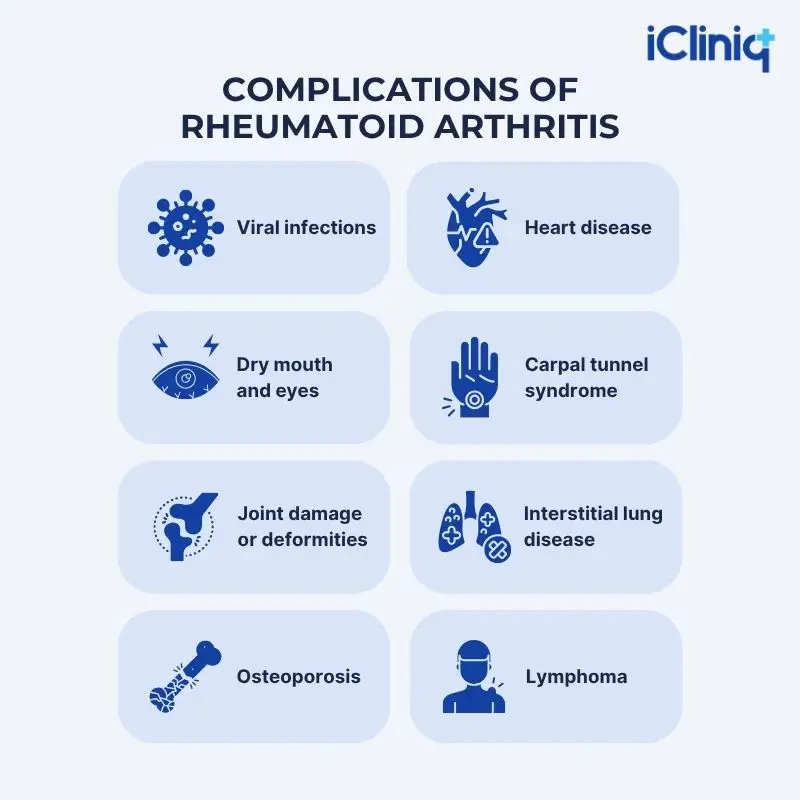
What Are the Complications of Rheumatoid Arthritis?
If left untreated, rheumatoid arthritis can cause a range of complications, such as:
- Joint damage or deformities.
- Dry mouth and eyes.
- Carpal tunnel syndrome.
- Heart disease.
- Interstitial lung disease.
- Osteoporosis.
- Lymphoma.
- Viral Infections.
Conclusion:
Rheumatoid arthritis is a tough condition that goes beyond just joint pain. It can mess with your whole body, leading to inflammation, stiffness, and disability if left unchecked. The earlier it is caught, the better the chances of managing it and avoiding long-term damage. People can still live a good life with the right treatment and lifestyle changes, even with RA. It is key to see a doctor if you notice any symptoms; catching it early can make a huge difference. RA might be challenging, but managing it and moving forward with the proper care is possible.