Table of Contents
What Is Autoimmune Hemolytic Anemia?
Autoimmune hemolytic anemia (AIHA) is a rare type of anemia that can occur at any age. Due to the immune system malfunctioning, autoantibodies are produced in the body that attacks the red blood cells. As a result, hemolysis of red blood cells is at a higher rate than its production, leading to anemia. The incidence of this condition is more in females than in males. This condition occurs suddenly or may develop gradually. The exact cause of autoimmune hemolytic anemia is unknown. However, it may appear along with the usage of some medication or with some disorders like lymphoma. If it is due to a virus attack, it may subside after some time. But in other cases, it can persist. Blood tests are the most accurate diagnostic tool for this condition. The primary strategy in the treatment involves immunosuppression.
What Are the Types of AIHA?
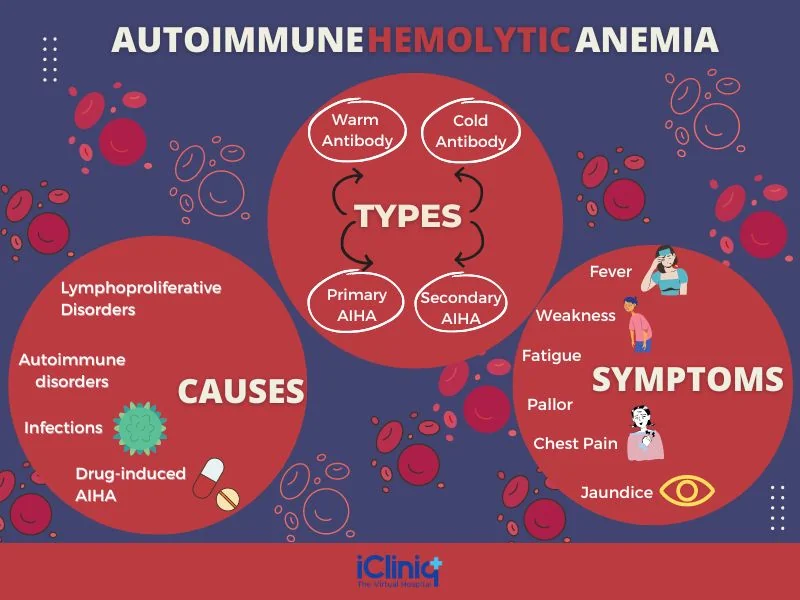
1.The two types of AIHA based on the temperature of antibody reaction are;
-
Warm Antibody Hemolytic Anemia: In this condition, the autoantibodies attach to the red blood cells and destroy it at a temperature equal to the body temperature or above it. It is the most common type of AIHA.
-
Cold Antibody Hemolytic Anemia: In this condition, autoantibodies against red blood cells are activated only at a temperature significantly below the average body temperature. Paroxysmal cold hemoglobinuria is a rare type of cold antibody hemolytic anemia in which red blood cells are destroyed even if the cold exposure is limited to a small area of the body.
2.It is also classified as;
a.Primary AIHA: This type of AIHA appears on its own.
b.Secondary AIHA: It mainly occurs due to the other illness the individual is suffering from.
What Are the Causes for AIHA?
The causes of AIHA are not well known. If it is primary AIHA, the illness is idiopathic. If it is secondary AIHA, it can be due to various reasons as follows;
1.Lymphoproliferative disorders like lymphoma and chronic lymphocytic leukemia.
2.Autoimmune disorders like systemic lupus erythematosus, Crohn’s disease, etc.
3.Some infections like viral pneumonia, infectious mononucleosis, etc.
4.Drug-induced AIHA due to drugs like Penicillin.
What Is the Pathophysiology of AIHA?
The primary antibodies involved in AIHA are immunoglobulin G (IgG) and immunoglobulin M (IgM). IgG AIHA involves phagocytosis of red blood cells, which takes place in the spleen. Phagocytic AIHA is also known as extravascular AIHA. IgM AIHA involves complement-mediated lysis of red blood cells, which takes place in Kupffer cells. Complement-mediated AIHA is known as intravascular AIHA. The most commonly observed AIHA is extravascular.
What Are the Symptoms of AIHA?
Symptoms of AIHA depend on the severity of the disease. If the disease is mild, the patient may remain asymptomatic. As the disease progresses, fatigue, weakness, pallor, and anemia can develop. Fever, chest pain, jaundice, shortness of breath, and even death can occur in severe cases. When the disease is chronic, it can cause splenomegaly (enlargement of the spleen). When AIHA is due to other diseases, the symptoms of those diseases can also accompany them. The bluish discoloration of the hands and feet is a symptom of cold antibody hemolytic anemia. Severe back pain, headache, dark brown urine, etc., are observed in paroxysmal cold hemoglobinuria.
How to Diagnose AIHA?
The key diagnostic tool for AIHA is a blood test. A complete blood count (CBC) is generally recommended. In this test, the number and size of red blood cells can be evaluated. Also, the amount of hemoglobin and the hematocrit value (the percentage of red blood cells in your blood) is assessed in this test. From the CBC test, if anemia can be diagnosed. Then the cause of anemia is explored by doctors. The reticulocyte count test determines if there is an increase in the number of reticulocytes (immature red blood cells). A peripheral smear test shows evidence of blood cell destruction. The bilirubin test determines the amount of bilirubin in the blood. Bilirubin is usually produced during the hemolysis of red blood cells. If levels are elevated, then it indicates the destruction of hemoglobin. Coomb’s test indicates the presence of antibodies that are produced against red blood cells. Haptoglobin is the protein that binds with hemoglobin during the lysis of red blood cells. So when there is increased hemolysis, its levels will be decreased in the blood due to increased usage. So haptoglobin test is another test that can be used to diagnose AIHA. The cold agglutinin titer test determines the level of antibodies that cause hemolysis at cold temperatures.
What Is the Treatment for AIHA?
For the proper treatment of AIHA, the underlying cause should be determined. The treatment should be given for the underlying disease that causes AIHA. A mild case of AIHA may require no treatment. If the destruction of red blood cells is severe, then blood transfusions are recommended. It is just a temporary treatment. Transfusion does not treat the causes of anemia.
Medical management involves the use of corticosteroids such as Hydrocortisone or Prednisone. At first, higher doses are recommended with a gradual decrease in dosage. It is the first-line treatment for warm autoimmune hemolytic anemia. Generally, after five to ten days, improvement can be expected. In patients who do not respond to corticosteroids, surgical management is the option. It involves the removal of the spleen. Even after the surgical removal, if hemolysis persists or in cases where splenectomy cannot be done, then immunosuppressants like Rituximab, Cyclosporine, or Cyclophosphamide are recommended. In cold autoimmune hemolytic anemia, cold exposure should be avoided. In this category of AIHA, corticosteroids and splenectomy is not that effective.
What Is the Prognosis of AIHA?
The prognosis of AIHA is good when the underlying causes are treated on time. Idiopathic AIHA in children is self-limiting and has a good prognosis. But if it occurs during the teenage or in the first two years of life, it can become chronic. Death due to AIHA is a rare situation.
Conclusion:
Autoimmune hemolytic anemia can usually be managed by avoiding the symptomatic triggers or by treating the underlying cause. The overall outlook of AIHA is good, and the condition only lasts for a limited period of time. With medical treatment, the impact is reduced.

