Table of Contents
- 1What Is Costochondritis?
- 2What Are the Causes of Costochondritis?
- 3What Are the Risk Factors of Costochondritis?
- 4What Are the Symptoms of Costochondritis?
- 5How Is Costochondritis Diagnosed?
- 6How Is Costochondritis Treated?
- 7Can Costochondritis Be Prevented?
- 8What Are the Effective Home Remedies for Managing Costochondritis?
Introduction
Did you know that not all chest pain is dangerous? One kind that goes away on its own is called costochondritis!
Pain caused by costochondritis mimics a heart attack or other heart disease, lung disease, osteoarthritis, and gastrointestinal problems. However, costochondritis is a harmless condition that usually gets better on its own.
This article contains information on costochondritis, what causes it, how doctors find out, how it’s treated, and how it can be prevented.
What Is Costochondritis?
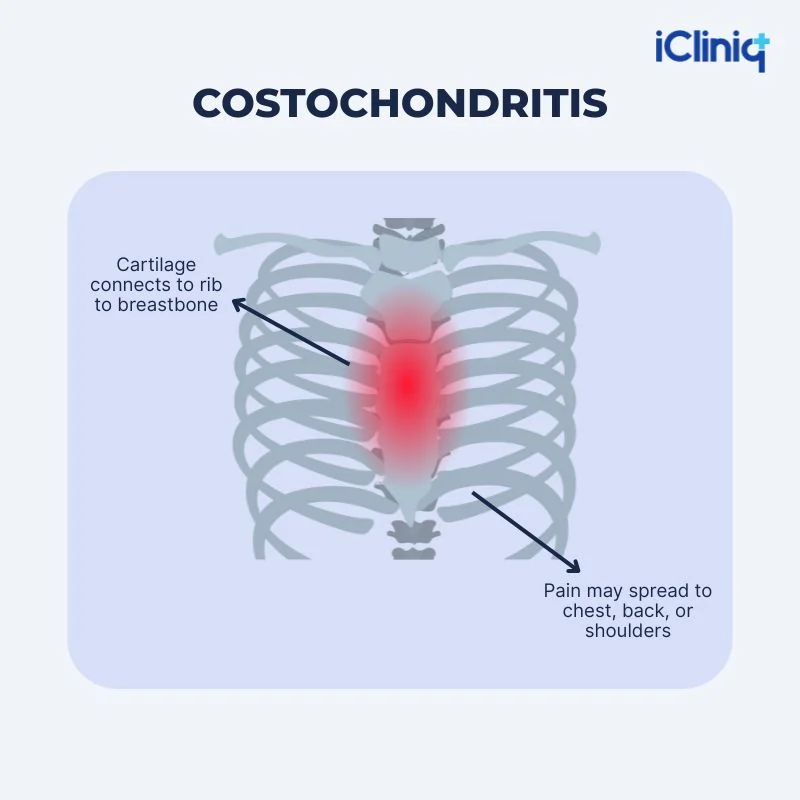
Costochondritis is inflammation of the cartilage connecting the rib to the breastbone (sternum). The condition primarily affects the upper ribs on the left-hand side of the body. The inflammation makes breathing or moving the chest painful.
The chest pain develops suddenly and progresses slowly across the chest. It is a short-term condition lasting a few days to a few weeks. Costochondritis is also called chest wall pain syndrome, costosternal, chondrodynia, or costosternal syndrome.
The condition accounts for 10 to 30 percent of chest pain among adolescents. Children who carry heavy bags on one shoulder are likely to have costochondritis. Among adults, the condition predominantly occurs in women over 40 years old.
What Are the Causes of Costochondritis?
Costochondritis has no clear cause. But there are a few things that can make it more likely to happen. These include:
-
Muscle strain.
-
Chest infections.
-
Severe coughing or vomiting.
-
Direct impact to the chest wall (from an accident or a fall).
-
Poor posture for a long time.
-
Hard exercises.
-
Heavy lifting.
Other possible causes are:
-
Overuse of arms.
-
Arthritis (especially ankylosing spondylitis, rheumatoid arthritis, etc.).
-
Tumors.
-
Respiratory infections.
What Are the Risk Factors of Costochondritis?
Anyone can get this condition, but some people have a higher chance. Let's examine what makes it more likely.
-
Athletes playing contact sports.
-
Physically demanding jobs.
-
Having allergies.
-
Being female (older than 40).
-
Hispanics (people related to Spain).
What Are the Symptoms of Costochondritis?
The most common sign of costochondritis is chest pain. Here’s how the pain may feel:
-
It occurs on the left side of the breastbone, and the pain may spread to the back or belly.
-
The pain is sharp, aching, or pressure-like, affecting one or more ribs.
-
At times, the pain radiates to the arm and shoulder.
-
Some patients experience worsening pain during deep breaths, coughing, sneezing, vomiting, reaching overhead, exercising, hugging others, lying on the affected side, or during any chest wall movement.
-
The pain improves when the individual stops moving or when breathing is quieter.
-
Individuals with costochondritis will have tenderness when pressing on the rib joints.
-
If costochondritis develops from infection post-surgery, it causes redness, swelling, and pus discharge at the surgery site.
-
Sometimes, the person may experience nausea, palpitations, or shortness of breath.
How Is Costochondritis Diagnosed?
Here is a list of things that doctors do to figure it out.
1. Medical history:
-
The diagnosis begins by asking simple questions, such as about the symptoms and nature of the pain.
-
They also ask if anything makes it better or worse.
2. Physical examination:
-
The doctors gently press along your chest and ribs to see if it feels sore or swollen.
-
They move your arms or ribs in certain ways to check if it makes the pain worse..
3. Other tests:
-
The condition cannot be diagnosed or confirmed with laboratory or radiographic imaging.
-
But tests like X-rays, CT (computed tomography) scan, MRI (magnetic resonance imaging), and electrocardiograms (ECG) help rule out other conditions like gastrointestinal issues, heart attack, and lung issues.
-
A blood test can help rule out infections.
How Is Costochondritis Treated?
Usually, the condition will resolve on its own, but resting is important. Here is how costochondritis is treated.
1. Medications:
-
Nonsteroidal anti-inflammatory drugs: Ibuprofen or Naproxen are over-the-counter pain relievers. Prescription medications are also available, but long-term use can damage the kidneys and stomach lining.
-
Narcotics: Severe pain can be managed with Tramadol. However, the medication can be habit-forming.
-
Antidepressant: Amitriptyline is a tricyclic antidepressant used for chronic pain. It is primarily used when the costochondritis pain interferes with sleep. Side effects of taking the medication are drowsiness and weight gain.
-
Anti-seizure medication: Gabapentin is an anti-epileptic medication that is successfully used for managing chronic costochondritis pain.
-
Steroids: Doctors may give corticosteroid shots directly into painful joints as a last resort. If the costochondritis pain cannot be controlled by medication or therapy, then numbing medication and corticosteroids are directly injected into the joint.
-
Antibiotics: Costochondritis caused by infections is treated with antibiotics (intravenous route).
2. Therapy:
-
Stretching exercises: Gentle exercises can relieve costochondritis pain.
-
Nerve stimulation: A procedure called transcutaneous electrical nerve stimulation (TENS) involves a device that sends weak electrical signals through patches placed on the skin near areas of pain. The electrical signals interrupt pain signals from reaching the brain.
-
Heat and cold therapy: This can help reduce inflammation.
3. Surgery:
-
If all other treatment fails to alleviate pain, surgical removal of the sore cartilage is necessary.
Can Costochondritis Be Prevented?
Sometimes, we don’t know exactly what causes costochondritis, so it’s not always easy to prevent. But the good news is, there are some smart things you can do to lower the chances of getting it!
-
Maintaining good posture.
-
Avoid repetitive strain to the chest.
-
Warming up before exercise.
-
Practicing proper techniques for lifting.
-
Getting properly treated in case of any respiratory infections.
-
Wearing protective gear.
What Are the Effective Home Remedies for Managing Costochondritis?
If you have costochondritis, there are simple things you can do at home to help your chest feel better.
-
Rest the affected area.
-
Taking over-the-counter pain medications can help ease pain caused by costochondritis.
-
Local heat or ice application can also help with pain.
-
Individuals suffering from costochondritis must avoid unnecessary exercise or activities that worsen the symptoms.
-
The affected individual must avoid contact sports until symptoms improve and should return to normal activities only as tolerated.
-
Stretching exercises can help with costochondritis.
-
Maintaining proper posture.
-
Stress can increase pain; medication and deep breathing may be helpful.
-
In case of infectious costochondritis, IV (intravenous) antibiotics and surgery may be required.
Conclusion
Costochondritis means soreness in the chest. It is a harmless condition and usually goes away pretty soon! Even though the cause is unclear, things like repeated straining, poor posture, injury to the chest, infection, etc, can make it happen.
The diagnosis usually depends on the clinical examination and ruling out other conditions. Management is symptomatic. The pain usually goes away within a few weeks. If the pain gets really bad or if you have a fever, it’s important to see a doctor right away.
Key takeaway from iCliniq
-
Costochondritis is common among adults between 40 and 50 years old.
-
It mostly affects women. About 69% of cases occur in females.
-
Costochondritis goes away on its own. The pain may last from a few days to weeks (most people feel better in about 3 to 4 weeks).
-
The pain may be strong, but it is not a dangerous condition. Still, it’s important to see a doctor to make sure it’s really costochondritis and not something else.
-
Visit our iCliniq orthopedician and traumatologist, who can help you understand what is happening, what might be causing it, and how you can heal your body.