Table of Contents
Introduction:
Nature ensures to curtail hazards; however, man exploits them. Environmental pollution and contamination are the most researched and debated topics requiring immediate attention. Environmental contamination is the accidental or purposeful adulteration of the environment with chemicals that may cause grave and severe health hazards. These environmental contaminants may or may not be the result of human activities. Contamination of the air, water, and soil with hazardous substances is a significant threat to the community as it affects the quality of life. Environmental contamination could occur naturally or result from industrial, agricultural, or other commercial activities. Unchecked contamination could result in various health problems, such as respiratory, cardiac, neurological, and even dermatological issues. Children and older people are more prone to health risks. In addition, these pollutants could enter the food chain and thus contaminate the food and water, posing a greater threat. Hence, it is essential to assess the risk and keep the various environmental contaminants in check to prevent community health hazards.
What Are the Various Environmental Contaminants?
Various environmental contaminants have been found in the soil, water, air, and even food. These are chemicals that are released from industrial or other commercial activities though some may occur naturally, too. Some common environmental pollutants are lead, arsenic, chlorinated compounds, mercury, bromate, and perchlorate. Of the various contaminants, lead contamination is more widespread because of its extensive obtainability. Lead occurs naturally in the earth’s crust and is also extensively added to the environment via various activities such as manufacturing, mining, and other commercial activities. As a result, lead is considered a dangerous pollutant as even low-level exposure poses a serious health risk, particularly in children.
What Is Lead Contamination?
Lead is a heavy metal that is found in the earth’s crust. It is a blue-gray metal that is increasingly found in areas with volcanic activities and places with geochemical weathering. It can be found suspended in air, water, and soil. It has excellent moldability and can be combined with different metals to form alloys. Hence it has been increasingly used in various industries and manufacturing units. Its extensive use has resulted in widespread environmental contamination. The World Health Organization has listed lead as one of the ten foremost chemicals of public health concern.
The Various Sources of Lead Are
-
Manufacturing of lead-acid batteries.
-
Manufacturing of paints
-
Mining.
-
Smelting.
-
Leaded petrol.
-
Unauthorized recycling of lead.
-
Lead pipes.
-
Ceramic manufacturing industries.
-
Soldering units.
-
Electronic waste.
-
Cosmetics and jewelry.
Various Forms of Lead Are:
-
Elemental Lead or Lead Ore: These forms are found in the earth’s crust (0.002 percent). They primarily exist as lead sulfide though other forms, such as lead carbonate, lead sulfate, and lead chlorophosphate, may also exist.
-
Inorganic Lead: They are usually found in old paint and soil. They exist in three forms:
-
White Lead - Lead carbonate.
-
Yellow Lead - Lead chromate and lead monoxide.
-
Red Lead - Lead tetroxide.
-
Organic Lead: This is a highly lethal form found in most manufacturing and commercial industries and petrol. This form is easily released into the atmosphere and absorbed into the soil. It is severely toxic to the brain and central nervous system and gets easily absorbed into the skin and circulation.
Routes of Exposure Are:
Individuals can become exposed to lead via various routes. A few of them are mentioned below:
-
Prenatal Exposure: During fetal life, lead can readily travel from the mother to the fetus via the placenta. The lead accumulated in the mother’s bones freely passes into the fetal circulation and may also enter the developing fetal brain due to an immature blood-brain barrier. Chronic and prolonged exposure may cause severe adverse health effects in the child.
-
Ingestion: Ingestion is one of the primary ways to lead exposure in children. Studies have shown that the body readily absorbs 10 to 70 percent of the ingested lead.
-
Inhalation: Lead particles are found suspended in the air, thus making inhalation the second most common route of lead exposure. However, unlike ingestion, most inhaled lead particles are absorbed by the body.
-
Absorption Through the Skin: Organic lead found in cosmetics, jewelry, and other such sources is readily absorbed through the skin.
What Is the Burden of Disease?
The disease burden is the effect of health challenges in a population as measured by the morbidity and mortality rates. It is quantitatively measured by a metric tool known as disability-adjusted life years or DALYs. Globally, lead exposure accounts for 21.7 million years lost to DALYS, mainly attributed to intellectual disabilities. Cardiovascular diseases like high blood pressure, stroke, ischemic heart disease, and renal disease also contribute to the global burden. Leaded petrol is one of the largest sources of exposure, especially in low-income countries. However, since the progressive dissolution of their use, there has been a drastic decline in blood lead levels, reducing the global disease burden.
Who Are the Vulnerable Population?
1. Children: Children are considered more vulnerable as they have a greater tendency to risk exposure. It is because of the following condition:
-
Due to their detrimental hand-mouth habit; there is an increasing risk of ingestion exposure.
-
Nutritional deficiencies, may result in an increased rate of lead absorption.
-
More risk of prenatal and fetal exposure.
-
Developing immune system.
-
Prolonged activity in the same environment.
2. Pregnant women: Pregnant women are also susceptible to lead exposure. The lead accumulated in the mother’s body can travel into fetal blood via the placenta and to the child through the breast milk.
3. Adults: Adults are exposed through contaminated soil or by consuming contaminated food and water.
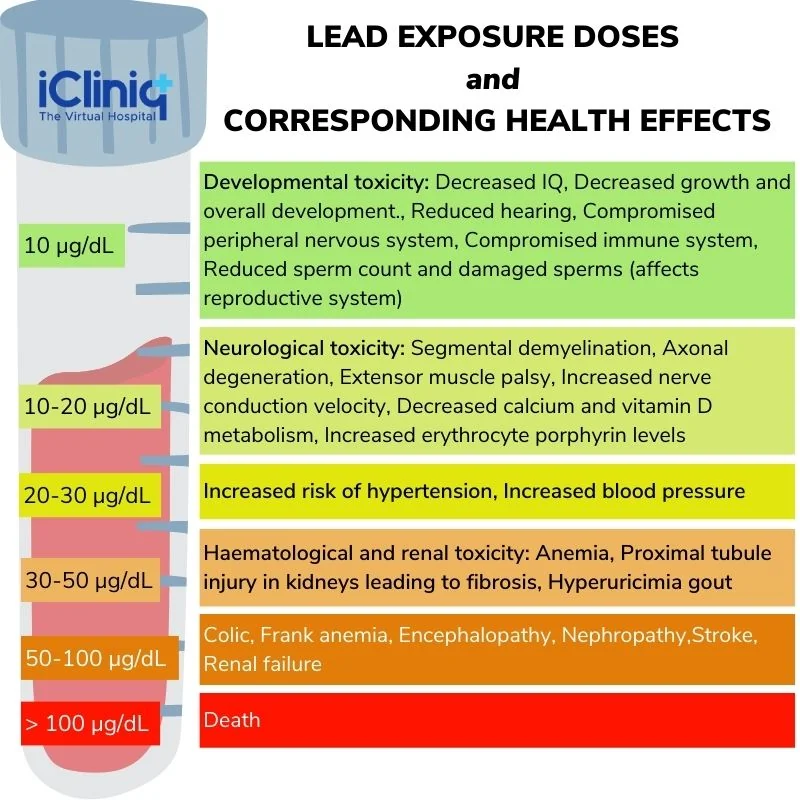
What Are the Exposure Doses and Adverse Health Effects?
There is no threshold or safe blood lead concentration below which no adverse effects may occur. However, it is seen that even blood levels as low as 3.5 µg/dL can be associated with neurological problems in children. With chronic and increased exposure, lead can affect all body organ systems, resulting in grave complications and fatalities.
Conclusion:
Environmental toxicity is detrimental to health and can cause significant complications and fatalities. Lead contamination is potentially harmful to everyone but is even more precarious to children. Even low levels of exposure in children can cause health deficits such as cognitive and intellectual disabilities, impaired growth and development, and poor immune response. These health hazards may, at times, be permanent and irreversible. Hence it is imminent to avert such environmental contamination as they are very much preventable and can help significantly in community growth.

