Table of Contents
How Does a Hair Grow?
A hair is a flexible thin shaft of cornified cells that extends from a cylindrical invagination of the epidermis, hair follicle. Hair growth is a prolonged process, and it takes time for the root to get nourished and to start producing new hair after treatment. It takes about 30 to 45 days, and then hair starts to grow about 1.5 to 2 inches in length. You will be able to see a difference in about six months.
Why Do We Get Hair Problems?
Just as crops require proper nutrition in the form of water, sunlight, pesticides, etc., regularly, so does the hair. It needs vitamins, conditioner, and nourishment. We can provide nutrition to dietary supplements like food rich in vitamins like green leafy vegetables, salads, fruits, dates, etc. But in our stressful life, it is hard to provide an adequate amount of nutrition. So, we need to take vitamin supplements and apply hair oil to provide nourishment. We can also increase nutrient flow to the hair by increasing blood flow to the hair and can do this by using Minoxidil solution. Like crops, even for hair, we need to take these supplements and apply lotions and Minoxidil regularly.
What Are The Common Hair Problems?
-
Dryness: Dryness leads to dandruff and white flakes, which can pluck the hair out of the root when the flakes are shed. When dandruff is more, an infection can occur, and this can leads to pain. At this stage, you need specialized medical treatment. Shampoos available in the market sometimes do not work on severe dandruff and might even worsen the condition. Shampooing too often can cause dry hair. Squeaky-clean hair is a good idea, but many overdo it by washing it once, sometimes twice, per day. That will remove away all of the hair's natural oils.
-
Hair Fall: Hair grows for some time and then falls off, and new hair takes its place. Every hair goes through this process, so if we have one lakh hair on the scalp, approximately 100 hairs fall off every day. Thus, a hair loss of a hundred per day is considered normal. Although hair loss is historically considered a problem among men, hair loss or thinning hair is also prevalent among women. It can be a male pattern balding for most men, and for females, hair loss is often caused by stress, changing hormones, medication, and even menopause. Additionally, various hair styling products (chemicals or excessive heat) can contribute to hair loss.
-
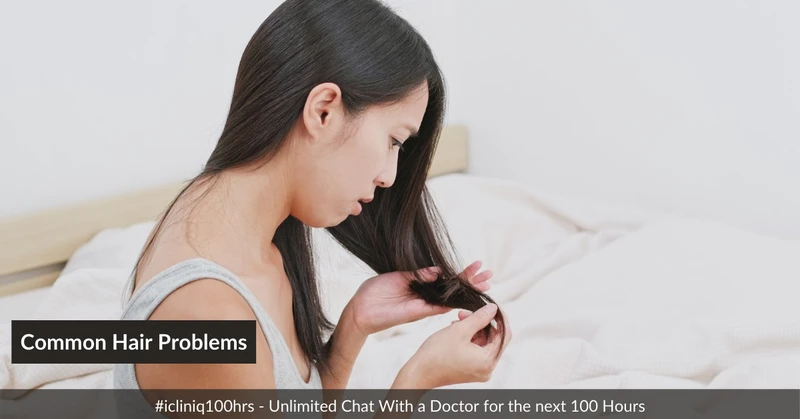
Split-Ends: Split-ends are a sign of decreased nutrition in the hair. It means that your hair is devoid of adequate supplements.
-
Dandruff: It is a scaly particle that adheres to the root of the hair. It can be caused by a deficient diet, an infection, or even a slow metabolism. You can use an anti-dandruff shampoo and conditioner of good quality, as recommended by a doctor.
-
Frizzy or Curly Hair: Frizzy hair can happen when the hair's moisture level falls below normal levels, and it can also be hereditary. Dehydration is the leading cause of this hair problem.
-
Lack of Volume: It will be an error if lack of volume does not appear on the list of common hair problems. It will happen for both men and women. Lack of volume can damage one's hair and affect his or her appearance. There are plenty of reasons for the lack of flat hair volume, including thyroid problems, hormone-related conditions, low iron levels, and nutrition. Even a wrong shampoo or an improper conditioner can make your hair too thick and result in a lack of volume.
-
Dull Hair: Many factors can cause hair to look dull, like chemical or heat-styling damages and environmental soils and stresses, which can roughen the hair's cuticle. Using shampoo and conditioner once a week is a suitable solution for dull hair.
-
Heat Damaged Hair: Using your flat iron or curling iron too much will damage your hair.
-
Color Damaged Hair: When hair coloring is done in your hair, the chemicals will open your hair shaft, leaving your hair extraordinarily porous and prone to brittleness and damage.
-
Gray Hair: Many factors can trigger greying early, such as malnutrition, hormonal imbalance, using electric dryers, hypothyroidism, hyperthyroidism, pernicious anemia, concentrated hair dyes, radiation, genetic disorders, andchemotherapy. Some studies also point out that greying early can happen due to the lack of copper, vitamin B, iodine, and iron in the daily diet and mental stress. Among these common hair problems, genes can define early greying, which means if your parents have premature graying, you should begin to worry about it.
- Oil or Greasy Hair: The scalp contains oil knownas sebum, which is responsible for keeping the skin lubricated and is produced by the sebaceous glands. These glands may sometimes work so hard that they produce excess oil, resulting in greasy hair. This hair problem is real trouble for many people who love cleanliness. To deal with this one, you should try cleansing your hair with a gentle shampoo to control sebum production.
How to Care for Your Hair?
-
Hair Oil: Applying oil to the hair reduces dryness. Oil should be used two to three times a week. Oil should be kept for at least 5 to 6 hours on the scalp before washing it. Do not wash immediately; those who do not like oil can use medicated hair serum.
-
Conditioner: You should use conditioners two to three times a week. You should apply it both to the scalp and the hair after regular hair wash. It should be left on the scalp for 3 to 5 minutes and then washed.
-
Cutting Hair Short: Cutting the hair short does not reduce hair fall. Hair fall and hair length have no relation. We are concerned with the root of the hair. Hair that has already grown out of the root does not change much. We thrive on making roots stronger to have stronger and thicker hair.
Conclusion
For most of us, the ultimate confidence objective is to have hair that is strong, gorgeous, and healthy-looking. It improves our appearance and well-being, reflects our general health, and boosts our self-esteem, which permeates every aspect of our lives. Nonetheless, hair is also incredibly sensitive, and it can be restored with a simple lifestyle adjustment.