Table of Contents
What Is Gastroesophageal Reflux Disease (GERD)?
GERD is a chronic condition involving acid reflux (when stomach acid flows in the backward direction) into your esophagus. GERD is considered chronic when it occurs at least twice a week for many weeks. Acid reflux may sometimes be temporary, but GERD is a constant mechanical problem that keeps coming back and causes more trouble.
In this condition, the stomach contents move up into the esophagus. Frequent acid reflux can turn into a disease when it causes severe symptoms and injury. The esophagus, pharynx, and respiratory tract may be damaged.
GERD has been found to occur in about 20 percent of adults and 10 percent of children in the United States.
What Are the Causes of GERD?
GERD is caused mainly by acid reflux. For acid reflux to happen, the contents should move up into the esophagus from the stomach. The valve present at the esophagus must open up. The valve is called the lower esophageal sphincter (LES). This valve is responsible for allowing the contents of the stomach to enter and preventing them from moving back into the esophagus.
Normally, the LES relaxes, allowing food and liquids to enter the stomach. After this, the LES closes again. If the LES becomes weak and fails to close, the stomach contents can move back into the esophagus. If this happens frequently, the acid that flows back can irritate the mucosa, or lining, of the esophagus and cause inflammation.
Several factors that occur temporarily may contribute to acid reflux, such as lying down after consuming large meals. As time passes, temporary acid reflux may turn into chronic GERD.
The causes of GERD include:
-
Hiatal hernia
A hiatal hernia is a condition in which a part of the stomach pushes up through an opening in the diaphragm into the chest. These are common and often observed more among older individuals.
-
Pregnancy
Gastroesophageal reflux disease during pregnancy can cause acid reflux, but it is typically a temporary condition.
-
Obesity
Obesity can increase the pressure and volume in the abdomen, which contributes to GERD.
-
Smoking
Tobacco smoke can be responsible for relaxing your LES, and that can cause GERD.
-
Birth defects
Defects such as esophageal atresia (a condition in which the esophagus does not develop properly and ends in a blind ended pouch) and hernias can affect the LES, causing GERD.
-
Connective tissue diseases
Conditions like scleroderma (an autoimmune disease characterized by the hardening and tightening of the skin and connective tissues) may affect the esophageal muscles.
-
Surgery
Previous surgeries in the chest or upper abdomen can cause GERD. These surgeries may injure the esophagus.
-
Medications
Certain medications, like Benzodiazepines and calcium channel blockers, may cause GERD.
Certain foods and drinks may also contribute to GERD.
What Are the Symptoms of Gastroesophageal Reflux Disease (GERD)?
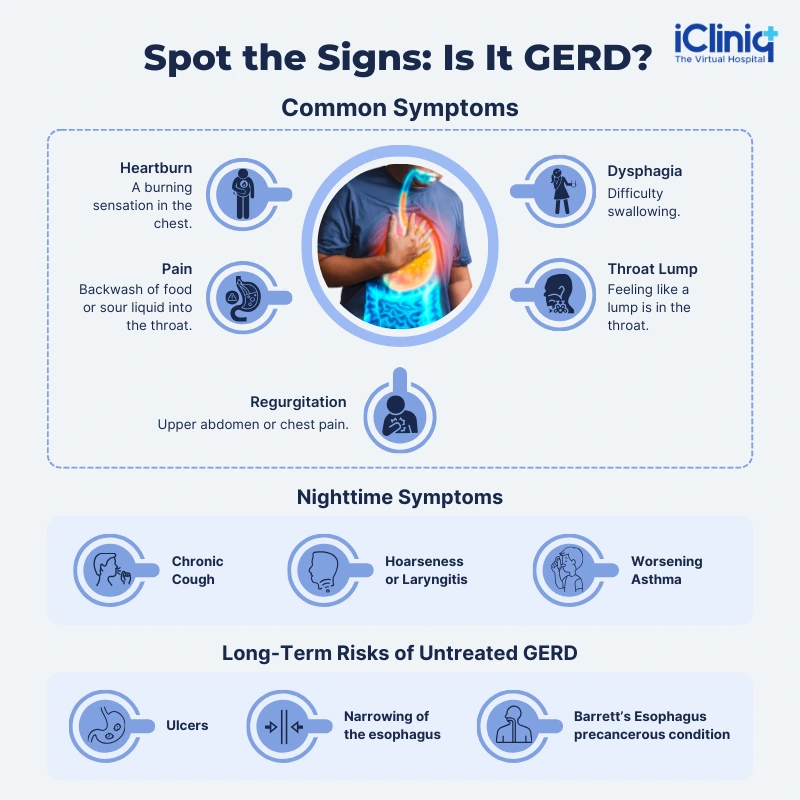
The common symptoms of GERD include:
-
A burning sensation in your chest, which is called heartburn.
-
A backwash of food or sour liquid can be observed entering the throat.
-
You may experience upper abdomen or chest pain.
-
Difficulty swallowing, called dysphagia, may be felt.
-
You may feel the presence of a lump in your throat.
If acid reflux occurs at night, the symptoms experienced include:
-
You may experience an ongoing cough. GERD can cause a chronic cough, known as a GERD-related cough.
-
Inflammation of the vocal cords or laryngitis may be observed.
-
Asthma, a new or worsening of an existing condition, may be experienced.
Initially, acid reflux can cause simple ulcers, which may respond to acid-suppressant medications. However, in the long term, if acid reflux is not controlled, it can narrow the lumen of the esophagus (peptic strictures) or result in Barrett's esophagus, a precancerous condition.
How Is GERD and Barretts Esophagus Linked?
Barrett's esophagus is a precancerous condition, which means it has the potential to cause cancer in the esophagus. The diagnosis of Barrett's esophagus is established through gastroscopy and a close examination of the lower part of the esophagus.
The risk of developing Barrett's esophagus increases with the duration of GERD. Patients with GERD for many years are at a higher risk of developing Barrett's esophagus.
The lifetime risk of developing Barrett's esophagus among patients with GERD is one percent to five percent, and approximately one percent of patients with Barrett's esophagus can develop cancer in the food pipe (esophagus).
It is recommended that a surveillance gastroscopy be performed every one to three years once the diagnosis of Barrett's esophagus is established.
How to Diagnose GERD?
Confirmation of gastroesophageal reflux typically requires the presence of typical symptoms or evidence of ulcers on endoscopy, as well as evidence of acidic exposure to the lower part of the food pipe, which can be assessed using specialized tests such as pH impedance testing or capsule endoscopy.
-
Gastroscopy
The investigation of GERD begins with gastroscopy, where an endoscopist or gastroenterologist inserts a thin, fiber-optic tube with a camera on one end through the mouth into the food pipe, stomach, and into the duodenum, a part of the small bowel, while closely observing the lining of the food pipe.
In patients with evidence of acid reflux, the lining of the food pipe appears inflamed or red, cracked, ulcerated, or shows spontaneous bleeding. Alternatively, it may have a completely normal lining in cases where patients experience clinical improvement after using acid-suppressant medications.
-
pH impedance test
The other test is pH impedance testing. In pH impedance testing, a gastroenterologist inserts a thin tube, made of metallic rings, called a probe, into the food pipe through the nose and leaves it in place in the lower part of the food pipe for the next 24 hours.
The probe measures acid reflux from the stomach over a 24-hour period. A mean acid exposure of more than four percent in 24 hours to the lower part of the esophagus suggests the presence of gastroesophageal reflux disease.
The pH impedance test often has drawbacks, such as the probe being withdrawn improperly into the upper part of the esophagus, which can result in false-negative test results, or being pushed too far into the stomach, leading to false-positive test results. A clinician should interpret results with caution in certain situations.
-
SmartPill
Nowadays, a SmartPill or PillCam (capsule endoscopy), a capsule-sized instrument that is swallowed by patients with physician guidance, is used. This capsule records serial measurements of pH or acid and the pressure changes across the food pipe, stomach, and small bowel.
The PillCam is easy to operate and does not excessively cause trouble for the patient. It is also important to note that a complete set of investigations is not usually required, especially among patients with typical symptoms and prompt responses to proton pump inhibitor therapy.
What Is the Treatment of GERD?
After a diagnosis of GERD is made through a combination of history, physical examination, and investigations, it can be treated in several ways. These include medicines, lifestyle modifications, and surgery.
Medications:
Chronic acid reflux requires treatment with medication for gastroesophageal reflux disease. These include:
-
Antacids: These medicines can help neutralize stomach acid. If they are taken for a long time, they may cause side effects.
-
Alginates: These are sugars derived from seaweeds. These help by creating a physical barrier between the acid and the esophagus.
Medications include:
-
Histamine receptor antagonists (H2 blockers): They act by blocking the histamine, which is responsible for acid production.
-
Proton pump inhibitors (PPIs): These medications help block the production of acid and promote healing. These are the first-line treatments for GERD.
-
Baclofen: It is a muscle relaxant, and it helps by reducing the relaxation of the LES. It is not a first-line treatment, but it can be part of the overall treatment.
Lifestyle modifications that help in GERD include:
-
Maintaining a proper weight can be achieved by consuming balanced meals and following a well-planned diet. You should take meals at scheduled times and exercise regularly.
-
You should avoid foods that trigger GERD. These include spicy foods, oily foods, carbonated and caffeine drinks, and fried foods.
-
Reduce your carbohydrate intake and add protein and fiber to your diet. This type of diet used to reduce GERD is called the GERD diet. The GERD diet includes fruits, vegetables, cereals, milk, and dairy products..
-
Stress management is very important. You should practice relaxation techniques like deep breathing, meditation, and yoga. These are to help manage your stress.
-
Avoid eating large portions of meals; having smaller meals more frequently helps you reduce GERD.
-
You should avoid lying down immediately after eating.
-
Sleeping on your left may help to ease the symptoms.
-
You should sleep by elevating your head with pillows to avoid GERD.
-
Avoid habits like smoking and alcohol consumption.
-
Avoid wearing tight clothes that may contribute to your heartburn.
How to Cure GERD Permanently?
Medications can alleviate symptoms, but they cannot prevent GERD from occurring. In severe cases of GERD, it may need definitive treatment to cure it permanently. In such cases, GERD surgery may help. This procedure is done to tighten the LES. These include:
-
Nissen fundoplication:
Nissen fundoplication is a laparoscopic surgery and the most commonly done surgery for GERD. In this procedure, the surgeon wraps the top of the stomach to tighten the junction between the stomach and lower esophagus.
- LINX device:
In this procedure, a device called LINX is implanted. This device features a ring of magnets that helps keep the junction between the esophagus and the stomach closed.
These procedures are minor but very effective in treating severe GERD. Hence, GERD can be cured permanently.
Conclusion
Gastroesophageal reflux disease (GERD) occurs due to the repeated backflow of stomach acid into the esophagus (a tube that connects the mouth to the stomach). Due to this acid reflux, the lining of the esophagus can get irritated. In patients with GERD, the sphincter, or in other words, this valve called LES, becomes loose and patent, allowing acidic juices from the stomach to flow in a retrograde direction to the lower part of the food pipe, resulting in pain, heartburn, sore throat, sore taste in the mouth, bad breath, cough, nausea, and vomiting in some patients. However, it is common for many individuals to experience acid reflux, and it can be treated with medications and lifestyle modifications.
Key Takeaway From iCliniq
-
GERD is a condition in which there is a backflow of acid from the stomach to the esophagus.
-
This condition, if not controlled well, may cause complications like Barette’s esophagus (a precancerous condition).
-
For more information, you can consult a medical gastroenterologist at iCliniq.