Table of Contents
- 1What Is Gastroesophageal Reflux With Laryngopharyngeal Reflux Disease?
- 2What Are the Similarities and Differences in Risk of GERD and LPR?
- 3What Are the Symptoms of GERD and LPR?
- 4Can GERD and LPR Occur Together?
- 5What Are the Causes of GERD and LPR?
- 6How Are GERD and LPR Diagnosed?
- 7What Is the Treatment for GERD and LPR?
- 8What Are the Complications of LPR and GERD?
- 9How Can We Prevent GERD and LPR?
- 10Key Takeaway From iCliniq
What Is Gastroesophageal Reflux With Laryngopharyngeal Reflux Disease?
When the stomach's acidic contents flow back to the esophagus, it is called acid reflux. This is because the sphincter muscles, which are designed to prevent the contents from entering the esophagus, do not function correctly. Acid reflux is not always associated with symptoms of heartburn. However, it is also associated with chronic conditions like gastroesophageal reflux and laryngopharyngeal reflux disease.
When acid reflux occurs frequently and the stomach contents reach the esophagus, it is called gastroesophageal reflux disease (GERD). If the acidic contents reach the voice box (larynx) and throat (pharynx), it is called laryngopharyngeal reflux (LPR).
What Are the Similarities and Differences in Risk of GERD and LPR?
Both these conditions are caused by acid reflux. When the food is digested, the ring at the bottom of the esophagus, known as the lower esophageal sphincter, begins to constrict, preventing the backflow of stomach contents into the esophagus. When the person experiences acid reflux, this mechanism will not work typically, leading to the cause of GERD and LPR. In the case of GERD, stomach contents move into the esophagus, resulting in acid reflux without heartburn. However, in the case of LPR (laryngopharyngeal reflux), stomach contents move up into the throat, causing a cough or sore throat.
As a result, in GERD, you mainly experience chest pain, heartburn, indigestion, and abdominal pain. On the other hand, in LPR, you feel severe burping, coughing, difficulty in swallowing, and a burning sensation in the throat.
GERD and LPR are common conditions that can occur in otherwise healthy individuals. Some risk factors increase the chance of developing them. These share similar risk factors, which include the following:
-
If you are a smoker or a regular alcoholic, you have a higher tendency to develop GERD and LPR.
-
Overweight and obesity are also related to acid-related issues.
-
Medical conditions like pregnancy and hiatal hernia can also trigger it.
-
Pregnancy.
-
Overeating.
In addition to the above factors, GERD has another risk factor, which includes taking some medications that can trigger acidity.
What Are the Symptoms of GERD and LPR?
When one experiences symptoms twice or more in a week, it is a concern that requires medical attention. Although both GERD and LPR often occur together, not everyone experiences symptoms of both. In a few adults, symptoms of either GERD or LPR only occur.
The following are the symptoms in adults:
-
Burping or belching.
-
Cough.
-
Regurgitation of stomach contents into the esophagus.
-
Presence of excess mucus.
-
Frequent clearing of the throat.
-
Sore throat or burning sensation in the throat.
-
Bitter taste.
-
A feeling of a lump in the throat.
-
Hoarseness of voice.
-
Difficulty in swallowing.
-
Post-nasal drip.
-
Difficulty in breathing.
-
Difficulty in swallowing.
-
Experiences of choking that can wake from sleep.
Can GERD and LPR Occur Together?
GERD and LPR can occur together or separately. Some believe LPR itself is a symptom of GERD. However, only some believe they are two different problems. It is possible to have GERD symptoms without LPR symptoms. Similarly, the converse is true. LPR symptoms can also occur without heartburn.
What Are the Causes of GERD and LPR?
Both physical causes and lifestyle factors contribute to GERD and LPR.
Physical causes:
-
The lower end of the esophagus, which meets the stomach, has abnormal or weak muscles.
-
Slow emptying of the stomach.
-
Abnormal esophageal spasms.
Lifestyle factors:
-
Pregnancy.
-
Eating foods like citrus fruits, spicy foods, chocolate, fatty foods, etc.
-
A habit of overeating.
-
Eating late.
-
Lying down soon after eating.
-
Alcohol and tobacco use.
How Are GERD and LPR Diagnosed?
A primary care physician usually makes the diagnosis. The symptoms of silent reflux, their timing of occurrence, medical history, and medication intake typically aid in diagnosis. There is no need for special diagnostic tests to diagnose GERD and LPR. However, the scarring or damage caused by these conditions can be checked by endoscopy. Endoscopy is a procedure in which a thin, flexible tube with a light and a camera is inserted into the throat to reach the stomach through the esophagus. The attached camera helps take images that aid in diagnosing and planning treatment.
The ambulatory acid probe test is another test that measures the following:
-
The number of times the acid comes up into the esophagus.
-
Amount of acid present.
-
The duration of acid in the stomach.
In this test, a monitor placed on the esophagus measures the values. One can wear the monitor attached to the computer. For GERD, treatment with a gastroenterologist may be needed, and for LPR, referral to an otolaryngologist, also called an ENT doctor, may be required.
What Is the Treatment for GERD and LPR?
Since GERD and LPR occur as our stomach acid travels up the food pipe, that is why treatment for both conditions is similar. Some simple steps are useful in preventing laryngopharyngeal reflux.
The treatment includes: .
1. Lifestyle modifications:
-
Limit the intake of junk, fatty, spicy, and acidic foods.
-
Obesity is a major concern for GERD. If you are overweight, you should focus on losing weight.
-
Excessive coffee intake can trigger acidity.
-
You should avoid addictions like alcohol and smoking.
2. Medications:
-
Antacids are recommended to provide immediate relief from heartburn. However, they do not prevent the occurrence of future heartburns or heal the damage caused.
-
Histamine-2 receptor blockers provide relief by reducing the production of stomach acid. However, these drugs do not provide instant relief.
-
Proton pump inhibitors are much more effective than H2 receptor antagonists. These also reduce acid production and heal the damage caused by acid reflux.
-
Stronger versions may be prescribed when the above over-the-counter medications do not provide relief.
3. Surgical corrections
If the medicines are ineffective, surgical corrections are recommended. Surgery for GERD and LPR aims to prevent acid reflux by strengthening the sphincter muscles.
After care for the throat:
-
Do not scream or shout, and take proper bed rest for a few days.
-
Moisten the throat.
-
Take plenty of fluids.
-
Avoid spicy food.
By following the above measures, the voice and the throat can be prevented from further damage.
What Are the Complications of LPR and GERD?
The main complications related to GERD are:
-
Erosive esophagitis (inflammation of the esophagus).
-
Esophageal stricture (narrowing of the esophagus).
-
Barrett’s esophagus (a condition where the lining of the esophagus alters due to the changes caused by stomach acid).
Some of the complications related to LPR are:
-
Chronic cough.
-
Laryngitis.
-
Regular lung infection.
-
Mouth ulcer.
How Can We Prevent GERD and LPR?
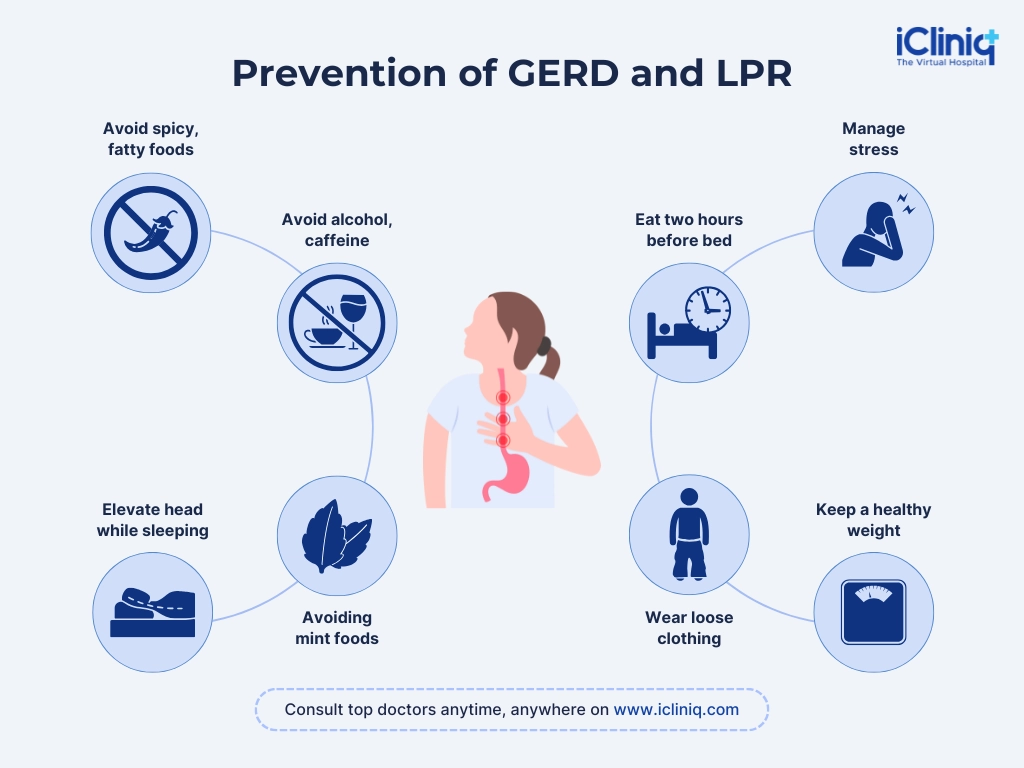
GERD and LPR can be prevented by:
-
Avoid acidic, spicy, and fatty foods.
-
Avoiding alcohol and tobacco.
-
Avoiding the intake of caffeine.
-
Avoiding mint or mint-flavored foods.
-
Avoiding chocolate.
-
Managing stress.
-
Eating at least two hours before bedtime.
-
Avoid tight clothing.
-
Maintaining a healthy body weight.
-
Avoid foods with high-fat content.
-
Elevating the head while sleeping.
Conclusion
The cause of gastroesophageal and laryngopharyngeal reflux disease is linked to your lifestyle. Simple changes in your daily routine can be useful in preventing acid reflux and GERD. However, if you have severe issues, medications help manage these conditions by reducing acid production. When one experiences symptoms, seeking treatment from a healthcare professional is advisable.
Key Takeaway From iCliniq
-
If you are suffering from chronic acidity-related issues, it could be due to either GERD or laryngopharyngeal reflux.
-
Early diagnosis can provide you with relief from symptoms like heartburn, chest pain, and burping.
-
If you ever need help or have questions about your complications, you can always consult our iCliniq gastroenterologist for guidance.