
- 1What Are the Relations Between GERD and CKD?
- 2What Are the Mechanisms Underlying GERD in CKD?
- 3What Are the Clinical Symptoms of GERD in CKD Patients?
- 4How to Diagnose GERD in CKD Patients?
- 5What Are the Treatment Strategies for Gastroesophageal Reflux Disease in Chronic Kidney Disease?
- 6Key Takeaway From iCliniq
What Are the Relations Between GERD and CKD?
Both gastroesophageal reflux disease (GERD) and chronic kidney disease (CKD) are becoming common health issues in today's world. A large number of the world's population is affected by severe acidity. On the other hand, chronic kidney disease (CKD), which affects almost a million people worldwide, causes a gradual loss of kidney function. Understanding the connection between acidity and kidney issues can help you solve your health issues. Additionally, for doctors, such issues can impact their treatment plans.
GERD is a complex problem influenced by several physiological and pathological factors in patients with chronic kidney disease (CKD). CKD predisposes individuals to GERD due to alterations in lower esophageal sphincter (LES) function, increased gastric acid secretion, and changes in gastrointestinal motility. Furthermore, GERD symptoms are made worse by comorbid diseases like diabetes and obesity, which are prevalent in CKD patients.
What Are the Mechanisms Underlying GERD in CKD?
A long-standing kidney disease can damage the normal functioning of our gastrointestinal tract. As a result, half-digested food items from your stomach do not move to the small intestine properly. Additionally, the process by which the acidic contents of our food tract are neutralized is hindered. The symptoms of GERD are exacerbated by this dysfunction, which raises the possibility of acid reflux into the esophagus. Apart from this, several other factors are:
Gastric acid secretion:
Chronic kidney disease alters or disrupts the body's acid balance. This shift leads to metabolic acidosis, causing the body's fluids to become more acidic. Excessive production of acid hampers the junction between your food pipe and stomach. Because of this, this acid goes up inside your food pipe and damages its lining.
Dysfunction of the lower esophageal sphincter (LES):
The kidneys act as filters in our body, maintaining the balance between different ions and minerals. If you suffer from a longstanding kidney problem, it can disrupt the balance of ions and minerals in your body. This leads to different nerve and muscle problems. As a result, the muscular junction between your esophagus and stomach (LES) does not function properly.
Comorbidities:
If someone is suffering from chronic kidney disease, there is a high chance that the person will also suffer from other health issues like obesity and type 2 diabetes. These medical issues are also related to CKD.
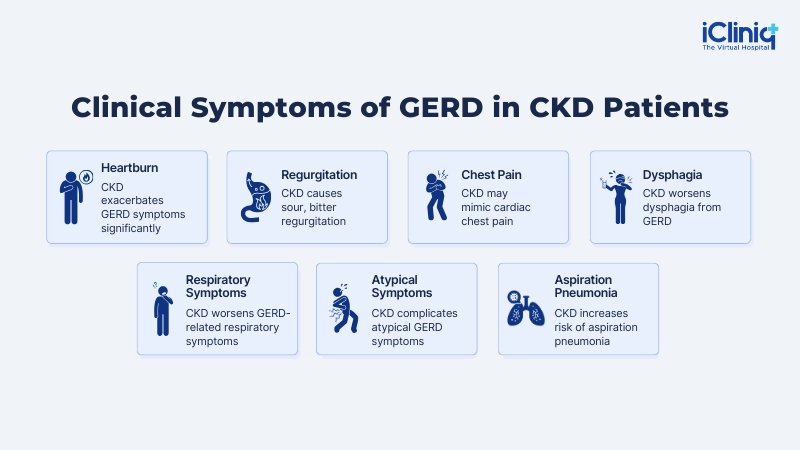
What Are the Clinical Symptoms of GERD in CKD Patients?
The main symptom of GERD is a burning feeling in the chest or throat. Patients with chronic kidney disease (CKD) may have heartburn, which can be made worse by spicy food, medications, and kidney issues.
Backflow of the stomach contents moves half-digested food into the foodpipe. Acidic stomach contents may reflux back into the throat or mouth, causing CKD patients to experience a sour or bitter taste in their mouth.
CKD patients may experience GERD-related chest pain, which is frequently misdiagnosed as cardiac chest pain. Usually felt behind the breastbone, the discomfort can vary in intensity and occasionally spread to the arms or back.
When GERD results in damage or narrowing of the food pipe, it causes issues with swallowing. Due to esophageal damage caused by GERD, patients with CKD may have difficulty eating and drinking.
When stomach contents reflux into the airways, it can cause symptoms like coughing, wheezing, and hoarseness. Fluid imbalances and underlying renal dysfunction may make these respiratory symptoms worse in patients with chronic kidney disease (CKD).
Patients with severe kidney problems may show some unusual symptoms of acidity, such as a regular sore throat, a habit of clearing the throat, damage to the teeth, and unusual chest pain.
Aspiration of stomach contents into the lungs can result in pneumonia in severe cases of acidity, especially in CKD patients with less immunity. Aspiration pneumonia causes fever, cough, chest pain, and breathing issues.
How to Diagnose GERD in CKD Patients?
Medical history:
Patients suffering from GERD often experience symptoms like acidity, chest pain, heartburn, and indigestion. Along with gastritis and acidity causing vomiting, CKD patients may also report bloating, indigestion, sour burps, and a reduced appetite. Doctors must understand the severity of such issues to understand the nature of stomach problems. If you have kidney issues, you will face issues like skin rashes, a change in urination, and breathing issues.
Physical examination:
Doctors conduct a thorough physical examination. In cases of severe acidity, doctors may observe an unnatural enlargement of the abdomen, pain in the midsection of the abdomen, ulceration in the tongue and esophagus, a smooth tongue, dry mouth, and loss of tooth structure. Swelling of the legs due to fluid accumulation, eye swelling, and skin itching may indicate kidney issues. Additionally, kidney problems can lead to nerve issues, muscle problems, and weakness.
Diagnostic examinations:
Upper endoscopy:
Here, doctors insert a camera through your mouth into your food pipe. This helps them to see the condition inside your food pipe and food tract. Any unnatural changes, such as ulceration, can be easily visible.
Esophageal manometry:
In this procedure, doctors attempt to determine how well the junction between the esophagus and the stomach is functioning. Additionally, this test can identify problems with the muscles of your food pipe. Usually, these muscles push the food downward. But in the case of any issue with the muscles, food goes upward in the food tract.
pH monitoring:
To detect GERD, the amount of acid that enters your food pipe must be measured. That is why 24-hour pH monitoring is performed.
Laboratory tests:
Although laboratory tests cannot diagnose GERD by themselves, they can help identify any issues with your kidneys. These tests can detect metabolic acidosis, electrolyte imbalances, or renal problems, which can impact GERD symptoms. Also, doctors must examine the proper functioning of your kidneys through tests like the estimated glomerular filtration rate.
Imaging tests:
An ultrasound of the lower abdomen can provide information about the kidney condition. Additionally, X-ray imaging of the food track can be performed using the barium swallow method.
What Are the Treatment Strategies for Gastroesophageal Reflux Disease in Chronic Kidney Disease?
You can modify your lifestyle to alleviate symptoms of acidity. Things like weight loss, dietary changes (such as avoiding spicy, caffeinated, and acidic foods), raising the head of the bed, and giving up alcohol and tobacco can be very helpful.
The management of GERD is largely dependent on taking medication, which includes proton pump inhibitors (PPIs), H2-receptor antagonists, and antacids. However, because there is a chance of drug interactions and side effects, especially with long-term PPI use, patients with kidney issues need to use these medications carefully.
If the condition is very severe, surgery can be a useful way out. If the patient is suffering from severe acidity, surgeries like fundoplication can control it very well. Also, in case of any abnormal condition like damaged lining of the food pipe or cancerous changes, surgery is very effective. However, due to kidney issues, performing surgeries can be difficult. That's why doctors should be very cautious.
It is essential to address underlying medical conditions, such as diabetes and obesity. Lifestyle interventions can also help to improve GERD symptoms and treatment outcomes in CKD patients.
Conclusion
Patients with chronic kidney disease often face regular acidity due to several factors. Their health condition, health issues, mental state, and treatment affect acid reflux issues. That is why patients with such conditions require special care during their treatment. Doctors, such as nephrologists, gastroenterologists, and dietitians, must collaborate to address the health issues of these patients.
Key Takeaway From iCliniq
Chronic kidney disease (CKD) can impact your gastrointestinal tract.
Long-standing kidney problems can worsen the symptoms of chronic acidity. Also, it can lead to acid reflux issues.
Surgery is not always possible due to the presence of associated medical issues. Lifestyle changes are very effective.
If you ever need help or have questions about your complications, you can always consult our iCliniq medical gastroenterologist for guidance.

