Table of Contents
- 1What Are the Contributing Factors for Road Traffic Accidents?
- 2What Should Be Done if One Witnesses a Road Accident?
- 3What Should Be Done if Involved in a Motor Vehicle Crash?
- 4What Is the Protocol for Emergency Management of Road Traffic Accidents?
- 5What Are the First Aid Tips for Coping With an Accident?
- 6What Is Known as the Golden Hour?
Introduction :
Road accident cases are increasing day by day and have emerged as a major public health issue. They are one of the leading causes contributing to morbidity and mortality globally. A typical emergency is when a patient has suffered a road traffic accident (RTA). The immediate concern should be identifying life-threatening situations affecting the respiratory, cardiovascular, and neurological systems. Immediate management to support the airway, breathing and circulation may prevent fatalities or any grave complications.
What Are the Contributing Factors for Road Traffic Accidents?
Many factors are responsible for road traffic accidents. Some of them are :
-
Speedy driving of vehicles.
-
Not following traffic rules.
-
Overburdened transport vehicles.
-
Poor maintenance of vehicles.
-
Sudden fatigue of the driver.
-
Choked roads and enormous pits.
-
Overcapacity hauling of public transport.
The primary cause of traffic accidents by human acts is “drunken driving.”
-
Injured drivers have excess alcohol in their blood, like blood alcohol concentration (BAC).
-
Youngsters are also majorly responsible because of overspeed.
-
If the person falls asleep during nighttime driving.
What Should Be Done if One Witnesses a Road Accident?
-
Call an emergency and note down the crash location and type of vehicles involved.
-
Do not move the injured.
-
If there are any hazards that might affect the patient, report them to the dispatcher.
What Should Be Done if Involved in a Motor Vehicle Crash?
-
Take a deep breath and try to remain calm.
-
Check oneself and others for injuries and call 911.
-
If possible, take vehicles to a safe place.
What Is the Protocol for Emergency Management of Road Traffic Accidents?
Emergency management may help prevent fatalities and may also improve the prognosis significantly. However, to execute the appropriate first aid services, certain parameters must be assessed:
-
Ensure the victim is breathing; if yes, place him on his back.
-
Cover the site firmly with adequate pressure if any visible bleeding spots or areas.
-
Do not force the victim to sit or stand.
-
Check for any bleeding from the eyes, ears, or nose. If yes, it might indicate a head injury. Do not move the patient by their neck or head in that case.
-
In case of any visible fracture, try not moving that area or supporting it by placing a rigid board under it.
-
Also, ensure to notify the emergency services and make sure the ambulance is on its way.
What Are the First Aid Tips for Coping With an Accident?
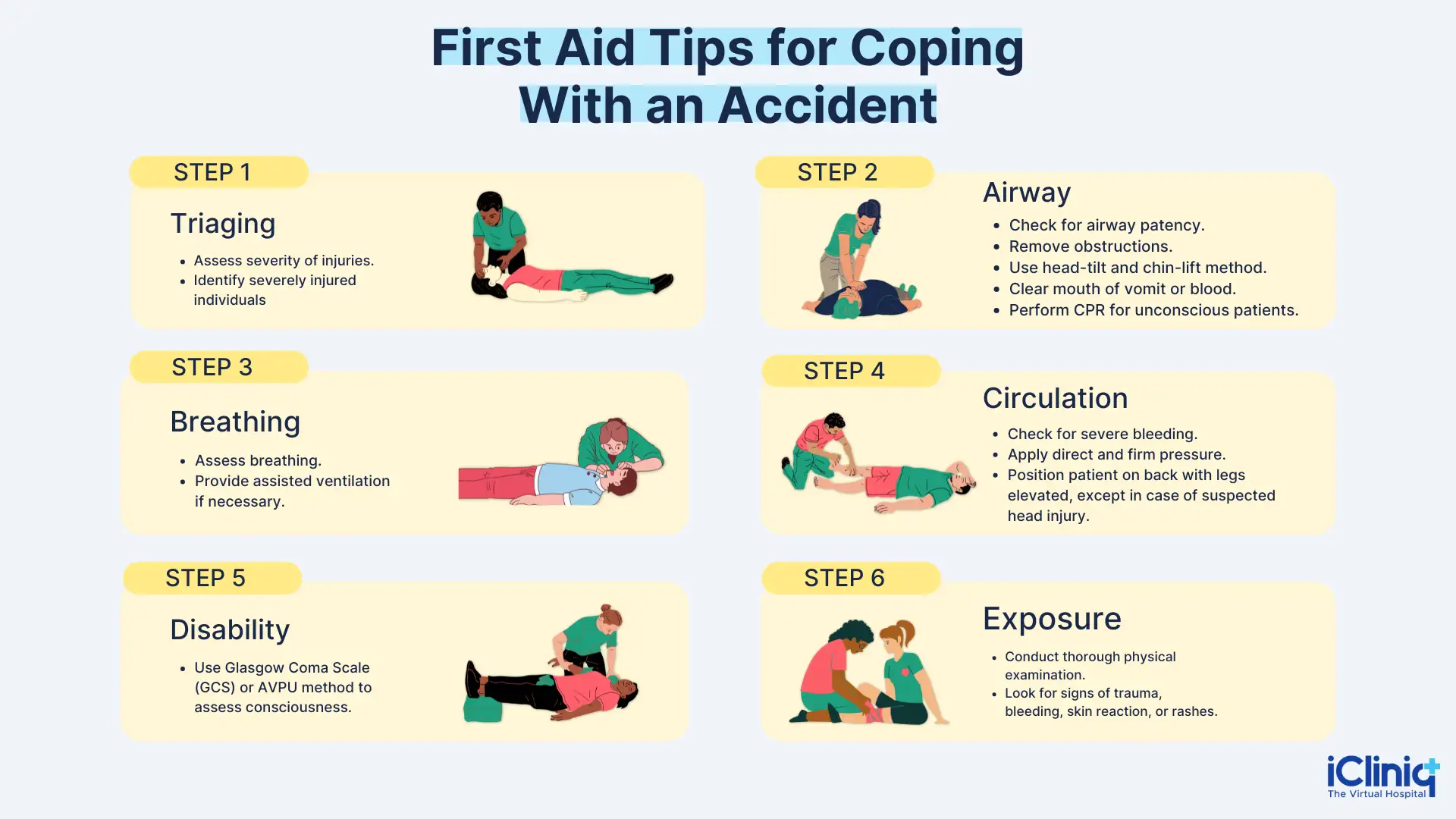
Any trauma or injury needs to be assessed and approached systematically. They are as given below:
-
Triaging: Assess the severity of the injury and identify the severely injured ones. Those who can talk, breathe, and are conscious are considered less severely injured.
-
Airway: Check if the airway is patent or if there is any obstruction in the airway. Airway obstruction can be partial or complete. Complete obstruction can be identified with no signs of breathing. A partial airway obstruction can be identified with noisy and labored breathing with increasing efforts. Untreated airway obstruction could result in immediate cardiac arrest. Hence it is imminent to establish a patent airway. A head-tilt and chin-lift method helps to establish the airway. Any foreign body obstructing the airway should be removed. A conscious patient can be given five back blows or five abdominal thrusts to remove the foreign body obstruction. Vomit or blood can be suctioned out from the mouth to open the airway. If the patient remains unconscious, start resuscitating by giving CPR (cardiopulmonary resuscitation).
-
Breathing: Assess if the breathing is normal and if insufficient assisted ventilation can be performed.
-
Circulation: Once the breathing is established, check for any severe bleeding. Profuse bleeding from the head, eyes, ears, nose, or mouth could be signs of an emergency as they indicate a head injury. Bleeding from any other parts can be stopped by applying direct and firm pressure. Try to place the patient on their back with their legs elevated to avoid complications of hypotension and hypovolemia; however, if any head injury is suspected, try limiting the patient's movement and mainly not moving the patient by their neck.
-
Disability: A Glasgow Coma Scale (GCS) can be used to assess the level of consciousness in the patient. GCS is an objective way of measuring the extent of impaired consciousness in a patient. However, a simpler and easier way would be to use the AVPU method. The patient is graded based on alertness (A), responsiveness to voice commands (V), pain responsive (P), or unresponsive (U).
-
Exposure: A thorough physical examination must be done to understand any signs of trauma, bleeding, skin reaction, or rashes. This would also help to treat the underlying cause better.
What Is Known as the Golden Hour?
The first hour as soon as the accident occurs is known as the golden hour because there are chances of survival if proper first aid is given. Loss of oxygen supply is one of the most common causes of road accident death. Mainly caused by a blocked airway, it takes less than four minutes for a blocked airway to cause death.
Road Safety as a Public Health Issue: If a person gets killed, injured, or disabled in an accident, others are affected by it, like the cost of prolonged medical care, loss of a family breadwinner, and disabilities. Survivors, their families, and other caregivers also suffer adverse social, physical, and psychological effects.
The Law Commission of India has taken “emergency medical care to victims of accidents and other emergencies,” which states that medical treatment may be urgently called for:
-
Without raising any objection regarding a medico-legal case requiring information from the police authorities,
-
Whether or not making immediate payment for screening and emergency medical treatment.
-
Whether a person has medical insurance, a medical scheme, or a system that otherwise provides for medical reimbursement.
Conclusion:
Despite several efforts, challenges are still present regarding delays in care, inadequacy, and lack of motivation of the medical staff. Road traffic accidents still are a leading cause of morbidity and mortality, particularly in developing countries. This requires strict road safety measures and a vigilant law system that could bring some drastic change. It is advisable for every individual to be aware of the basic first aid steps to be carried out in case of RTA so that major complications and fatalities can be prevented and thereby help the health care professional and improve the outcome.

