Table of Contents
Introduction
Any infection or injury to the eyes will show signs and symptoms evidently. An infection shows signs of swelling and redness commonly. But in many cases, a person will feel pressure behind the eye. This pressure can be an issue with the eye. The most common eye condition causing pressure behind the eyes is glaucoma. But it will stem from problems with the adjacent structures. Pain and pressure are different. Pain will feel like a burning sensation, but the pressure will feel like fullness. This article will discuss the various eye conditions and non-eye conditions causing pressure behind the eyes.
What Are the Conditions Causing Pressure Behind the Eyes?
Conditions causing pressure behind the eyes are as follows:
-
Dry eyes.
-
Optic neuritis.
What Is Dry Eyes?
A dry eye is a condition caused due to inadequate production of tears to lubricate the eyes. For example, a few might experience dry eyes after working on a computer for a long time, in an airplane, or in an air-conditioned room for a long time.
Symptoms:
-
A feeling of something present behind the eyes.
-
Blurred vision.
-
Redness and sensitivity to light.
-
Tearing eyes.
-
Wearing contact lenses becomes difficult.
-
Burning or scratchy sensation.
Treatment:
-
Oral antibiotics for inflammation and eye drops.
-
Tear stimulating cholinergic drugs like Pilocarpine and Cevimeline.
-
A hydroxypropyl cellulose insert will be placed between the lower eyelid and eyeball to produce tears.
-
Warm compression to free the blocked oil glands, eyelid massages, and prescribing special lenses.
What Is Scleritis?
The white of the eye is the sclera, and it serves as a protective covering. It occupies more than 80 % of the total structure of the eye. Scleritis is an inflammatory condition caused by an exaggerated immune response.
Symptoms:
-
Decreased or blurred vision.
-
Excessive tearing.
-
Redness due to inflammation.
-
Sensitive to light.
Treatment:
-
Non-steroidal anti-inflammatory drugs (NSAIDs) and oral glucocorticoids are prescribed to reduce inflammation.
What Is Optic Neuritis?
The optic nerve is responsible for carrying the visual messages from the eye to the brain. Any swelling of the eye might impinge on the optic nerve and cause optic neuritis (an inflammatory condition). Few diseases like multiple sclerosis (the coverings of the nerves will be damaged) and neuromyelitis optica (the spinal cord and the nerves of the eyes will be damaged). Women are most commonly affected by optic neuritis.
Symptoms:
-
Pain in the eyes.
-
Loss of vision.
Treatment:
-
Steroids will be administered intravenously to fasten the vision recovery.
-
If steroid administration does not work, then plasma exchange therapy is attempted.
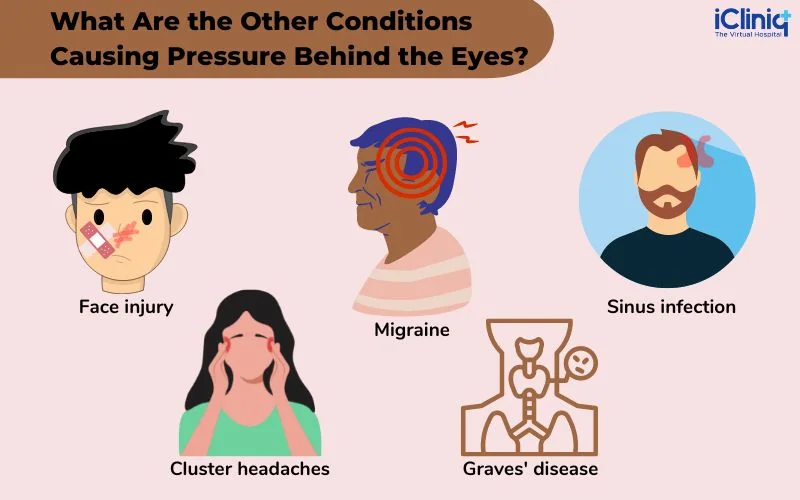
What Are the Other Conditions Causing Pressure Behind the Eyes?
-
Sinus infection.
-
Headaches.
-
Face injury.
Sinus Infection
Sinuses are hollow structures present within the bone seen in the area of the forehead, eyes, and cheekbones. These sinus structures will produce mucus that lubricates the nose's inner layers and protects it from dirt, dust, and microorganisms. The sinus linings will get inflamed or swollen, and this condition is called sinusitis.
Sinusitis condition will cause pressure behind the eyes and is also accompanied by a few other symptoms like,
-
Cough.
-
Severe headaches.
-
Weakness.
-
Sinus drainage.
-
Loss of smell.
-
Bad breath.
-
Nasal congestion.
Treatment
Several treatment modalities are suggested.
-
Steaming.
-
Decongestants (but should not be used beyond what is recommended since it causes severe congestion).
-
The use of vaporizers gives good relief.
-
Antibiotics.
Headaches
Pressure behind the eyes is present almost all the time, along with headaches. Headache is a common pain form.
Headaches are classified into two categories. They are,
-
Tension headaches.
-
Migraine-type headaches.
-
Cluster headaches.
Tension headaches are caused due to stress and anxiety. The muscles of the shoulder, neck and scalp are stiff during this type of headache.
Cluster headaches are the most excruciating headaches caused due to abnormalities in the biological clock of the body. These headaches may last from 15 minutes to three hours and usually at night and around the same time. Alcohol and Nitroglycerin drugs tend to trigger cluster headaches.
Migraine is often characterized by pain behind the eyes. Hormones, stress, and flashing lights are the common causes of migraines. Migraines can be treated with steroids, opioids, and triptans.
Graves' Disease
The immune system will identify the thyroid gland as a foreign body and attack it. Thus the gland produces large amounts of its hormones, causing hyperthyroidism. This condition is called Graves' disease. Robert Grave first described this condition and, therefore, is named after him. These overactive thyroid glands affect the heart, bone, and muscles.
Graves' disease affects the eye's muscles, causing the eyes to swell up. Because of the swelling, when the patients try to move their eyes, pressure is felt behind the eyes. Also, blurred vision, double vision, sensitivity to light, and optic nerve damage leading to vision loss are seen.
Treatment
-
Beta-blockers like Propranolol and Metoprolol are the suggested fine line of treatment for Graves' disease. These medications are prescribed to keep the status of the heart under control until hyperthyroidism is cured.
-
Methimazole and Propylthiouracil are antithyroid drugs and will be prescribed to lower the levels of thyroid hormones and control hyperthyroidism. These medications in a few people can rarely cause skin rashes and rarely affect the liver.
-
Radiation therapy is also recommended for two to three months to shrink the thyroid gland and eventually reduce the production of hormones. The treatment includes the patient taking an Iodine pill.
-
In severe cases, surgical removal of the thyroid gland partially or wholly is also suggested.
Face Injury
Injuries to the face that include the eye structure also, from accidents or sports fields can cause pressure behind the eyes.
Eye socket fractures are common and show symptoms like,
-
Pressure behind the eyes.
-
Black eye.
-
Swollen eyes.
-
Double vision.
Treatment
-
Ibuprofen, Aspirin, or Acetaminophen are prescribed to treat the pressure behind the eyes.
Conclusion
The pressure or pain behind the eyes can be scary, but in the majority of cases, no severe illness will be associated with it. Consulting with an ophthalmologist at the earliest will give way for an early diagnosis and treatment.