Table of Contents
- 1What Is a Brief Psychotic Disorder?
- 2What Causes the Brief Psychotic Disorder?
- 3Is Brief Psychotic Disorder Common?
- 4What Are the Typical Symptoms of a Brief Psychotic Disorder?
- 5How to Diagnose a Brief Psychotic Disorder?
- 6What Are the Complications of Brief Psychotic Disorder?
- 7What Is the Outlook of Brief Psychotic Disorders?
Introduction:
Mental health is equally important as physical health. One should maintain mental health by spending time with family and friends and sharing thoughts and feelings. Denying to do so may result in mental disorders. In addition, factors like stress also induce behavioral changes. One such is a brief psychotic disorder (sudden onset of psychotic behavior) that occurs suddenly due to a stressful event and may last less than a month. This article gives an insight into the brief psychotic disorder.
What Is a Brief Psychotic Disorder?
A brief psychotic disorder is characterized by sudden psychotic behavior (hallucination, strange speech) that lasts for less than a month, followed by complete recovery. It differs from other psychotic disorders because it occurs suddenly and lasts for a shorter period, whereas other mental illnesses may be chronic and require lifelong treatment.
What Causes the Brief Psychotic Disorder?
The factors that trigger the onset of brief psychotic disorders include:
-
Stress.
-
Traumatic events.
-
Loss of loved ones.
-
Preexisting personality disorders.
-
Specific medical conditions.
The different forms of brief psychotic disorder based on their causes are listed below:
-
Brief Psychotic Disorder With a Stressor - This occurs immediately due to a stressful event. The event can be a loss of loved ones, an accident, or a disaster. It is also referred to as brief reactive psychosis.
-
Brief Psychotic Disorder Without Stressors -The psychotic symptoms occur suddenly without underlying stress or triggers.
-
Brief Psychotic Disorder With Postpartum Onset - This type affects women explicitly, and the psychotic symptoms occur four weeks after childbirth (postpartum).
Is Brief Psychotic Disorder Common?
Brief psychotic disorder is a rare condition; women and individuals with preexisting personality disorders are more affected. Its prevalence is higher in individuals with high stress (natural disaster victims, refugees, and immigrants) and those between 20 and 40 years of age. In addition, several studies show that its occurrence is higher in developing than in developed countries.
What Are the Typical Symptoms of a Brief Psychotic Disorder?
The classic features considered during the evaluation of brief psychotic disorder are as follows:
-
Odd behavior.
-
Hallucination (sensing things that are not present).
-
Delusion (false beliefs).
-
Strange or disorganized speech.
-
Mood disturbance.
-
Confusion.
-
Problem with memory.
-
Attention problems.
These symptoms last a shorter period, mostly one day or less than one month.
How to Diagnose a Brief Psychotic Disorder?
-
Clinical Examination: The psychiatrist may ask questions related to previous stressful events (disaster, death, or recent immigration), any underlying psychotic disorders, and medical conditions present. In addition, the presence of psychotic disorder for less than a month confirms the diagnosis.
-
Urine Toxicology Test: A urine sample is collected and screened for the presence of legal or illegal drugs. It aids in differentiating from drug-induced psychosis, where symptoms like hallucinations and delusions occur as a result of specific medications.
-
Magnetic Resonance Imaging (MRI): MRI of the brain may help detect any injury, infection, or tumor in the brain structures. Therefore, the MRI helps identify the specific cause of psychotic symptoms.
-
Pregnancy Serum Test: A pregnancy test assists in evaluating the cause of behavioral disturbances in women. Stress, anxiety, and other mood changes are normal during pregnancy.
What Are the Other Conditions Related to Brief Psychotic Disorders?
The conditions that often lead to misdiagnosis of brief psychotic disorders are,
-
Psychotic-Affective Disorder: A mental disorder characterized by symptoms like hallucination, depression, mania, or delusion. The severity and duration of symptoms vary from one to another. This disorder affects functioning at school, work, or other places. The affected individual may respond well to treatment, but the symptoms do not resolve within a month.
-
Substance-Induced Psychosis: It is also referred to as drug-induced psychosis and may occur due to excessive intake or withdrawal of specific drugs or substances (alcohol). The healthcare specialist may suggest antipsychotics to manage the symptoms.
-
Schizophrenia-Spectrum Disorders: A chronic mental disorder that involves symptoms like mood disturbances, delusion, hallucination, and disorganized speech, which may last more than six months.
-
Borderline Personality Disorder: A person affected with borderline personality disorder may have problems with their self-image, managing emotions, and relationships. The classic symptoms include mood swings, anger, fear of rejection, unstable relationships, and suicidal thoughts. Immediate psychotherapy (talk therapy) and other medications are essential in preventing its progression.
Is Brief Psychotic Disorder Treatable?
Pharmacological Management: The brief psychotic disorder is usually treated with second-generation antipsychotic drugs. The doctor may suggest continuing the medication (one to three months) even after remission. The remedies are usually indicated in oral forms; in the case of an emergency, the doctor may use intramuscular forms. The drugs indulged in treating brief psychotic disorder are listed below:
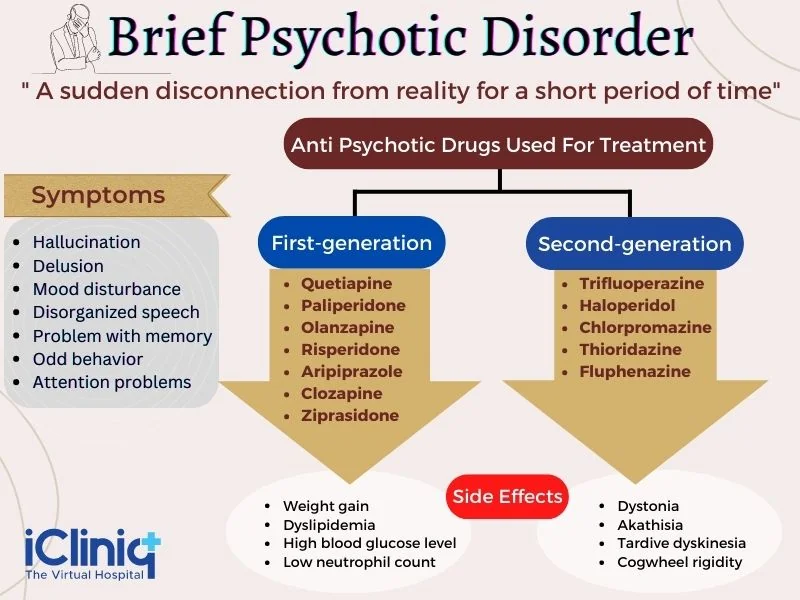
-
Psychiatric Management: This treatment mainly focuses on relieving stress and improving other skills. The psychiatrist may have several follow-ups with the patient to identify any relapse. The specialist also educates the family and friends of the affected individual about the condition and the support needed. The brief psychotic disorder usually subsides within a month; however, combined pharmacological and psychological management aids in improving the symptoms and preventing their relapse.
What Are the Complications of Brief Psychotic Disorder?
The complications include:
-
Sudden loss of function.
-
Repeated stressful events may push the patient into violence and suicidal thoughts.
What Is the Outlook of Brief Psychotic Disorders?
The general outlook of the condition is that it usually lasts only for a month, and the patient fully recovers soon after this event. However, in rare cases, a brief psychotic disorder may occur more than once. The doctor may consider the condition as schizophrenia (a mental health condition that affects the way a person feels, thinks, or behaves) if the symptoms last for more than six months.
Conclusion
Brief psychotic disorders cannot be prevented because they occur due to stressful events like accidents or natural disasters that are not preventable. But how a person reacts to it matters. One should be able to cope with things happening in life. Even though brief psychotic disorder is an acute disorder and has a good prognosis with proper treatment, it is essential to discuss it with a psychiatrist or psychologist to prevent unnecessary thoughts and conditions from worsening. In addition, one should always express one's feelings to family and friends to avoid mental stress.