
- 1What Is Pantoprazole Used For?
- 2How Does Pantoprazole Work?
- 3What Is the Dosage and Administration of Pantoprazole?
- 4How to Use Pantoprazole?
- 5What Are the Drug Warnings and Precautions?
- 6What Are the Side Effects of Pantoprazole?
- 7What Are the Drug Interactions of Pantoprazole?
- 8What Are the Common Brand or Trade Names of Pantoprazole?
What Is Pantoprazole?
Pantoprazole is a proton-pump inhibitor (PPI). These are medicines that strongly reduce the amount of acid your stomach makes. They block the stomach’s proton pumps responsible for making acid. The body eventually makes new proton pumps, so stomach acid levels slowly return to normal.
Pantoprazole is a medicine doctors prescribe for conditions like acid reflux (GERD), damage and inflammation of the food pipe (esophagitis), stomach ulcers, and situations where the stomach makes too much acid, such as Zollinger–Ellison syndrome. It is available as a pill or an injection, and most adults take 40 mg once a day. Taking it for a long time may sometimes lead to low vitamin B12, low magnesium, or weaker bones.
The FDA approved Pantoprazole on February 2, 2000.
Drug Group:
Pantoprazole belongs to the drug class called PPIs (proton pump inhibitors). PPIs block the proton pump in the stomach lining, which reduces the amount of acid the stomach makes.What Is Pantoprazole Used For?
What Are the Uses of Pantoprazole?
1. Short-Term Treatment of GERD-Related Esophagitis
-
Pantoprazole tablets are used in adults to treat erosive esophagitis (when acid reflux damages the food pipe).
-
Treatment usually lasts up to 8 weeks.
-
If healing hasn’t happened by then, your doctor may give you another 8 weeks of treatment.
-
Pantoprazole can also be used for this condition in children 5 years and older, but its safety for use beyond 8 weeks has not been proven.
2. Keeping the Esophagus Healed
-
Pantoprazole is used in adults to maintain healing after erosive esophagitis.
-
It helps reduce the chance of heartburn returning, both during the day and at night.
3. Long-Term Conditions with Too Much Stomach Acid
-
If your stomach produces too much acid (for example, in Zollinger-Ellison syndrome), your doctor may prescribe Pantoprazole. Depending on how the body responds, a person might need to take it for a longer time.
4. Other Uses:
-
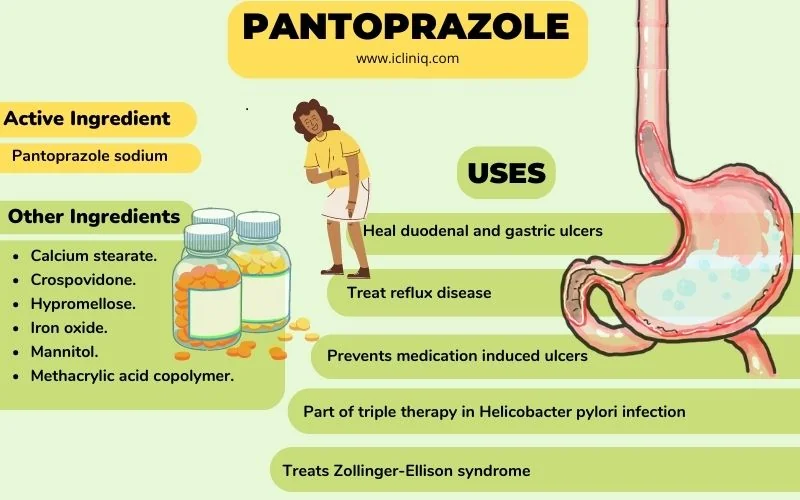
NSAIDs Related Ulcers: Pantoprazole may be used to prevent or heal stomach ulcers caused by NSAIDS (non-steroidal anti-inflammatory drugs) such as Ibuprofen or Naproxen, especially in patients at high risk.
-
H. pylori Treatment Combo: Pantoprazole is used with antibiotics to treat ulcers caused by H. pylori.
Pantoprazole Warnings and Precautions:
Pantoprazole warnings and precautions are as follows:
-
Gastric Cancer: Feeling better with Pantoprazole does not mean you don’t have stomach cancer.
-
Atrophic Gastritis: Long-term use of Pantoprazole, especially in people with H. pylori infection, may sometimes cause thinning of the stomach lining (atrophic gastritis).
-
Vitamin B12 Deficiency: Taking acid-reducing medicines like Pantoprazole for over 3 years may lead to Vitamin B12 deficiency. Doctors should check for this if symptoms (like fatigue, nerve problems, or anemia) appear.
-
Bone Fracture: Taking Pantoprazole for a long time or in high doses may weaken bones and increase the risk of breaks, especially if you have weak bones. Use the lowest dose for the shortest time needed.
-
Low Magnesium (Hypomagnesemia): Pantoprazole may rarely cause low magnesium levels, usually after 3 months to 1 year of use. This can lead to serious problems like seizures, abnormal heart rhythm, or muscle spasms. Doctors may check magnesium levels, especially if you take medicines like Digoxin or diuretics.
-
Risk of Tumors: In long-term studies on animals, Pantoprazole sometimes caused rare stomach tumors. It’s not known if this can happen in people.
-
THC Urine Test: Pantoprazole may interfere with urine tests for marijuana (THC).
-
Use with Methotrexate: When taken with high-dose Methotrexate, Pantoprazole may increase Methotrexate levels in the blood and cause side effects. Doctors may stop Pantoprazole temporarily during Methotrexate treatment.
For Patients
How Does Pantoprazole Work?
- Pantoprazole helps by making less acid in your stomach.
-
Your stomach has tiny pumps that release acid to digest food.
-
Sometimes these pumps make too much acid, which causes problems like heartburn, reflux, or ulcers.
-
Pantoprazole turns off these pumps, so less acid comes out.
-
With less acid, your stomach and food pipe can heal.
-
Think of it as turning down the stove's heat so food doesn’t burn. Pantoprazole turns down the acid so your stomach doesn’t get hurt.
How Is Pantoprazole Administered?
-
Pantoprazole is usually given as tablets that must be swallowed whole, with or without food.
-
For adults with GERD-related erosive esophagitis, the usual dose is 40 mg daily for up to 8 weeks. If the stomach or esophagus hasn’t healed, the doctor may extend treatment for another 8 weeks.
-
40 mg once daily is recommended for maintaining esophagus healing. In cases of pathological hypersecretory conditions like Zollinger-Ellison syndrome, doses may start at 40 mg twice daily and be adjusted as needed.
-
Intravenous (IV) Pantoprazole can also be used when oral treatment is impossible. In this case, the usual dose of 40 mg is given once daily by IV injection over at least 2 minutes or by infusion over 15 minutes. Higher IV doses up to 240 mg daily may be given in severe conditions, depending on the patient’s needs.
Pantoprazole is usually prescribed for short-term use (up to 8 weeks). Long-term use may be required for some conditions, but only under close medical supervision.
What Are the Side Effects of Pantoprazole?
1. Common Side Effects of Pantoprazole:
- Headache.
- Nausea or vomiting.
- Gas (bloating).
- Diarrhea.
- Dizziness.
- Joint pain.
- Stomach pain.
- Constipation.
- Dry mouth.
- Sleep problems (insomnia).
- Feeling depressed or anxious
- In men, trouble getting or keeping an erection.
2. IV-specific Side Effects:
- Pain, swelling, or redness at the injection site.
3. Serious Side Effects (Get Medical Help Right Away):
- Call your doctor right away if you notice blistering, peeling, or painful sores on your mouth, lips, genitals, or face. These can also come with fever or swollen glands.
- Allergic reactions include rash, hives, lips, eyes, throat, or tongue swelling, or if you have trouble breathing or swallowing.
- Irregular or fast heartbeat, muscle spasms, shaking, seizures, extreme tiredness, or dizziness.
- Severe diarrhea with stomach pain or fever that does not go away (possible C. difficile infection).
- New or worsening joint pain, or rash sensitive to sunlight on cheeks or arms.
- Kidney problems (changes in urination, blood in urine, nausea, fever, or swelling).
- Pantoprazole may rarely trigger lupus erythematosus, an immune condition that causes joint pain, skin rashes, and sensitivity to sunlight.
4. Long-Term Risks (More Likely With High Doses or Over 1 Year of Use):
- Higher risk of bone fractures (hip, wrist, spine).
- Development of fundic gland polyps (growths in the stomach lining).
Always call your doctor if you notice any unusual symptoms while taking Pantoprazole. If you are receiving IV treatment, report any pain or swelling at the injection site.
What Are the Things to Inform the Doctor Before Taking Pantoprazole?
Before taking Pantoprazole:
- Allergies: Tell your doctor or pharmacist if you are allergic to Pantoprazole or medicines like Esomeprazole, Lansoprazole, Omeprazole, or similar ones. If you're not sure, ask for a list of ingredients.
- Other Medicines: Some medicines, vitamins, or supplements (like iron) can cause problems with Pantoprazole. Tell your doctor and pharmacist about everything you take. Don’t start or stop medicines without asking your doctor.
- Health Problems: Tell your doctor if you have:
-
Low minerals in your blood (magnesium, calcium, potassium).
-
Weak bones (osteoporosis).
-
Low vitamin B12.
-
Autoimmune disease (your body attacks itself).
-
Problems with parathyroid hormone.
-
-
Pregnancy or Breastfeeding: If you are pregnant, plan to get pregnant, or are breastfeeding, tell your doctor. Call your doctor if you get pregnant while taking Pantoprazole.
-
Older adults: If you are 70 or older, discuss the risks with your doctor. Take the medicine only as long as your doctor says.
Dietary Considerations:
While taking Pantoprazole, try to avoid foods and habits that worsen reflux, such as spicy foods, large meals before bedtime, smoking, and heavy alcohol intake.
Missed Dose:
Take your missed Pantoprazole dose as soon as you remember. If your next dose is coming soon, skip the missed one and continue normally. Don’t take two doses together.
Overdose:
Taking too much Pantoprazole can be dangerous. Symptoms of an overdose may include:
- Severe dizziness.
- Fast heartbeat.
- Feeling very sleepy or weak.
- Trouble breathing.
If someone takes too much Pantoprazole, call the doctor or visit the nearest emergency room immediately. Bring the medicine with you so the doctors know what was taken.
Storage and Handling:
- Keep the medicine in its original container with the lid tightly closed.
- Store it at room temperature, away from heat, moisture, and sunlight (don’t keep it in the bathroom).
- Keep it out of reach and sight of children. Many containers are not child-proof, so always lock safety caps and place them somewhere high and safe.
- Do not flush the medicine down the toilet.
- Dispose of unused medicine safely so children, pets, or others cannot take it. Use a medicine take-back program.
For Doctors
- Chemical Taxonomy
- Chemical Formula: C₁₆H₁₅F₂N₃O₄S
- Chemical Class: Substituted benzimidazole.
- Molecular Weight: 383.37 g/mol.
- IUPAC Name: 6-(Difluoromethoxy)-2-[(3,4-dimethoxypyridin-2-yl)methylsulfinyl]-1H-benzimidazole.
Dose:
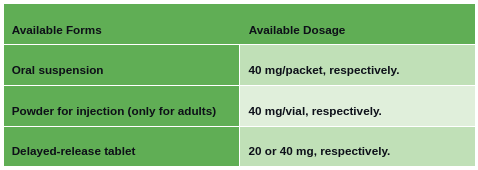
Oral (Tablet) Dosage:
1. For Erosive Esophagitis (GERD-related):
-
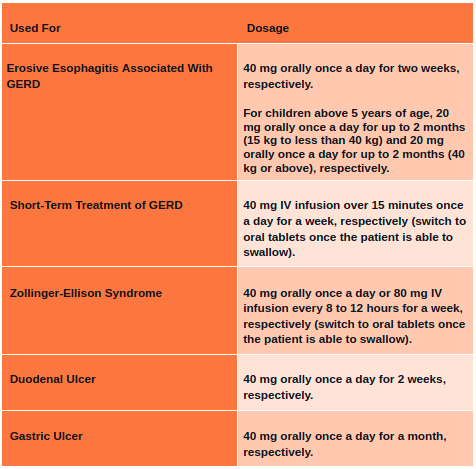
Adults: 40 mg once daily for up to 8 weeks.
-
If not healed, treatment may be extended for another 8 weeks.
2. For Maintenance Therapy (After Healing of Esophagitis):
-
Adults: 40 mg once daily.
3. For Zollinger-Ellison Syndrome or Other High Acid Conditions:
-
Adults: 40 mg twice daily.
-
Dose may be increased up to 240 mg/day if needed.
-
For Wyeth's version, pediatric use (5 years and older with erosive esophagitis due to GERD) is approved.
IV (Injection) Dosage:
1. For Erosive Esophagitis (GERD-related, When Oral Not Possible):
-
Adults: 40 mg IV (through vein) once daily for 7 to 10 days.
-
Switch to oral tablets when the patient can swallow.
2. For Zollinger-Ellison Syndrome or Other High Acid Conditions:
-
Adults: 80 mg IV every 12 hours.
-
It can be adjusted, with a maximum of up to 240 mg/day.
-
Given as a slow IV infusion (at least 2 minutes).
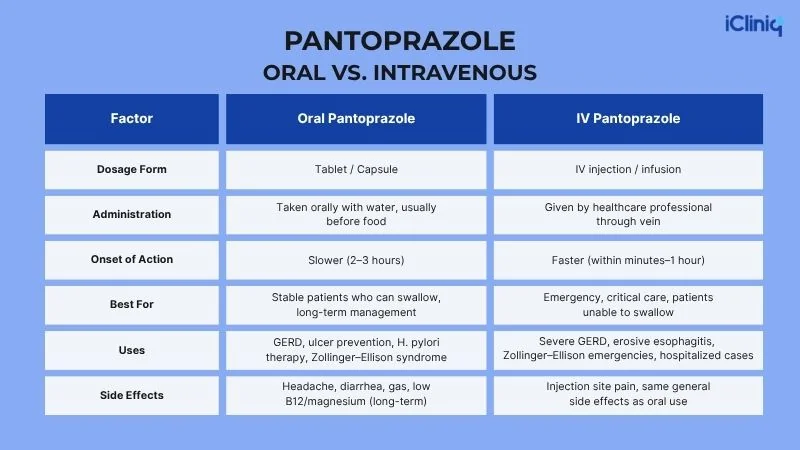
Oral or IV: Which One Is Right for You?
-
Oral (By Mouth): If you can comfortably swallow and your body absorbs medicine well, oral tablets or capsules are the simplest, least invasive, and most convenient option, especially for long-term treatment.
-
Intravenous (IV): If you need quick relief, can’t swallow, or your condition requires a controlled dose directly into the bloodstream (like in emergencies), IV is usually the safer and faster route.
Decision-making:
-
Start oral if the patient is stable, able to take tablets, and absorption is not an issue.
-
Use IV in emergencies, severe illness, or when oral intake isn’t possible.
What Are the Pharmacological Actions of Pantoprazole?
1. Pharmacokinetics:
- Pantoprazole is absorbed well in the stomach.
- Reaches its highest level in the blood within 2 to 3 hours.
- Leaves the body primarily through urine.
- Works the same in men, women, the elderly, and kidney patients (dose may vary).
2. Mechanism of Action: It stops the stomach's H⁺/K⁺ ATPase enzyme, reducing acid secretion.
3. Pharmacodynamics:
- Pantoprazole blocks stomach acid strongly (best at 40 mg).
- Works within hours, effect lasts 24 hours or more.
- Acid levels return to normal about a week after stopping.
- It may raise the gastrin hormone, but it returns to normal after stopping.
Toxicity:
- Rats and mice given very high doses (up to 200 to 400 mg/kg/day, many times higher than human doses) developed stomach, liver, and thyroid tumors.
- Stomach cell overgrowth (ECL cell changes) was seen at doses greater than or equal to 50 mg/kg/day.
- Fertility and pregnancy studies in rats (up to 500 mg/kg/day) and rabbits (up to 450 mg/kg/day) showed no harm to babies.
- Other high-dose effects: heavier stomachs, liver changes, higher blood fats, and mild blood changes. Most went away after stopping the drug.
What Are the Contraindications of Pantoprazole?
Pantoprazole should not be used in people who are allergic to Pantoprazole or have severe allergic reactions to any PPI, its ingredients, or other similar medicines called substituted benzimidazoles.
What Are the Drug Interactions of Pantoprazole?
- HIV Medicines (Atazanavir, Nelfinavir): Do not take these with Pantoprazole. The acid-blocking effect lowers their levels, making them less effective and possibly causing drug resistance.
- Blood Thinner (Warfarin): Pantoprazole, used with warfarin, may increase INR and bleeding risk. Patients need close monitoring.
- Antiplatelet (Clopidogrel): Safe to take with Pantoprazole. No dose change is needed.
- Medicines that need stomach acid to act: For example, Ketoconazole, Ampicillin esters, and iron salts. Pantoprazole may reduce its absorption.
- Urine Drug Tests for THC: Pantoprazole may cause false positive results. A confirmatory test should be used.
- Methotrexate (Especially High Doses): Pantoprazole may increase methotrexate levels in the blood. Caution is advised.
Which Clinical Studies Support the Use of Pantoprazole?
-
Erosive Esophagitis (EE):
-
US Multicenter Healing Study: Pantoprazole 40 mg healed 75 % in 4 weeks and 93 % in 8 weeks.
-
European Dose-Response Trial – 40 mg worked faster than 20 mg.
-
-
Long-Term Maintenance:
-
12-Month Relapse Prevention Study – Pantoprazole was healed at 70 to 86 % compared to 35 to 37 % with Ranitidine.
-
Pantoprazole Heartburn Relief Trial – fewer symptoms than ranitidine.
-
-
Hypersecretory Conditions: Pantoprazole Zollinger–Ellison Program – High doses (80 to 240 mg/day) controlled acid for up to 2 years.
Use in Specific Populations
-
Pregnancy: Limited human data. Animal studies showed no major risk, but use only if clearly needed.
-
Lactation: Pantoprazole passes into breast milk in small amounts. Depending on its importance to the mother, consider stopping breastfeeding or the drug.
-
Pediatric Use: Pantoprazole is approved for children 5 years and older with erosive esophagitis due to GERD. Safety has not been established for children under 5. In the U.S., it is FDA-approved for children 5 years and older with GERD-related erosive esophagitis. In the U.K., it is not generally recommended for those under 12 unless prescribed by a specialist.
-
Geriatric Use: There are no major differences in safety or effectiveness, but the elderly may be more sensitive to side effects.
-
Renal Impairment: No dosage for Pantoprazole adjustment needed.
-
Hepatic Impairment: In moderate-to-severe liver disease, exposure to Pantoprazole is increased. Use it cautiously.
Conclusion:
Pantoprazole helps by lowering the extra acid in your stomach. This gives your food pipe (esophagus) and stomach a chance to heal. When used the right way, it is safe and works well. It also provides long-lasting relief from heartburn and acid reflux. Overall, Pantoprazole is a trusted medicine for acid problems.
Note from iClinq:
- Pantoprazole reduces stomach acid and helps treat problems like GERD and erosive esophagitis.
- Studies show that an 8-week course usually heals erosive esophagitis, but if healing takes longer, a longer treatment may be needed.
- Long-term or high-dose use may increase fracture risk, so doctors recommend using the lowest effective dose.
- Consult our gastroenterologist if symptoms persist, side effects appear, or you need prolonged Pantoprazole therapy.

