Table of Contents
- 1What Is Bevacizumab?
- 2How Does Bevacizumab Work?
- 3What Cancers Does It Treat?
- 4Important Safety Information
- 5What Are the Ways to Receive Bevacizumab?
- 6Who Should Be Careful While Taking Bevacizumab?
- 7When Can Bevacizumab Not Be Used?
- 8For Patients
- 9What Is Cancer Anyway?
- 10Warning Signs
- 11What to Expect During Infusion?
- 12Is Bevacizumab Safe?
- 13Side Effects to Watch For
- 14For Doctors
- 15Major Drug Interactions
- 16Clinical Trial Evidence
What Is Bevacizumab?
Bevacizumab is an antiangiogenic agent that interferes with the formation of new blood vessels to deliver oxygen to tumor cells. Bevacizumab serves as a steroid-sparing agent when given together with immunotherapy.
Bevacizumab is a cancer treatment that works differently from traditional chemotherapy. Instead of directly killing cancer cells, it cuts off their food supply by blocking new blood vessel growth. Think of it as starving the tumor rather than poisoning it.
This drug is used in combination with other cancer drugs to treat tumors of the colon, rectum, and other organs. It is FDA (Food and Drug Administration) approved to be used with chemotherapy, especially in the case of ovarian cancer patients.
How Does Bevacizumab Work?
Your body produces something called VEGF (vascular endothelial growth factor). Cancer cells love this because it helps them build their own blood supply. Bevacizumab blocks VEGF from doing its job.
When this happens, two good things occur. First, the tumor's blood vessels become more normal, which sounds odd but actually helps. Second, chemotherapy drugs can reach the cancer more easily.
Your body breaks down Bevacizumab through a natural process throughout your system. Men clear it slightly faster than women (0.207L per day). The drug sticks around for about 20 days, though traces can remain for up to four months.
What Cancers Does It Treat?
Bevacizumab has been given the green light by the FDA for use in a number of cancer types:
-
Colorectal Cancer:
This type of cancer affects the colon and rectum.
-
Lung Cancer:
Specifically, non-small cell types.
-
Kidney Cancer:
Also called renal cell cancer.
-
Glioblastoma:
An aggressive brain or spinal cord tumor.
-
Cervical Cancer:
When it has spread or can't be surgically removed.
-
Liver Cancer:
More specifically, hepatocellular carcinoma, when it has spread.
Important Safety Information
Black Box Warnings
This medicine has serious safety warnings.
-
Severe Infusion Reactions:
Bevacizumab can cause sudden, serious reactions during or after infusion. These need immediate medical attention.
-
Intestinal Tears:
It increases the risk of holes or tears in the intestines.
-
Wound-Healing Problems:
Cuts or surgical wounds may heal slowly or poorly.
-
Serious Bleeding:
There is a higher risk of dangerous bleeding.
Important FDA Note
In November 2011, the FDA withdrew approval for using Bevacizumab in breast cancer after finding it was not safe or effective for that condition.
What Are the Ways to Receive Bevacizumab?
Bevacizumab is primarily injected directly into your vein. You may also be given the drug under the skin or into a muscle, but drug administration will be through an IV (intravenous) vein in most cases.
Available Strengths
The concentration of the solution is 25 mg/mL. Two sizes of vials are available: one smaller 100 mg vial (3 ml) and a larger 400 mg vial (16 ml).
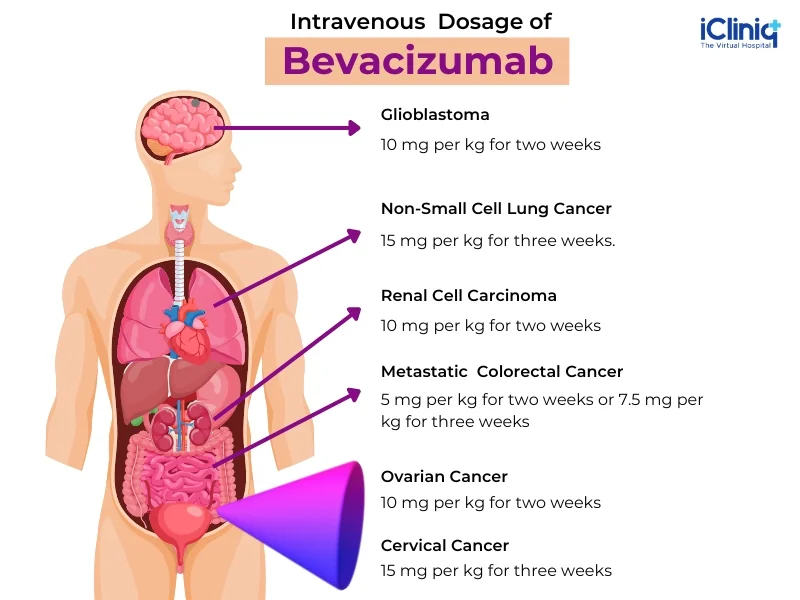
Typical Doses
You should not exceed a dose of 20 mg per kilogram of your body weight.
Who Should Be Careful While Taking Bevacizumab?
Allergies:
If you experienced a negative reaction to Bevacizumab, avoid using it a second time. The main symptoms to watch out for are the appearance of skin rashes, itching, flushing, swollen lips or feet, and difficulty in breathing.
Pregnancy and Nursing:
This medicine can cause serious harm to a baby in the womb. If you are pregnant or want to get pregnant, a doctor may suggest different drugs. You should take effective contraceptive measures during the course of the medication and for six months after the last dose.
The same goes for breastfeeding. Wait at least six months after your final dose before nursing.
Older Adults:
Seniors may experience more severe side effects with long-term use. Your doctor will monitor you more closely.
Children:
There is no adequate safety data for kids yet, so doctors typically don't prescribe Bevacizumab to pediatric patients.
Daily Activities:
This treatment can make you tired and give you headaches. Avoid driving or operating machinery if you feel drowsy or unfocused.
When Can Bevacizumab Not Be Used?
Some conditions make this drug too risky:
-
Fistulas:
If you have an abnormal connection between organs, this drug can make it worse or even fatal.
-
Bowel Problems:
People with intestinal blockages or certain types of bowel involvement shouldn't use it. The drug can cause tears in your intestines.
-
Recent Surgery:
Bevacizumab affects how wounds heal. You'll need to wait at least 28 days after surgery before starting treatment. The same goes before planned surgery.
-
Bleeding Issues:
If you've recently coughed up blood or had significant bleeding, this isn't the right treatment for you.
-
A Brain Condition Called PRES (Posterior Reversible Encephalopathy Syndrome):
This neurological disorder causes headaches, seizures, confusion, and vision problems. If you've had it before, avoid Bevacizumab.
-
Vaccines:
Stay away from live vaccines (rubella, mumps, measles, yellow fever) during treatment and for 12 months after finishing.
Use With Caution If You Have
-
High Blood Pressure:
Bevacizumab can make it worse. Your doctor will check your pressure regularly.
-
Kidney Problems:
The drug can increase protein in your urine, especially if your kidneys aren't working well.
-
Blood Clot History:
This medication raises your risk of dangerous clots in veins and arteries.
For Patients
What Is Cancer Anyway?
Let's take a step back. Cancer is the growth of malignant cells in your body that spreads to places where they normally wouldn't be. Normal cells mutate into abnormal cells, which in turn can become malignant cells.
Your whole body can be affected by cancer, and in fact, it might be there without you knowing for years. Tobacco smoking, high sugar and fat diets, toxins or radiation, and hormone therapy have all been linked as risk factors for cancer.
Warning Signs
Watch out for these early symptoms:
-
Unexplained weight loss.
-
Constant fatigue.
-
Pain that lasts for a long time and is deep in your tissue.
-
Night sweats.
Changes in the skin, especially the development of new moles or changes to pre-existing ones
As the disease develops, you may also experience:
-
Easy bruising and bleeding.
-
Lumps under the skin.
-
Difficulty in breathing or swallowing.
Important Facts About Your Treatment
-
Timing:
You'll receive doses every two to three weeks.
-
When It Starts Working:
The drug begins working with your first dose. Don't expect to feel different right away since it doesn't treat cancer symptoms. Instead, it slows the growth of cancer cells.
-
Stay Hydrated:
Drink plenty of fluids throughout treatment.
-
Infection Prevention:
Wash your hands frequently and avoid contact with sick people when possible.
-
Sun Protection:
Limit sun exposure during treatment.
-
Duration:
Effects last three to four months in your body, though this varies based on your dose and treatment length.
What to Expect During Infusion?
Your initial infusion will last around 90 minutes. If the first one goes well, the second one will be 60 minutes. Later on, infusions might be as short as 30 minutes.
A doctor or nurse who has been trained will administer the medication in a hospital or clinic. The medicine will be given to you through a needle in your arm or hand connected to a cannula (a small tube). For longer courses of treatment, you may be given a central line (a tube placed into a large vein) that can be kept for months.
When you get your treatments and how often depends on the type of cancer you have, the other drugs you're taking, and how your body is.
Some people react very badly. When this occurs, your healthcare provider may decide to reduce the infusion rate, postpone the treatment, or discontinue it altogether.
Monitoring Your Health
-
Regular blood tests are required before each treatment and sometimes after treatment. These laboratory tests identify your blood cell counts, liver and kidney functions, and other important markers.
-
If you forget to take a medication, take it when you remember. Never double up on doses, as this can cause dangerous reactions.
-
Always make sure to review the expiration date on your medication package. Don't ever take Bevacizumab that is past its expiration.
Discuss With Your Doctor Everything
Before initiating therapies, tell your doctor all your medical records:
-
Medications:
List all medicines, including prescription drugs, over-the-counter medicines, vitamins, supplements, and herbal products. Inform if you are on anthracycline (a drug for breast cancer or leukemia).
-
Allergies:
Inform your doctor about any previous adverse reactions to Bevacizumab or its components.
-
Radiation History:
Your doctor has to be informed if you have had radiation treatment on your chest or pelvis.
-
Pregnancy Desires:
Talk about it even if it's just a thought.
-
Upcoming Procedures:
This includes dental work. Your doctor will likely pause treatment for at least 28 days before and after surgery until you're fully healed.
Is Bevacizumab Safe?
Bevacizumab can cause serious problems like bleeding, high blood pressure, wound healing issues, and intestinal tears.
Does It Work?
Yes, if used properly. Bevacizumab is a powerful inhibitor of cancer's blood vessel-forming ability. Depriving cancer cells of oxygen and nutrients, thus killing them. It is especially effective for advanced stage III and IV cancers.
Side Effects to Watch For
Common, Manageable Effects
-
Taste changes.
-
Dry skin.
-
Reduced appetite.
-
Diarrhea.
-
Sleep difficulties.
-
Minor bleeding (nosebleeds, rectal bleeding).
-
Headaches.
-
Voice changes.
-
Stuffy or runny nose.
Serious Effects That Require Immediate Medical Attention
-
Blood Clots:
Such complications could result in heart attacks, strokes, chest pain, and lung or leg clots.
-
Intestinal Perforation:
Symptoms may include very sharp abdominal pain.
-
Brain and Vision Problems:
Potential outcomes of these disorders include blindness, intense headaches, seizures, very high blood pressure, and disorientation.
-
Kidney Damage:
When the urine contains too much protein, it can lead to symptoms such as bloating, weight gain, high blood pressure, swollen hands and feet, and foamy urine.
-
Infusion Reactions:
These are dangerous allergic reactions that may cause symptoms such as chest pain, wheezing, sweating, and drastic changes in blood pressure.
-
Heart Failure:
This condition manifests as symptoms such as bloating, extreme fatigue, wheezing, breathlessness, and frequent coughing.
-
Early Menopause:
The symptoms that women may experience include stopping their periods, vaginal dryness, sleep disturbances, and changes in their mood.
Never Stop Suddenly
-
Always take Bevacizumab under medical supervision. Never stop without first discussing it with your doctor. They'll need to reduce your dose gradually if you're discontinuing treatment.
-
Don't take more than prescribed, even if you think you need it.
Food and Drink Restrictions
Skip alcoholic beverages during treatment. They can worsen side effects like headaches.
Proper Storage
-
Keep medication in its original packaging. Once opened, use vials immediately. If you have unopened vials, keep them stored in the refrigerator at a temperature between 2 and 8 Celsius (36 and 46 Fahrenheit).
-
Diluted solutions can be kept in the refrigerator at the same temperature for up to 8 hours.
-
Keep all medicines away from heat, sunlight and air. Don’t leave the drugs in a hot car or next to a sunny window.
-
Make sure that children and pets cannot get any medications. Where available use child-resistant caps.
Safe Disposal
Never stock up on old or unnecessary medications. Dispose of opened but unused portions of the medicine by throwing them into the trash.
In case of a spill, keep the area clear of people. Don protective gloves and safety glasses. Clean with absorbent paper and then treat the area with a five percent sodium hypochlorite solution.
Place contaminated materials in a sealed disposal bag designed for cytotoxic drugs. These must be incinerated at extremely high temperatures (1100 degrees Celsius).
When your medicine expires or your doctor stops treatment, return syringes to your pharmacist. Never flush them down the toilet or throw them in regular trash.
In Case of Overdose
Call your local poison control center immediately. If someone has collapsed or can't breathe, call emergency services right away.
For Doctors
FDA-Approved Uses
Bevacizumab is approved to treat the following cancers:
-
Cervical Cancer:
When the cancer has spread, come back, or stopped responding to other treatments.
-
Colorectal Cancer:
Metastatic disease, used with Fluorouracil as a first- or second-line treatment.
-
Glioblastoma:
Only for cancer that has come back after treatment.
-
Liver Cancer (Hepatocellular Carcinoma):
When the tumor cannot be removed by surgery or has spread.
-
Non-Small Cell Lung Cancer (Non-Squamous Type):
The initial therapy for an illness that either cannot be surgically removed or has come back.
-
Ovarian or Primary Peritoneal Cancer:
The combination of Carboplatin, Paclitaxel, and this drug has been used for recurrent disease.
-
Renal Cell Carcinoma:
Metastatic disease treated with Interferon-alpha.
Pharmacology Details
-
Bevacizumab is a VEGF-blocking monoclonal antibody. It works by preventing the formation of new blood vessels to tumors so that it can slow down the growth of cancer, and thus, besides your doctor’s guidance, it will be a great addition to your overall treatment plan.
-
This drug is a monoclonal antibody manufactured in a laboratory that is very similar to natural human antibodies. As a result, it not only performs its function effectively in the body but also has a lower risk of triggering unwanted immune responses.
-
Bevacizumab is a clear, colorless, sterile liquid (pH 6.2).
-
There are two vial sizes, so your doctor can select the one that best fits your treatment plan: a small 100 mg vial with 4 mL, or a large 400 mg vial with 16 mL.
What Does It Contain?
Active Ingredient:
Bevacizumab
Inactive Ingredients:
-
Sodium phosphate (51 mM).
-
Trehalose dihydrate.
-
Polysorbate 20 (0.04%).
Before Use
Must be diluted with 0.9 % sodium chloride (normal saline) before giving the drug.
Mechanism of Action
VEGF is the key factor that cancer cells release to induce tumor angiogenesis and, hence, tumor growth. The vascular system gets disorganized, and cancer cells in the tumor become hypoxic. These oxygen-deprived cancer cells are highly aggressive and thus survive very well in such an environment.
Bevacizumab recognizes and binds VEGF in the blood serum, thereby inactivating it and blocking proangiogenic signals. This restrains the formation of new blood vessels, thereby reducing the tumor's existing blood supply.
Pharmacodynamics
Bevacizumab, a monoclonal antibody, binds circulating VEGF, making it unavailable to bind its receptors. This leads to normalization of the vasculature at tumor sites, thereby facilitating better oxygen delivery and, consequently, better delivery of chemotherapeutic drugs to the targeted areas.
Pharmacokinetics
-
Mean Cmax-17.38 μg/ml.
-
Median Tmax-2.50 hours.
Distribution
-
Steady-state plasma levels - Achievement time was 84 days.
-
Average half-life - 20 days.
-
Protein binding - More than 97 %.
-
Time to steady-state - 100 days.
-
Volume of distribution - 3.29 L (men), 2.39 L (women).
Metabolism
The major mechanism is proteolytic breakdown throughout the body via non-specific pathways, including neonatal Fc receptor and target-mediated elimination.
Elimination
Because the molecular size is large, renal elimination does not occur under normal circumstances. Metabolism and excretion are the main elimination pathways.
Major Drug Interactions
-
Clozapine:
This mix should be avoided at all costs. Two drugs are very likely to lower white blood cell count, potentially leading to a bone marrow function problem.
-
Deferiprone:
Co-administration not suggested. The combination leads to a very severe decrease in white blood cells and bone marrow.
-
Panitumumab:
Using Panitumumab with other chemotherapy drugs can make the situation worse and increase both the frequency and severity of side effects.
-
Thalidomide:
These two drugs combined significantly increase the risk of blood clots, especially in patients with a history of or the presence of risk factors like hypertension, high cholesterol, or smoking.
Clinical Trial Evidence
Trial 1 (Metastatic Colorectal Cancer)
The participants in this phase 3 open-label trial were patients 18 to 75 years old with the first or the single-line treated unresectable metastatic colorectal cancer.
Goal:
Evaluate whether the use of Bevacizumab in a sequential manner improves its effectiveness as compared with the concurrent use.
Outcomes:
The tumor shrinkage rates were the same regardless of the chosen schedule. Nevertheless, the sequential approach showed longer survival, fewer side effects, and better quality of life compared to concurrent Oxaliplatin-based regimens.
Trial 2 (Ovarian Cancer)
This was a phase 3 randomized study involving 1,873 women who were newly diagnosed with ovarian, fallopian tube, or primary peritoneal cancer and had incompletely resected stage III-IV cancer and had surgery.
The treatment protocol for patients was six 21-day cycles of Carboplatin and Paclitaxel intravenously with or without Bevacizumab concurrently and as maintenance.
Main Result Measured:
Disease-specific survival.
Findings:
There was no survival benefit in either group. Those who received Bevacizumab had no better disease-specific survival than those who had only chemotherapy.
Frequent Issues
-
High Blood Pressure:
The most commonly reported side effect. Monitor the patients' blood pressure before each treatment. Bevacizumab should be stopped permanently if blood pressure remains high despite the use of drugs.
-
Protein in the Urine:
It is dose-related and more frequent with prolonged administration. Test urine protein before each dose. Discontinue use if nephrotic syndrome develops (24-hour urine protein is more than 3.5 g).
-
Bleeding:
A Nosebleed is a side effect that happens quite often. Patients with brain tumors are at a higher risk of bleeding. Select the patients carefully and assess the risks before starting the therapy.
-
Blood Clot Formation:
Among patients with brain tumors, this side effect is relatively common. The preferred anticoagulant therapy for patients treated with Bevacizumab is low-molecular-weight heparin.
-
Arterial Thromboembolic Events:
They can be cerebral infarction, unstable angina, or transient ischemic attacks. Be careful when dealing with patients over 65 and those with a history of vascular diseases.

