Introduction
Obesity is now a significant global health issue, impacting millions worldwide and posing serious risks to health and well-being. Tackling obesity requires a comprehensive diagnostic and therapeutic approach that emphasizes practical assessment and extends to tailored management strategies.
Diagnosing Obesity: A Comprehensive Approach
Healthcare professionals should assess all adult patients for obesity and offer comprehensive counseling, as well as behavioral interventions, focused on achieving lasting weight reduction. The evaluation process for obesity includes four primary steps:
-
Conduct a targeted history of obesity-related aspects such as lifestyle habits, diet, exercise, sleep, and stress management.
-
A physical examination is performed to establish the extent and nature of obesity.
-
Evaluation of any associated medical conditions.
-
Estimation of patient’s readiness to embrace new lifestyle modifications.
Obesity Measurement
Efforts are underway to develop more sensible and practical assessments for identifying high-risk individuals, drifting beyond sole reliance on the BMI (body mass index) scale. Like staging systems for grading diseases like chronic kidney disease, the American Association of Clinical Endocrinology (AACE) guidelines and the American College of Endocrinology (ACE) propose a straightforward and clinically suitable treatment system for obesity. This system will incorporate ethnic-specific BMI thresholds along with evaluations for complications related to obesity.
-
Stage 0 - Individuals without complications despite being overweight or obese according to the BMI scale.
-
Stage 1 - Individuals with mild to moderate complications are categorized.
-
Stage 2 - Individuals with severe complications.
Conversely, the Edmonton Obesity Staging System (EOSS) provides a varied functional staging approach, classifying obese individuals into five graded categories (0 to 4) based on their morbidity and health risk profiles across three medical, functional, and mental factors. This is significant as the staging in the EOSS is conducted independently of BMI.
-
Stage 0: No risk factors, physical and psychological symptoms, or limitations experienced by the individual.
-
Stage 1: There can be light physical complaints, existing risk factors, light psychological complaints, or constricted well-being.
-
Stage 2: There can be pronounced risk factors that require medical care, moderate psychological complaints, and moderate limitations in daily activities.
-
Stage 3: There can be significant end-organ damage, considerable psychological complaints, severe functional limitations, or severe deterioration of well-being.
-
Stage 4: Chronic disease due to obesity, grave psychological symptoms, or grave functional hindrances.
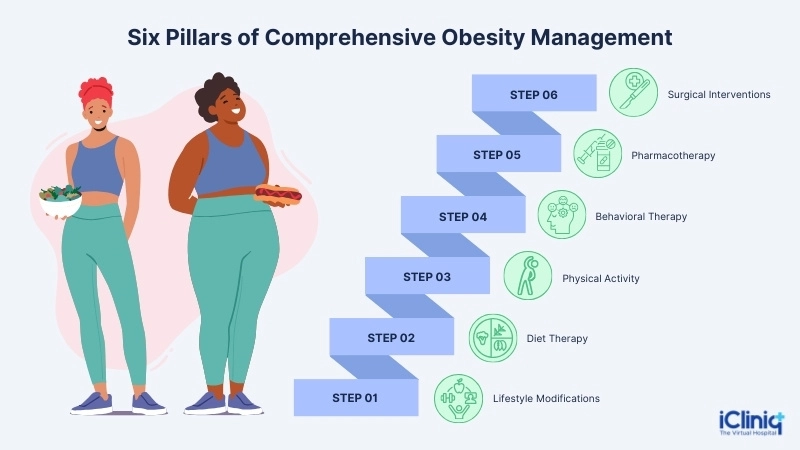
Six Pillars of Comprehensive Obesity Management
Obesity goes beyond just the number on the scale, as it can significantly affect health and overall well-being. Treatment goals aim to improve related health issues, enhance quality of life, and minimize the risk of complications. Comprehensive medical history, physical examination, and clinical tests help determine the risks and formulate an effective action plan. However, the intensity and choice of treatment depend on the patient's preferences and available resources. It typically involves lifestyle changes initially followed by medications or surgery, depending on the body mass index.
An ideal weight loss goal is losing 8 to 10 percent of body weight over six months.
1. Lifestyle Modifications
Obesity management targets three crucial aspects of lifestyle: eating habits, physical activity, and behavior modifications. Since obesity arises due to an imbalance in energy, patients need to learn the principles of energy consumption (diet), expenditure (physical activity), and integration into daily activities (behavioral therapy). Research indicates that lifestyle changes can lead to a moderate weight loss of around 3 to 5 kilograms (6 to 11 pounds) compared to receiving no treatment or usual care.
2. Diet Therapy
-
Diet therapy mainly targets cutting down on calories.
-
Following recommendations from leading health organizations like the American College of Cardiology, American Heart Association, and The Obesity Society, treatment most often starts by minimizing daily calorie intake by 500 to 750 calories compared to what the person originally ate.
-
Women can aim for 1200 to 1500 calories per day, and men for 1500 to 1800 calories per day (modified for body weight), striving for a weekly weight reduction of about 1 to 2 pounds.
-
This can be done by swapping out some foods for healthier options, like choosing smaller meal portions, adding more fruits and vegetables, choosing whole-grain foods, lean meats, and low-fat dairy, and cutting back on fried foods, fatty foods, and sugary drinks.
-
It is necessary for the individual to focus on the dietary advice and set specific achievable goals.
Balance Is the Key
-
The balance of nutrients in the diet relies on personal food preferences and health conditions.
-
The 2020 U.S. Dietary Guidelines suggest adopting a diet abundant in whole grains, dietary fiber, fruits, and vegetables while keeping added sugars, sodium, and saturated fats under 10 percent of daily calories.
-
Using meal replacements can result in 7 to 8 percent of weight loss. However, the mix of nutrients in the diet solely depends on a person’s likes, cooking methods, culture, and any related health issues.
-
Another method of evaluating a diet is to examine the energy density (the number of calories in a given amount of food).
-
People usually eat about the same volume of food regardless of its calories.
Healthy Swaps With Nutrient Balance
-
Foods with low energy density, like soups, vegetables, fruits, and lean meats, can help manage hunger and aid in weight loss.
-
However, foods high in energy density, such as cheese, pretzels, and red meat, can result in weight gain.
-
In certain cases, very low-calorie diets (VLCDs) may be suggested for quick weight loss over 3 to 6 months.
-
These diets usually provide fewer than 800 calories daily, along with protein and essential nutrients.
-
They are suggested for people who are very focused on losing weight, especially if they are moderately to severely obese and have not had success with other methods.
-
VLCDs should be monitored by healthcare professionals in a medical setting with careful monitoring and lifestyle support.
3. Physical Activity
The best approach combines exercise and dietary changes to manage and treat obesity. Exercise is mandatory for keeping weight off. The 2018 Physical Activity Guidelines suggest that adults should target 150 minutes of moderate-intensity or 75 minutes of high-intensity aerobic activity weekly. Simple ways to be more active daily include using stairs, walking briskly, doing chores, or playing sports. It is also necessary to sit less, as too much sitting is linked to health risks. Keeping track of daily activity with an accelerometer or pedometer is also recommended, which can help, as step counts show how active one is. Everyday activities are as important as structured workouts for getting fit and losing weight. One must be very active (engaging in at least 150-300 minutes of moderate-intensity exercise each week to facilitate weight loss). These exercise goals may initially seem difficult, so one must start gradually. Getting advice from an exercise expert or personal trainer will also help.
4. Behavioral Therapy
Cognitive behavioral therapy (CBT) is employed to support people in adopting and sticking to new habits related to diet and exercise. This includes strategies like keeping track of meals and physical activity, stress management, controlling triggers (like using smaller plates or avoiding eating while watching television), seeking support from others, resolving problems, and minimizing negative thoughts. It is helpful for them to record plans to foresee progression. Since these techniques can be time-consuming, they are often supervised by other staff in the doctor's office, like a nurse practitioner or dietitian.
5. Pharmacotherapy
Weight loss pills may be considered for certain patients with a BMI of 30 kg/m2 (kilogram per sq. meter) or higher or for those with a BMI of 27 kg/m2 or higher who have obesity-related conditions and other conservative approaches have failed. When prescribing anti-obesity drugs, it is vital for patients to actively participate in a lifestyle program that guides them in the use of medication effectively, as this can maximize overall weight loss.
Since 2012, the FDA (Food and Drug Administration) has approved four new medications to help manage weight long-term, although one was voluntarily withdrawn in February 2020. These medications affect hunger, fullness after eating, and how the body responds to high-calorie foods, which can help patients stick to their calorie-restricted diets easily.
6. Surgical Interventions
Bariatric surgery is a choice for individuals with severe obesity (BMI more than or equal to 40 kg/m2) or moderate obesity (BMI of 35 kg/m² or higher) with associated health problems. Traditionally, weight-loss surgeries have been classified based on their effect on the anatomy: restrictive bariatric surgery (which limits food intake), malabsorptive bariatric surgery (which limits food absorption), and a combination of both.
WHO Strategies for Prevention and Management
Efforts towards preventing and managing overweight and obesity, along with associated non-communicable comorbidities, are primarily within reach and are controllable. At the individual level, people can reduce their risks of obesity by following preventive measures across various life stages, which start very early from the pre-conception stage and extend through the early years. These measures include:
-
Appropriate weight gain during pregnancy must be ensured with the treating physician in nearby health centers.
-
Exclusive breastfeeding for the first six months postpartum must be ensured, and breastfeeding should continue for 24 months or more.
-
Encouraging children to develop healthy habits regarding nutrition, adequate physical activity, sedentary behaviors, and proper sleep is essential regardless of their current weight.
-
Children and adolescents should reduce their screen time and engage in outdoor sports.
-
Restriction of sugar-sweetened beverages and nutrient-rich foods while promoting healthier eating habits.
-
Individuals must adopt a balanced lifestyle comprising a healthy diet, physical activity, proper sleep, tobacco and alcohol restriction, and emotional self-regulation.
-
One should restrain energy intake from fats and sugars while also increasing the consumption of whole grains, vegetables, fruits, legumes, and nuts.
Eight Cutting-Edge Innovations in Obesity Treatment
-
Adiposity-Based Chronic Disease (ABCD) Nomenclature: In 2016, the American Association of Clinical Endocrinology and the American College of Endocrinology recommended renaming obesity as "adiposity-based chronic disease" (ABCD) to capture its chronic nature and multifactorial causes better.
-
Protein Inhibiting Brown Fat Function: Researchers have identified a protein that inhibits brown fat function, with the potential to safely activate brown fat and address obesity and related health issues.
-
Gelesis100 Capsule: Introduced in 2020 and approved by the FDA in 2019, this capsule releases a cellulose-based gel in the stomach that absorbs water, filling up to 25 % of the stomach volume, promoting a feeling of fullness without systemic side effects.
-
Bariatric Surgery Advances: Recent research highlights the metabolic benefits of bariatric surgery, which are linked to alterations in gut hormones, microbiota, bile acid metabolism, and adipose tissue metabolism.
-
Laparoscopic Sleeve Gastrectomy (LSG): LSG involves vertical stapling and division of the stomach, removing about 80% of the greater curvature. Compared to other bariatric procedures, LSG results in significant weight loss.
-
New Weight Loss Pills: Novel weight loss pills have shown increased efficacy in managing obesity. Semaglutide, a GLP-1 analog, has shown efficacy in promoting weight loss and improving metabolic and cardiovascular outcomes. Another promising drug is Tirzepatide, a dual agonist targeting GLP-1 and glucose-dependent insulinotropic polypeptide, which has shown significant weight loss results.
-
Innovative Polypharmacology Strategies: Unimolecular polypharmacology strategies targeting multiple obesity-related pathways have been developed, opening new avenues in the pharmacological management of obesity.
-
Telehealth and E-Health Interventions: The use of telehealth technologies for obesity management, such as internet-based programs and videoconferencing for behavioral counseling and treatment adherence, is gaining traction and showing promising results.
Conclusion
Addressing obesity requires a multi-faceted approach, combining thorough evaluation, personalized treatment plans, and continuous support. Lifestyle modifications, dietary adjustments, physical activity, behavioral therapy, pharmacotherapy, and surgical options play vital roles in managing obesity and its related health issues. Emerging innovations and increased global awareness, as seen with events like World Obesity Day, further empower individuals and healthcare providers to combat this widespread condition. By embracing these strategies, one can significantly improve health outcomes and enhance the quality of life for those affected by obesity.