Table of Contents
- 1What Is a Bone Marrow Transplant?
- 2Why Is BMT Performed?
- 3What Are the Types of Bone Marrow Transplants?
- 4The Bone Marrow Transplant Procedure
- 5What Are the Risks and Complications of a Bone Marrow Transplant?
- 6Who Is Eligible to Be a Bone Marrow Donor?
- 7What Complications and Side Effects May Happen Following BMT?
- 8Key Takeaway From iCliniq
What Is a Bone Marrow Transplant?
A bone marrow transplant (BMT) is a procedure done when the bone marrow stops working or does not produce sufficient healthy blood cells. The other name for this procedure is stem cell transplant.
Bone marrow is a soft tissue that is responsible for the development and storage of blood cells. The blood cells that form other blood cells are called stem cells. The earliest stage of stem cells is called a pluripotent cell. A pluripotent cell can produce an identical cell, differentiate, and form subsets of more mature cells. Stem cells are necessary for a bone marrow transplant.
Why Is BMT Performed?
The cells used during the bone marrow transplant procedure are either from your own body or from a donor. This procedure is done for the following reasons. These include:
-
To cure many diseases and cancers.
-
During some of the cancer treatment, the required amount of chemotherapy or radiation therapy may be high. This damages or destroys the bone marrow. Such patients may need BMT.
-
Bone marrow may be damaged in many other diseases. In such cases, a bone marrow transplant is needed.
The procedure is used for:
-
Replacing damaged or small functioning bone marrow in conditions such as leukemia, aplastic anemia, and sickle cell anemia.
-
It helps regenerate a new immune system, which helps fight residual or existing leukemia or other cancers.
-
It helps replace damaged bone marrow during cancer therapies. This phenomenon is known as rescue.
-
It also replaces bone marrow with genetically healthy bone marrow. This helps prevent damage to the bone marrow due to genetic diseases like Hurler’s syndrome.
What Are the Types of Bone Marrow Transplants?
Bone marrow transplants are of different types. These types are based on the type of donor. These include:
1. Autologous BMT:
In this type, the stem cells are taken from the patient only. In this procedure, stem cells are taken from a patient, and they are frozen. They are given back to the patient after treatment.
2. Allogenic BMT:
In this type of BMT, the donor is not the patient but someone else. Donors share the same genetic type as the patient. Stem cells are taken from genetically matched donors. Genetically matched donors are brother or sister. Other allogenic donors include:
-
Parent: This type of transplant is rare. They are half identical genetic matches to the receiving donor. A parent is also called a haploid identical match.
-
Unrelated matched donor: Sometimes, an unrelated person’s stem cells may be matched for BMT. These can be found from bone marrow registries.
3. Umbilical cord blood transplant:
In this type of BMT, stem cells are taken from the umbilical cord immediately after an infant's delivery and preserved until they are needed in the future.
The Bone Marrow Transplant Procedure
In the BMT procedure, donors and recipients need to be matched first and foremost. Matching requires typing with human leukocyte antigen (HLA) tissue. The antigens present on the special white blood cells determine an individual's immune system's genetic makeup.
There are more than 100 antigens present, but for matching purposes, a few major antigens need to be matched. This can help identify whether the donor and recipient match. Research is being done to understand all the antigens' roles in BMT.
The team of BMT involves:
-
Specialists in oncology, immunology, hematology, and bone marrow transplantation.
-
A nurse coordinator who can organise all aspects, such as before and after BMT.
-
Social workers like those who help you deal with aspects like lodging, transportation, finances, and legal issues.
-
Dietitians help in guiding your nutritional needs.
-
Physical therapists help you become strong after BMT, especially in movement.
-
Pastoral care is given for the support of the patient through a religious leader or trained caregiver.
-
Other team members involved are pharmacists, respiratory therapists, lab technicians, infectious disease specialists, dermatologists, gastroenterologists, and psychologists.
The team will decide on the evaluation, and the patient will be selected for BMT based on certain factors. These include:
-
Age of the patient, overall health, and medical history.
-
How much has the disease extended?
-
Whether the donor is available or not.
-
Tolerance of the patient for certain medicines, procedures, and therapies.
-
How the disease will progress.
-
Patient’s opinion and their preferences.
Preparation and Conditioning:
In this stage, both donors and recipients are prepared.
-
Preparation of recipients: Recipients are thoroughly evaluated for their medical history and physical fitness. They are subjected to many tests to evaluate their organs.
They have to come to the hospital much before, like 10 days before, for hydration, evaluation, placement of a central venous line, and other preparations.
In the case of allogenic BMT, finding a donor is a challenging process, especially when siblings are not present.
-
Preparation of donors: Once the donor is identified, they will be subjected to various tests to identify the extent of the match. Donors are instructed about bone marrow donation.
-
Stem cell collection is done after this.
-
Patients are emotionally and practically prepared for BMT.
Stem cell collection methods:
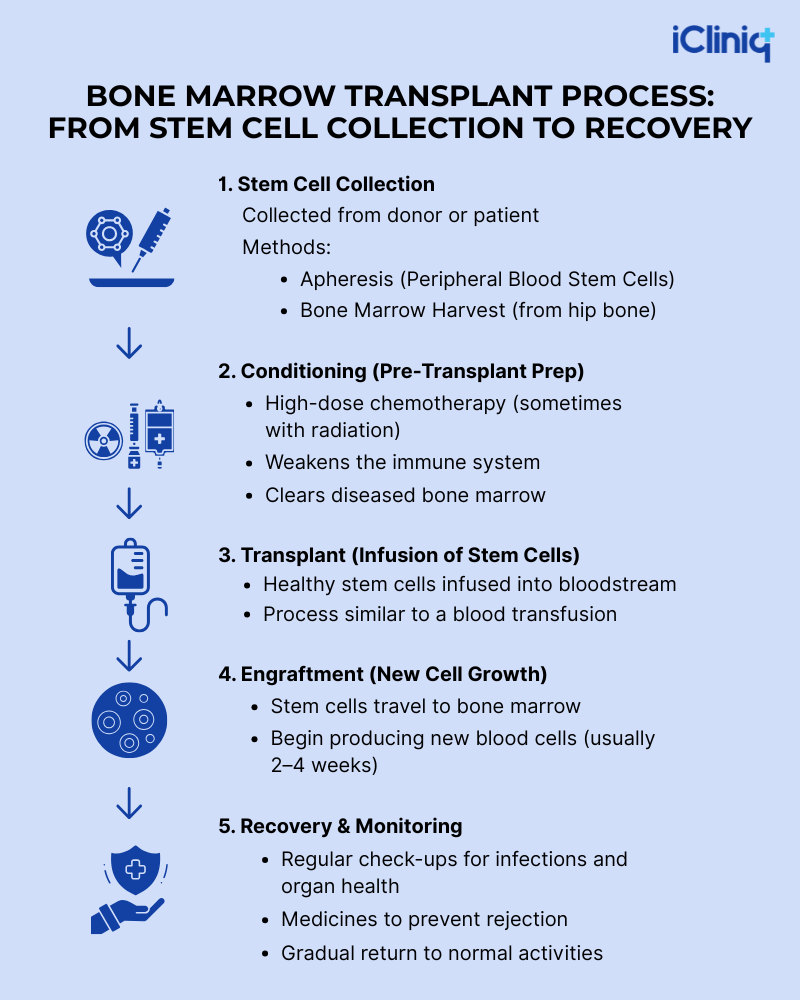
In the case of an autologous transplant, the stem cells are collected from the patient beforehand. Stem cells are harvested through apheresis, a procedure in which a machine collects stem cells from the patient’s blood and stores them for future use. In some cases, the bone marrow is directly harvested using a needle and placed into the patient’s bone (hip).
In the case of an allogenic transplant, the donor undergoes a procedure that is similar to apheresis. Stem cells are collected from the blood or bone marrow.
Stem cells are collected in two ways:
Peripheral blood stem cells (PBSC): In this procedure, called apheresis, the donor is connected to a machine (a special cell separator) through a needle inserted into an arm vein. Blood is taken from a vein and sent to the machine, where it separates the stem cells and returns the remaining blood and plasma back to the donor through another needle inserted into another arm. Many sessions are required to collect enough stem cells.
A medicine may be given to donors a week before an apheresis procedure to increase the number of new stem cells.
Bone marrow harvest: In this procedure, stem cells are collected by a needle placed into the soft center of the bone marrow. The donor is given anesthesia during this procedure.
Conditioning regimen:
During the preparation procedure, before BMT, conditioning is done to prepare the body for the new stem cells. Conditioning regime includes:
-
Chemotherapy: High doses of chemotherapy are given to destroy cancerous cells. It clears out the bone marrow, and it helps suppress the immune system.
-
Radiation: Sometimes, radiation may be used with chemotherapy to target specific areas.
-
Immunosuppressive drugs: These drugs are given when an allogenic transplant is performed. They help prevent the immune system from rejecting the donor’s cells.
Bone marrow transplantation:
BMT involves many steps. Hence, the process requires careful planning and coordination. Preparation and conditioning are done before the BMT procedure, as already mentioned above.
While performing the BMT procedure, a catheter (a thin tube) is inserted to deliver the stem cells. This tube directly delivers the stem cells into the bloodstream. This procedure is done intravenously (IV) and resembles receiving a blood transfusion.
Stem cells in the bloodstream travel to the bone marrow. Once there, they start multiplying, which helps form new healthy blood cells.
It is important to take care of the patient after the BMT. The patient should be closely monitored and provided with a sterile environment. Post-transplant care includes:
-
Monitoring: A patient should be monitored for their vital signs, blood count, and organ functioning. This helps in detecting any infection or complications if present.
-
Supportive care: To help patients fight infections, antibiotics, antivirals, and antifungals may be given, and a blood transfusion if necessary.
-
Graft versus host disease (GVHD) prevention: In the case of an allogenic transplant, immunosuppressive drugs are given. This helps prevent GVHD, a condition in which the donor cells attack the patient’s body.
Engraftment:
In this process, the transplanted cells start to multiply and grow by forming new healthy blood cells. This may happen within two to four weeks after the BMT procedure. Sometimes, the time taken for new blood cells to form may be longer. During this period, patients are taken care of for any complications, medications are given, and if required, a blood transfusion may be done.
What Are the Risks and Complications of a Bone Marrow Transplant?
The risks and complications may vary. These depend on various factors like:
-
Type of bone marrow transplant.
-
Type of condition needing BMT.
-
Preparation procedure followed.
-
Age and overall health of the patient.
-
Presence of complications.
Complications include:
-
Infections:
Patients are immunocompromised. Hence, they are prone to many infections, such as bacterial, viral, and fungal. These infections may occur at any stage of the procedure.
-
GVHD:
When an allogenic transplant is done, it may sometimes be considered foreign and cause damage to the patient.
-
Organ damage:
Sometimes, the organ damage may be possible due to the use of high-dose chemotherapy or radiation. The organs affected include the liver, heart, kidneys, and lungs.
-
Rejection of the graft:
Sometimes, the patient’s body may reject the stem cells, especially when they are of an allogenic type. The rejection may be due to a non-functioning immune system. It may be treated with immunosuppressive drugs.
-
Bleeding and anemia:
Patients may sometimes experience bleeding and anemia during the recovery phase. In such situations, a blood transfusion may be given.
-
Secondary cancers:
In some cases, there is a chance of secondary cancers. These may be possible due to high doses of chemotherapy and radiation used during BMT. This needs regular monitoring and treatment if it occurs.
Who Is Eligible to Be a Bone Marrow Donor?
The decision to undergo BMT may depend on many doctors involved in the team. Apart from their decision, patients’ general condition and factors like age, overall health, donor availability, and stage of the disease are important to consider while deciding eligibility for BMT.
Some conditions that need to be excluded include:
-
Patients with severe infections that cannot be controlled.
-
Those with organ failure.
-
Patients of advanced age.
-
If patients do not have suitable donors.
What Complications and Side Effects May Happen Following BMT?
Along with the above-mentioned complications, other complications that can happen following BMT include:
-
Pain:
Pain may occur for many reasons, such as mouth sores or gastrointestinal pain. It may also be caused by high doses of chemotherapy and radiation.
-
Low platelets and red blood cells:
This condition may occur due to the non-functioning of the bone marrow. Low platelet counts in the lungs, gastrointestinal tract, or brain may cause bleeding.
-
Fluid overload:
Fluid overload may cause pneumonia, liver damage, and high blood pressure. The reason for fluid overload may be that the kidneys may not take the load of the fluid being given. The reason for fluid overload may be due to intravenous medicines given, through nutrition, and blood products. Another reason is kidney damage that may occur due to an overdose of chemotherapy, radiation, disease, infection, or antibiotics.
-
Respiratory distress:
Respiratory function is important during BMT, but it may be affected by reasons like infection, fluid overload, GVHD, and bleeding.
Conclusion
Blood cells are essential for the functioning of the whole body. They are involved in important functions of the body, like carrying oxygen, functioning of the immune system, etc. BMT is a medical procedure that replaces bone marrow with healthy blood cells. This procedure can control disease, cure, and improve an individual's quality of life. It cannot be done for everyone. Hence, a thorough knowledge of the procedure is important before considering it.
Key Takeaway From iCliniq
A bone marrow transplant (BMT) is a procedure done to improve the patient’s condition due to cancer and other diseases.
The importance of BMT, its indications, procedure, and risks and complications should be known for its success.
For more information, you can consult a hematologist at iCliniq.