Table of Contents
- 1What Is a Targeted Prostate Biopsy?
- 2What Are the Types of Targeted Prostate Biopsy?
- 3What Are the Benefits of Targeted Prostate Biopsy Over Traditional Biopsy?
- 4What Are the Side Effects of Targeted Prostate Biopsy?
- 5What Are the Indications for Biopsy?
- 6What Are the Limitations and Challenges of Targeted Prostate Biopsy?
- 7Conclusion
- 8
What Is a Targeted Prostate Biopsy?
Targeted prostate biopsy is a new and accurate method of prostate biopsy. Doctors utilize multiparametric MRI to identify suspicious areas and sample them for biopsy instead of randomly sampling tissue as in a standard biopsy procedure. It reduces the prostate biopsy risk by targeting areas that need attention. The new approaches enhance cancer detection, reduce the need for repeat biopsies, and enable doctors to focus on areas most likely affected, making the diagnosis quicker, clearer, and more reassuring for patients.
What Are the Types of Targeted Prostate Biopsy?
There are two main approaches:
-
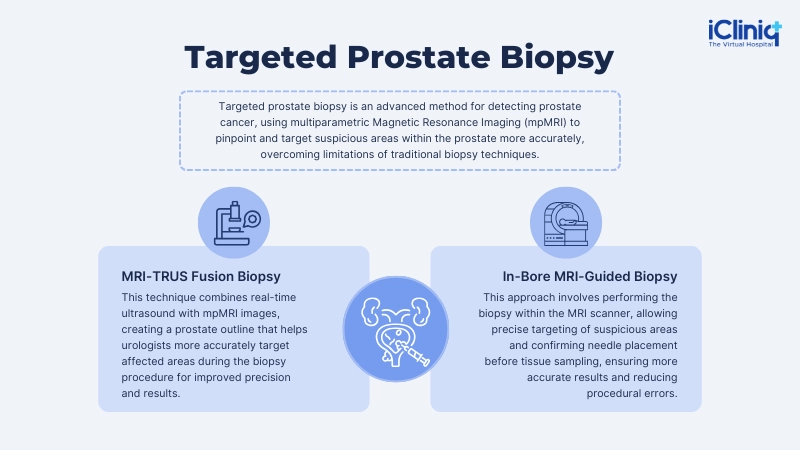
MRI-TRUS (magnetic resonance imaging–transrectal ultrasound) fusion biopsy, which merges MRI images with real-time ultrasound of the prostate gland. When both images are fused, it provides a clear view for removing the biopsy sample.
-
In-bore MRI-guided biopsy is performed by extracting tissue for biopsy when the patient is inside the MRI scanner. It provides greater accuracy, as the target tissue and the biopsy needle can be viewed in real time.
What Are the Benefits of Targeted Prostate Biopsy Over Traditional Biopsy?
-
More accurate detection: Helps identify prostate cancers that are more likely to need treatment, improving diagnostic accuracy.
-
Fewer unnecessary diagnoses: It focuses only on the suspicious areas, minimizing the chances of finding harmless or slow-growing cancers.
-
Fewer repeat procedures: Most patients, because the first test was more accurate, do not have to return for another.
- Better planning of treatment: With improved diagnostic methods, doctors can select the most suitable treatment options for each patient.
What Are the Side Effects of Targeted Prostate Biopsy?
1. Common ones:
-
A little amount of blood in the stool, urine, or semen.
-
Slight pain with stiffness.
2. Less common but serious:
-
Infection or fever.
-
Heavy bleeding.
-
Urinary retention (difficulty urinating).
3. How to reduce risks of side effects?
-
Take prescribed antibiotics.
-
Follow all pre- and post-procedure instructions.
-
Contact your doctor at once if you develop a fever, heavy bleeding, or cannot urinate.
What Are the Indications for Biopsy?
-
Generally, a targeted prostate biopsy is recommended for men aged 50 to 70 years with high levels of PSA (prostate-specific antigen) or suspicious findings on a digital rectal exam, such as lumps, swelling, or anything unusual.
-
If there is still any chance of cancer after a previous negative biopsy, it may be recommended.
What Are the Limitations and Challenges of Targeted Prostate Biopsy?
-
Although targeted prostate biopsy offers many benefits, it does come with a few drawbacks. Fusion biopsies, for example, require a high level of training to make sure the sampling is accurate and nothing important is missed.
-
In-bore MRI-guided biopsies are extremely precise, but they can take longer to perform, which may limit the frequency with which the MRI machine can be used for other patients or diagnostic needs.
Understanding these limitations helps patients and doctors choose the approach that best suits them.
Conclusion
Targeted prostate biopsy is an advanced method of performing prostate biopsy. It utilizes MRI to focus on areas most likely to harbor cancer, thereby increasing accuracy and reducing the number of unnecessary samples taken. Knowing about this targeted prostate biopsy method helps you take charge of your prostate health.
Key Takeaway
-
Targeted prostate biopsy employs MRI-guided approaches for more precise sampling.
-
It reduces the rate of repeat biopsies and diminishes overdiagnosis. It also helps reduce the total sample size required for performing a biopsy.
-
At the same time, it greatly enhances the detection of significant prostate cancer.
-
For the best advice on targeted prostate biopsy, consult our urologist.