Table of Contents
What Is Stage 3 Lung Cancer?
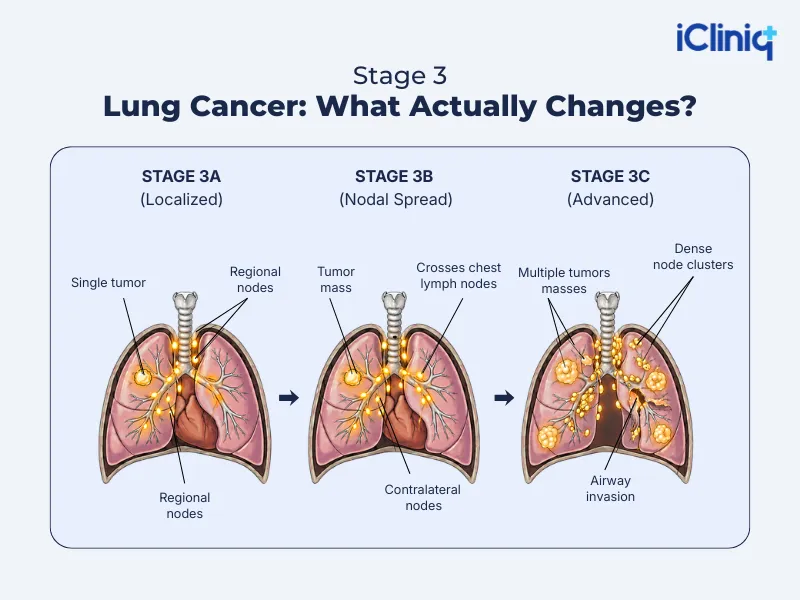
Stage 3 lung cancer is the spread of cancer to the nearby tissues and lymph nodes. However, it does not involve the distant organs. It is an advanced stage of the disease, divided into 3A, 3B, and 3C, depending on the extent of tumor dissemination. The treatment regimen involves chemotherapy, radiotherapy, and sometimes surgical intervention for effective management.
Why Is It Not Stage 4?
Stage 3 lung cancer is not stage 4 cancer because in stage 3 cancer, the cancer cells have not yet reached any distant parts of the body. They are still confined to the chest, including the nearby lymph nodes and tissues. Stage 4 refers to cancer that has spread beyond the chest.
Stage 3 Lung Cancer Survival Rate
Stage 3 lung cancer is deadly but not yet widespread within the body. It has a five-year survival rate of 13% to 37%, which varies based on its type (stage 3A, stage 3B, or stage 3C), type of cancer, and response to treatment.
The average five-year survival rate is higher for those diagnosed with stage 3A, at around 36%, while for those with stage 3C, it is much lower, at around 13%.
|
Factor |
Stage 3 Lung Cancer |
|
Stage Type |
Locally advanced |
|
Spread |
Nearby lymph nodes |
|
Subtypes |
3A, 3B, 3C |
|
Common Symptoms |
Cough, chest pain, fatigue |
|
Treatment |
Chemotherapy, radiation, surgery, and immunotherapy |
|
5-Year Survival Rate |
~15% |
|
Curability |
Rare, but treatable |
|
Goal of Treatment |
Control disease and extend life |
Stage 3 Lung Cancer Subtypes (3A, 3B, 3C):
-
3A: The cancer has metastasized to the adjacent lymph nodes. This is on the same side of the chest wall. It is at an early stage of local advancement. Surgery can be considered in some instances.
-
3B: Cancer has advanced into the chest area. The cancer could affect additional lymph nodes. Surgery can not be done. Treatments without surgery will involve chemo and radiation therapies, possibly including immunotherapy.
-
3C: The cancer has developed further in the chest area. The cancer might be in several regions. There will be no surgery. Chemotherapy and radiotherapy will be the main modes of treatment.
What Is the Difference Between Stage 3A, 3B, and 3C Lung Cancer?
|
Feature |
Stage 3A Lung Cancer |
Stage 3B Lung Cancer |
Stage 3C Lung Cancer |
|
Tumor Size |
Small to moderate |
Any size |
Larger and/or multiple tumors |
|
Lymph Node Involvement |
Nearby lymph nodes (same side of chest) |
Lymph nodes on the opposite side or above the collarbone |
Extensive lymph node spread (multiple regions) |
|
Spread Location |
Localized within the lung and nearby nodes |
More widespread within the chest |
Advanced regional spread within the chest |
|
Surgical Option |
Sometimes operable |
Usually not operable |
Not operable |
|
Treatment Approach |
Surgery + chemotherapy/radiation (in selected cases) |
Chemotherapy + radiation ± immunotherapy |
Aggressive combination therapy (chemo + radiation + immunotherapy) |
|
Complexity Level |
Moderately advanced |
Advanced |
Highly advanced |
|
Prognosis |
Better than 3B/3C |
Moderate |
Lower compared to 3A and 3B |
Symptoms of Stage 3 Lung Cancer
Common symptoms of stage 3 lung cancer:
-
Persistent cough.
-
Feeling short of breath or having a wheezing sound while breathing.
-
Pain in the chest that may increase when coughing, laughing, or taking deep breaths
-
Feeling tired.
-
Losing weight.
-
Reduced appetite.
-
Frequent infections, repeated chest infections like bronchitis or pneumonia.
-
Voice changes like a hoarse or rough voice.
-
Swelling in the face, neck, or arms due to blocked blood flow.
When lung cancer spreads, symptoms may include:
-
Bone pain.
-
Headache.
-
Arm or leg weakness or numbness.
-
Dizziness or balance problems.
-
Seizures.
-
Yellowing of the skin and eyes (jaundice).
-
Swollen lymph nodes.
How Stage 3 Lung Cancer Is Diagnosed?
-
A chest X-ray is usually the first test done. It can show if there is something unusual in the lungs.
-
If the X-ray suggests a problem, a computed tomography scan is done to get clearer and more detailed images. A contrast dye may be used for better results.
Other tests to check how far the cancer has spread include:
-
PET: A positron emission tomography (PET) scan helps detect active cancer cells in the body.
-
MRI: A magnetic resonance imaging (MRI) scan gives detailed images of soft tissues.
-
A bone scan checks if cancer has spread to the bones
-
Biopsy: A small sample of tissue is taken and examined under a microscope to confirm if it is cancer.
Treatment Options for Stage 3 Lung Cancer
For the majority of patients, treatment options for stage 3 lung cancer may include several therapies:
-
Chemotherapy: The administration of medication to destroy cancer cells.
-
Radiation Therapy: It involves exposure to high-energy radiation that kills cancer cells and reduces their activity, often preceding a surgical procedure.
-
Surgical Treatment: It helps remove the lung and nearby lymph nodes when the cancer has not spread significantly.
-
Targeted Therapy: It involves specialized medications that inhibit the growth of cancer cells.
-
Immunotherapy: It helps the body fight cancer cells effectively.
-
Laser therapy: This involves using a laser to destroy cancer cells.
-
Endoscopic stent: The placement of a special tube that prevents closure of the airway caused by a tumor.
Living with Stage 3 Lung Cancer
It is difficult to estimate the survival rate by age with stage 3 lung cancer. Some may survive for many years, whereas others will have a limited life expectancy. Only the right therapy for the condition and its consequences needs to be timely and appropriate. Joining a support group helps because it enables patients to express themselves and interact with other patients experiencing the same problems. Consulting a psychiatrist may help manage emotions.
When to See a Doctor?
One must consult their doctor if they have experienced signs such as
-
A continuous or increasing cough.
-
Spitting blood.
-
Breathing difficulty.
-
Chest pain or recurrent chest infections.
-
Other indicators could include unintentional weight loss, loss of appetite, fatigue, changes in voice tone, or swelling in the face, neck, or arms.
Conclusion
Stage 3 lung cancer is treatable. However, because people differ in how they respond to treatment, the success rate and recovery will also vary. Age and general health are two other factors that determine the patient’s recovery. Early screening is important for detecting lung cancer sooner and beginning treatment at the right time. If symptoms appear, consulting a lung specialist early can help improve outcomes and overall quality of life.
Key Takeaways:
- Stage 3 lung cancer remains confined to the chest area, affecting local tissues and lymph nodes only.
- It is further classified into three stages: 3A, 3B, and 3C, according to the extent of spreading, complications, and different treatments used.
- Initial symptoms of stage three lung cancer can be similar to breathing problems, which could delay diagnosis.
- Early diagnosis and adequate treatment contribute significantly to life expectancy and quality of life.
- Various treatment modalities are usually necessary for stage 3 lung cancer to prevent progression and achieve better results.

