Table of Contents
What Is Prostate Cancer?
Prostate cancer occurs when cells in the prostate begin to multiply unchecked, creating tumors that may be benign (non‑cancerous) or malignant (cancerous). Malignant tumors can break free and spread to other parts of the body. Benign ones typically stay where they originated.
Prostate cancer in elderly men often advances slowly so that it can go unnoticed for years, without apparent symptoms. When the condition is flagged early and the response is prompt, even advanced scenarios can be managed, allowing a sizable number of individuals to maintain a quality of life.
What Are the Causes of Prostate Cancer?
The causes of prostate cancer remain unknown, but many risk factors have been discovered.
-
Age: The risk is highest in men over 65 and increases after age 50.
-
Family history: Having a father, brother, or close relative with prostate cancer increases the risk.
-
Genetic mutations: Mutations in genes such as BRCA1 (breast cancer gene 1), BRCA2 (breast cancer gene 2), and HOXB13 (homeobox B13) can increase a person's susceptibility.
-
Race or ethnicity: Men of African descent are more likely to develop aggressive prostate cancer.
-
Hormones: High levels of testosterone or dihydrotestosterone (DHT) can lead to prostate cancer growth.
-
Diet: Eating a diet high in red meat, processed foods, and dairy, but low in fruits and vegetables, may increase the risk.
Other factors are:
-
Excess body weight is associated with more aggressive forms of prostate cancer.
-
Certain pollutants, such as pesticides or industrial toxins.
-
Tobacco usage or smoking.
What Are the Signs of Prostate Cancer?
While prostate cancer may not show symptoms in its early stages, advanced cases can present various symptoms, such as:
-
Frequent urination, especially at night.
-
Weak or interrupted urine flow.
-
Painful urination or ejaculation.
-
Blood in urine or semen.
-
Pain in the back (lower region), hips, or pelvis, which could indicate metastasis to bones.
-
Fatigue and unintentional weight loss.
-
Erectile dysfunction (inability to maintain an erection).
How Is Prostate Cancer Diagnosed?
Prostate cancer diagnosis includes the following:
1. Digital rectal examination (DRE): The purpose of this finger examination is to look for abnormalities in the prostate. Although it is less successful in early detection, it can identify tumors that do not release PSA, although it misses many cases.
2. Prostate-Specific Antigen (PSA) test: It is not only associated with cancer, but it also aids in the diagnosis of prostate problems. Although some early cases may be overlooked in older men, using age-based PSA limitations improves the accuracy of the results.
3. Imaging Techniques:
-
CT (Computerized Tomography) and Bone Scans: These examinations determine whether, particularly in later stages, prostate cancer has migrated to the bones or other organs.
-
MRI (Magnetic Resonance Imaging): MRI helps identify suspicious areas in the prostate and guides biopsies. Multiparametric MRI can help determine whether the cancer is aggressive or not.
-
PET Scans: PSMA-PET scans are very sensitive and help to detect prostate cancer that has spread to other parts of the body.
4. Biomarker testing: Tests like the prostate health index (PHI) and genetic tests such as Oncotype Dx and Polaris show cancer risk and guide treatment, but a doctor should interpret the results.
5. Biopsy:
-
TRUS (Transrectal Ultrasound)-Guided Biopsy: This is the most typical approach for taking tissue samples from the prostate using ultrasound guidance to confirm cancer.
-
MRI (Magnetic Resonance Imaging) Fusion Biopsy: This technique combines MRI and ultrasound to target tissues for sampling more accurately, thereby increasing accuracy.
6. Gleason Score and Grading:
-
Gleason score: It is a grading system based on the appearance of cancer cells under a microscope, with a grading range from 1 (less aggressive) to 5 (most aggressive). This helps determine the prognosis and treatment plan.
-
Grade groups: A less complex classification system (grade groups 1 to 5) that is a simplified version of the Gleason Score.
7. Risk stratification: Based on tumor stage, Gleason score, and PSA levels, prostate cancer is classified as low, moderate, or high risk. From straightforward surveillance to more aggressive medicines, it aids physicians in making treatment decisions.
8. Other Considerations:
-
Family history and genetic testing: Patients with a family history of prostate cancer or other cancers may have an advantage with genetic counseling and testing for hereditary cancer syndromes.
-
PSA velocity and PSA doubling time: Measure how quickly PSA levels rise over time to assess the aggressiveness of cancer.
What Are the Different Modules for Prostate Cancer Treatment?
Prostate cancer treatment is based on the stage of diagnosis as well as the grade of the patient's illness.
Some common treatments will then be applied in the following ways:
1. Active surveillance: Actively supervised watching for prostate cancer over time by means of recurrent PSA tests, biopsies, and imaging.
2. Surgery: Complete removal of the prostate gland and sometimes the seminal vesicles. It’s mostly done when cancer is still confined to the prostate.
3. Radiation therapy:
-
External beam radiation: High-energy rays are directed at the prostate to kill cancerous cells.
-
Brachytherapy: Tiny radioactive seeds are placed inside the prostate to destroy cancer from within.
4. Hormone therapy (Androgen Deprivation Therapy): Lowers male hormone (testosterone) levels in the body, slowing cancer growth. It’s mainly used for advanced or metastatic prostate cancer.
5. Chemotherapy: Used when hormone therapy stops working. It uses drugs that kill fast-growing cancer cells.
6. Immunotherapy: This treatment helps the body’s immune system find and destroy prostate cancer cells. An example is sipuleucel-T, a vaccine-like therapy for patients with advanced prostate cancer.
7. Targeted therapy: This focuses on specific gene changes or proteins that make cancer grow. PARP inhibitors are used for cancers with BRCA (breast cancer gene) mutations.
8. Cryotherapy: This treatment freezes and kills prostate cancer cells. It’s usually used for cancer that is still within the prostate or as an option instead of surgery.
9. High-intensity focused ultrasound (HIFU): Uses sound waves to heat and destroy cancer cells in the prostate.
10. Bone-targeted therapy: When prostate cancer spreads to the bones, treatments like bisphosphonates or Denosumab can help ease pain and prevent fractures.
How to Prevent Prostate Cancer?
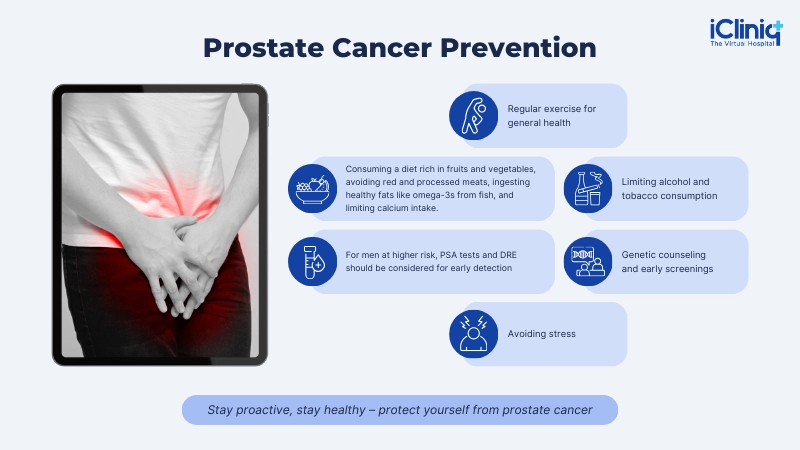
Prostate cancer cannot be prevented, but the risk can be reduced by:
-
Consuming fresh fruits and vegetables, staying away from processed and red meats, and getting healthy fats like omega-3s from fish.
-
Exercising daily.
-
Staying stress-free.
-
Limiting alcohol and tobacco consumption.
-
Genetic testing and early screening.
-
Genetic testing and early screening.
Conclusion:
Men frequently develop prostate cancer. It can be successfully managed with the right knowledge, early detection, and treatment. Even in situations where a diagnosis is made later in life, lifestyle decisions, regular examinations, and prompt therapies are essential to preserving quality of life.
Key Takeaway
-
Prostate cancer is an uncontrollable growth of prostate cells, which form malignant tumors that can spread.
-
Early stages are often silent; later ones cause urinary problems, pain, and tiredness.
-
Diagnosis involves assessing the severity of cancer through tests such as PSA, imaging, and biopsy.
-
Depending on the stage of the malignancy, treatment options include radiation, hormone therapy, surgery, and targeted therapy.
-
If you experience unusual urinary symptoms or pelvic discomfort, get expert prostate cancer advice. Early evaluation helps maintain prostate health and prevents future complications.

