Table of Contents
- 1What Is Bilateral Breast Cancer?
- 2What Are the Various Types of Bilateral Breast Cancer?
- 3What Are the Symptoms of Bilateral Breast Cancer?
- 4What Are the Risk Factors for Developing Bilateral Breast Cancer?
- 5How Common Is Bilateral Breast Cancer compared to Unilateral Breast Cancer?
- 6Is There a Metastasis of Bilateral Breast Cancer?
- 7How Can Breast Cancer Be Diagnosed?
- 8What Are the Treatment Options for Bilateral Breast Cancer?
- 9What Is the Prognosis for Bilateral Breast Cancer?
- 10Key Takeaway/Note From iCliniq:
What Is Bilateral Breast Cancer?
Bilateral breast cancer may not be the most common form of breast cancer, but when it occurs, it can be emotionally and medically overwhelming. In simple terms, it means cancer is present in both breasts at the same time (synchronous) or develops in the second breast months or years later (metachronous).
Diagnosis and early detection of bilateral breast cancer is the greatest challenge. Due to the fact that symptoms are either subtle and develop gradually or manifest at various times, most cases are either missed or receive treatment late, resulting in negative outcomes.
Early detection, particularly among high-risk women and the use of better imaging methods, genetic screening, and customized treatment schedules, can greatly enhance survival and quality of life.
The bilateral breast cancer is no longer a medical enigma due to modern oncology. Women are more likely to diagnose the disease at an early stage, get better treatment, and be successful in learning about their responsibility to be in the habit of early self-examination and frequent follow-ups.
What Are the Various Types of Bilateral Breast Cancer?
The following are the various types of bilateral breast cancers:
-
Metachronous Breast Cancer - It is a commonly occurring breast cancer. Most metachronous breast cancers are genetically occurring cancers. They occur at different times in either breast.
-
Synchronous Breast Cancer - It is the most uncommon type of breast cancer and is also known as contralateral breast cancer. It is a cancer in which two or more different tumors are present. It can be invasive or non-invasive. The cause of synchronous breast cancer is unknown. It is to be remembered that both metachronous and synchronous breast cancer are equally deadly.
-
Bilateral Lobular Breast Cancer - Lobular breast cancer occurs in the breast's lobules. Lobules are the glands in the breast that secrete milk. It is an invasive cancer that spreads to the surrounding breast tissue as well as the lymph nodes.
-
Bilateral Intraductal Breast Cancer - Lobules in the breast are all connected through ducts, making a passage for the milk. Cancer occurring in these ducts is called intraductal cancer.
What Are the Symptoms of Bilateral Breast Cancer?
Symptoms are similar to regular breast cancer, but they occur in both breasts. They may include:
-
Lump or swelling in any part of either breast.
-
Thickening or hardening of breast tissue.
-
Skin dimpling that makes the breast look like an orange peel.
-
Pain in the breast or nipple.
-
Nipple turning inward.
-
Red, dry, flaky, or thickened skin over the breast or nipple.
-
Nipple discharge (fluid coming from the nipple).
-
Swelling of lymph nodes near the armpit or collarbone
However, in certain cases, there are no symptoms at all, and cancer is found during routine screening. This is why regular mammograms are very important, especially for women at high risk.
What Are the Risk Factors for Developing Bilateral Breast Cancer?
The causes of risk for bilateral breast cancer remain unknown to date, although some identified risk factors include the following:
-
Heavy alcohol consumption.
-
First diagnosis before the age of 30 years.
-
Inheritance of a BRCA1, BRCA2, or CHEK2 mutation.
-
Family history of breast cancer, especially in first-degree relatives (mother, sister, daughter) and second-degree relatives (grandmother, aunt). A strong family history increases the chances of cancer developing in both breasts.
-
Urban residence.
-
Lobular cancers (where cancer starts in the milk-producing glands), rather than ductal cancers.
-
Cancers that are estrogen receptor-negative (ER-negative).
-
Receipt of scatter radiation.
Some factors that reduce bilateral breast cancer risk are:
-
Trailing at first menarche at age 13 years or more.
-
Having three or more pregnancies.
-
The traditional breast cancer risk factors include smoking cigarettes, hormone replacement therapy, and oral contraceptives, none of which increases the risk for bilateral breast cancer.
How Common Is Bilateral Breast Cancer compared to Unilateral Breast Cancer?
Bilateral breast cancer is a rare finding, yet lethal when compared to unilateral cancer. It can be caused by genetic mutations or exposure to risk factors. The chances of occurrence of bilateral breast cancer in individuals already having breast cancer are higher than in individuals without cancer.
Is There a Metastasis of Bilateral Breast Cancer?
Like other cancers, bilateral breast cancer can spread to other organs, a process known as metastasis. The most common places breast cancer spreads to are the bones, lungs, liver, and brain. In some cases, it can spread to the stomach. When this happens, doctors have to carefully study whether the cancer in the stomach began there or spread from the breast. This is important because treatment changes based on where the cancer started.
How Can Breast Cancer Be Diagnosed?
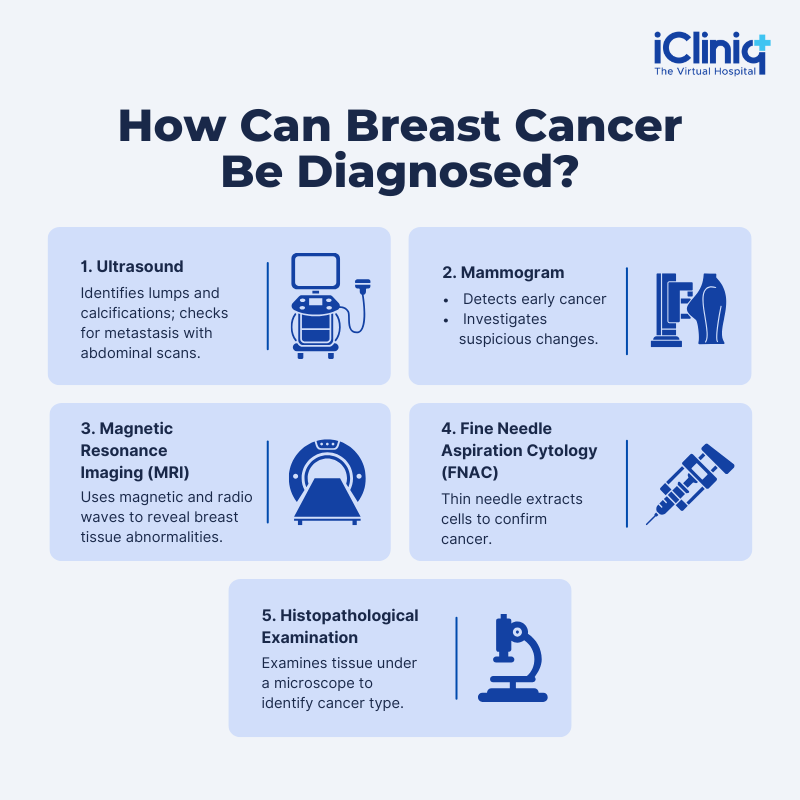
Diagnosing bilateral breast cancer requires several tests.
-
Doctors often begin with an ultrasound to check the nature of a lump. An ultrasound shows whether the lump is solid or filled with fluid and can detect small calcifications. Mammograms are also widely used.
-
A screening mammogram is done for women without symptoms to catch cancer early. A diagnostic mammogram is performed when a suspicious change or lump is found. For more detailed images, a breast MRI (magnetic resonance imaging) may be done. This test uses magnetic waves to show hidden or tiny tumors that might not be seen on ultrasound or a mammogram.
-
To confirm cancer, a test called FNAC (fine needle aspiration cytology) may be done. In this test, a thin needle removes a small sample of cells or fluid, which is studied under a microscope. In most cases, doctors also take a small piece of tissue from the lump for histopathology. This test gives clear information about the type of cancer, how fast it is growing, and whether it can spread.
What Are the Treatment Options for Bilateral Breast Cancer?
Treatment modalities for bilateral breast cancer involve the following approaches:
-
Modified Radical Mastectomy With or Without Lymph Node Dissection - Bilateral breast cancers usually include the adjacent lymph nodes, due to which the resection of lymph nodes along with mastectomy (complete removal of the breast) is performed. In certain cases, lumpectomy is also performed, which is the removal of only the affected tissue of the breast.
-
Chemotherapy - Chemotherapy includes administering anticancer drugs to kill cancer cells.
-
Radiotherapy - The body is exposed to high-dose radiation that directly destroys the cancer cells. Radiation therapy is given to patients at one-month intervals.
-
Adjuvant Therapies - Adjuvant therapies are treatments added after the surgery to obtain a positive treatment outcome. Chemotherapy and radiotherapy are advised to improve the treatment outcome.
What Is the Prognosis for Bilateral Breast Cancer?
The prognosis of bilateral breast cancer is different for every woman. Several factors decide the outcome, such as whether the cancer is synchronous or metachronous, how early it is detected, whether lymph nodes are involved, and what type of tumor is present. Women with synchronous bilateral cancer may have a slightly poorer outcome because the body is fighting two cancers at the same time.
However, outcomes have improved a lot with early detection, better imaging, genetic screening, and modern treatment options. Early screening plays a very important role. Women above the age of 40 should go for routine mammograms. Women with a strong family history or genetic risk may start screening earlier.
Conclusion:
Bilateral breast cancer is a rare but serious form of breast cancer that affects both breasts. It may occur at the same time or at different times. Women with a strong family history and BRCA (breast cancer gene) gene mutations have a higher chance of developing it.
Early diagnosis, undergoing regular mammograms, genetic testing, regular self-examination, and timely treatment improve survival and quality of life. With modern medical advances, personalized treatment, and better awareness, many women manage this condition successfully.
Key Takeaway/Note From iCliniq:
-
Bilateral breast cancer occurs when cancer develops in both breasts, either at the same time or at different times.
-
Family history and BRCA1/BRCA2 gene mutations significantly increase the risk.
-
Diagnosis involves clinical exam, mammography, ultrasound, and breast MRI, which help find tumors in the early stage.
-
Treatment includes surgery, chemotherapy, radiation, hormone or targeted therapy, and genetic counseling for patients and for families at high risk. If concerned, you can ask an oncologist at iCliniq for guidance.

